Corral del Carbón

Corral del Carbón

Corral del Carbón, called al-fundaq al-yadida in Arabic, meaning New Corn Exchange, was constructed in the first half of the 14th century, functioning as a storehouse and point of sale for wheat, as well as accommodation for the merchants who brought it to Granada.

After the end of Al-Andalus in the 16th century would become a theatrical courtyard and in the 17th century, it was also a neighbors’ courtyard, the rooms of the lower floor being used to store coal, from which its current name is taken.

In 1887, it was declared a National Monument, miraculously saved from profiteering. Corral del Carbón was then a house inhabited by 36 families. In the first third of the 20th century, Leopoldo Torres Balbás acquired it for 128,000 pesetas from the sale of tickets to the Alhambra, restoring it between 1929 and 1931.

Corral del Carbón is accessed by a single door which imitates those of the eastern Iwanes, with a large, acute horseshoe arch of scalloped brick, with arabesque spandrels carved from plaster. Over the door is surah 112 of the Quran “God is one, God is Eternal, He neither begets nor is born, nor to Him is there any equivalent” and has two double windows, one on the first floor and another on the upper floor, topped with beautiful eaves with a large overhang, supported by corbels angled upwards.

Behind the facade, the hallway, which takes up the space of the first two floors, has a beautiful ceiling of and two blind arches on each side, with seats. The interior of the corn exchange, centered around a large, almost square patio with a pillar, was divided between three floors. The lower floor was for goods and pack animals, and the two upper floor, each with 22 small rooms, with lamps but without beds, with only large mats, were the rooms in which the merchants slept, wrapped in large cloaks. Through two different pipes in the central pillar of the patio, water flowed from the Darro river, arriving from the Romayla canal, and from the Genil river, arriving from an urban branch of the Gorda canal.

The floors are supported by stone pillars on the ground floor, and brick on the upper floors, with wooden footings very similar to those that the Maristán had. There were no windows in the whole building, to prevent the goods being stolen, and for which the corn exchange master (fundeqayr) was responsible, who lived in the rooms over the door, monitoring the arrival and departure of goods, Its only door was hermetically closed at sunset, the merchants not being able to leave until dawn. Just before sunset, they were told to gather their property and animals, opening the doors afterwards, thereby preventing anyone from taking what was not theirs.

The Throne Hall of Yusuf I in the Alhambra of Granada

The Throne Hall of Yusuf I in the Alhambra of Granada

The Nasrid Court at Its Zenith

The Throne Hall of Yusuf I, better known today as the Hall of the Ambassadors, is the most imposing ceremonial space in the Alhambra. Located inside the Palacios Nazaríes, within the Palacio de Comares, it was conceived as the political and symbolic heart of Nasrid power in 14th-century Granada.

Built during the reign of Yusuf I (r. 1333–1354), the hall functioned as the royal audience chamber, where the sultan received ambassadors, signed treaties, and staged displays of dynastic authority. Academic research and publications by the Patronato de la Alhambra emphasize that this space was not merely architectural—it was ideological.

Yusuf I ruled during a period of political consolidation and artistic brilliance in the Nasrid Kingdom of Granada. Under his patronage, the Alhambra evolved into a refined palatine city combining administrative, residential, military and ceremonial functions.

The Throne Hall was strategically placed at the northern end of the Comares Palace, overlooking the city of Granada. This elevated position symbolized dominion over territory—an architectural metaphor for sovereignty.

As the primary audience chamber, the hall hosted:

  • Diplomatic receptions

  • Negotiations with Castilian envoys

  • Formal court rituals

The hall is a perfect square (approximately 11 meters per side), rising dramatically beneath one of the most extraordinary wooden domes in Islamic architecture.

The Wooden Dome: A Vision of the Heavens

The cedarwood ceiling forms a complex geometric composition based on interlaced stars. According to scholarly interpretations, this dome represents the seven heavens of Islamic cosmology, creating the illusion of a celestial vault above the ruler.

Light enters through nine high windows, producing a mystical atmosphere. The interplay between shadow and illumination reinforces the idea of the sultan as a divinely guided ruler, positioned symbolically between earth and heaven.

Epigraphy 

The walls are covered in intricate stucco decoration featuring:

  • Qur’anic verses

  • Poetic inscriptions

  • The Nasrid motto: “Wa lā ghāliba illā Allāh” (“There is no victor but God”)

These inscriptions, studied extensively in academic literature and Alhambra publications, articulate a clear political theology: power belongs to God, and the sultan rules by divine will.

This fusion of architecture, poetry and theology transforms the Throne Hall into a three-dimensional manifesto of legitimacy.


Visiting the Alhambra

The Throne Hall is included in the visit to the Nasrid Palaces within the Alhambra in Granada, Spain. Due to strict capacity limits, advance booking is essential.

Hall of Abencerrajes in Palace of the Lions

Hall of Abencerrajes in Palace of the Lions

This is the stunning centrepiece of the Alhambra, the most brilliant Islamic building in Europe, with perfectly proportioned rooms and courtyards, intricately moulded stucco walls, beautiful tiling, fine carved wooden ceilings and elaborate stalactite-like muqarnas vaulting, all worked in mesmerising, symbolic, geometrical patterns. Arabic inscriptions proliferate in the stucco work.

Admission to the palacios (included in the Alhambra ticket) is strictly controlled. When you buy your ticket, you'll be given a time to enter. Once inside, you can stay as long as you like.

The palace was originally divided into three main areas: the Mexuar, the administrative and public part of the complex; the Palacio Comares, the emir’s official residence; and the Palacio de los Leones, his private quarters.

Entrance is through the Mexuar, a 14th-century room used as a ministerial council chamber and antechamber for those awaiting audiences with the emir. The public would have gone no further.

From the Mexuar you pass into the Patio del Cuarto Dorado, a courtyard where the emirs gave audiences, with the Cuarto Dorado (Golden Room) on the left. Opposite the Cuarto Dorado is the entrance to the Palacio de Comares through a beautiful facade of glazed tiles, stucco and carved wood.

Built for Emir Yusuf I, the Palacio de Comares served as his official residence. It's set around the lovely Patio de los Arrayanes (Patio of the Myrtles) with its rectangular pool. The southern end of the patio is overshadowed by the walls of the Palacio de Carlos V. Inside the northern Torre de Comares (Comares Tower), the Sala de la Barca (Hall of the Blessing) leads into the Salón de los Embajadores (Chamber of the Ambassadors), where the emirs would have conducted negotiations with Christian emissaries. This room's marvellous domed marquetry ceiling contains more than 8000 cedar pieces in a pattern of stars representing the seven heavens of Islam.

The Patio de los Arrayanes leads into the Palacio de los Leones (Palace of the Lions), built in the second half of the 14th century under Muhammad V. The palace rooms surround the famous Patio de los Leones (Lion Courtyard), with its marble fountain channelling water through the mouths of 12 marble lions. The courtyard layout, using the proportions of the golden ratio, demonstrates the complexity of Islamic geometric design – the 124 slender columns that support the ornamented pavilions are placed in such a way that they are symmetrical on numerous axes.

Of the four halls around the patio, the southern Sala de los Abencerrajes is the most spectacular. Boasting a mesmerising octagonal stalactite ceiling, this is the legendary site of the murders of the noble Abencerraj family, whose leader, the story goes, dared to dally with Zoraya, Abu al-Hasan's favourite concubine. The rusty stains in the fountain are said to be the victims’ indelible blood. At the eastern end of the patio is the Sala de los Reyes (Hall of the Kings) with a leather-lined ceiling painted by 14th-century Christian artists. The name comes from the painting on the central alcove, thought to depict 10 Nasrid emirs. On the northern side of the patio is the richly decorated Sala de Dos Hermanas (Hall of Two Sisters), probably named after the slabs of white marble flanking its fountain. It features a fantastic muqarnas dome with a central star and 5000 tiny cells, reminiscent of the constellations. This may have been the room of the emir's favourite paramour. At its far end, the tile-trimmed Mirador de Daraxa (Daraxa lookout) was a lovely place for palace denizens to look onto the garden below.

From the Sala de Dos Hermanas a passage leads through the Estancias del Emperador (Emperor's Chambers), built for Carlos I in the 1520s, and later used by the American author Washington Irving. From here, descend to the Patio de la Reja (Patio of the Grille) and Patio de Lindaraja before emerging into the Jardines del Partal, an area of terraced gardens. Leave the Partal gardens by a gate facing the Palacio de Carlos V, or continue along a path to the Generalife.

The Palacios Nazaríes are also open for night visits.

An Islamic Tour of Granada

An Islamic Tour of Granada

Embark on a mesmerizing journey through the enchanting city of Granada, where the echoes of its Islamic past reverberate through its streets, architecture, and culture. This SEO-friendly Islamic tour of Granada invites you to explore the rich history, breathtaking landmarks, and spiritual significance that define the city’s Islamic heritage.

Tour Summary

Granada’s Islamic Legacy: Unveiling the Alhambra Palace

Unravel the Alhambra’s significance in Islamic history.
Explore the intricate designs of the Nasrid Palaces.
Witness the stunning Generalife Gardens.

Albaicín: The Moorish Quarter’s Charms

Wander through the narrow streets of Albaicín.
Admire the Alcazaba Cadima’s remains.
Experience the captivating Mirador de San Nicolás.

Islamic Art and Architecture at the Madrasah Yusufiyya

Delve into the architectural marvel of Madrasah Yusufiyya.
Appreciate the fusion of Islamic and Spanish styles.

Spiritual Haven: Granada’s Historic Mosques

Visit the Grand Mosque of Granada.
Learn about its role in preserving Islamic heritage.

Halal Culinary Delights: Exploring Islamic Gastronomy

Indulge in authentic Andalusian halal cuisine.
Discover the flavors that shaped Granada’s Islamic past.

Islamic Heritage Walk: Tracing the Steps of History

Follow a guided walking tour of significant sites.
Immerse yourself in the stories of the past.

Granada’s Islamic Legacy: Unveiling the Alhambra Palace

The Alhambra Palace stands as a testament to Granada’s Islamic heritage. Immerse yourself in the captivating Nasrid Palaces, where intricate Islamic designs adorn every surface. Discover the delicate beauty of the Court of Lions, with its iconic fountain representing paradise. Stroll through the Generalife Gardens, which offer resplendent views of the Alhambra and showcase the harmonious connection between architecture and nature.

Albaicín: The Moorish Quarter’s Charms

Step back in time as you traverse the charming labyrinth of Albaicín. Lose yourself in the authentic Moorish atmosphere as you explore the remains of the Alcazaba Cadima, a fortress that once guarded the city. Don’t miss the Mirador de San Nicolás, where you can gaze upon the Alhambra against the backdrop of the Sierra Nevada mountains.

Islamic Art and Architecture at the Madrasah Yusufiyy

The Madrasah Yusufiyya stands as a masterpiece of Islamic art and architecture. Marvel at the intricate stucco decorations and geometric patterns that adorn its walls. The fusion of Islamic and Spanish elements in its design is a testament to the city’s cultural diversity.

Spiritual Haven: Granada’s Historic Mosques

Pay homage to Granada’s Islamic heritage by visiting the Grand Mosque of Granada. This spiritual sanctuary serves as a beacon for the city’s Muslim community, offering a place of worship and reflection. Learn about the mosque’s vital role in preserving Islamic traditions in Granada.

Islamic Heritage Walk: Tracing the Steps of History

Embark on a guided Islamic heritage walk through Granada’s historic sites. Listen to expert guides as they transport you back in time, sharing stories of the city’s Islamic past. Immerse yourself in the captivating narrative that unfolds through its architecture, streets, and landmarks.

Unveil the hidden treasures of Granada’s Islamic heritage through this captivating tour. From the awe-inspiring Alhambra to the charming streets of Albaicín, every corner of the city carries the echoes of its rich history. Embrace the fusion of cultures, art, and spirituality that define Granada, and immerse yourself in an unforgettable experience that celebrates its Islamic legacy.

Halal Culinary Delights: Exploring Islamic Gastronomy

Savor the rich flavors of halal cuisine that bear witness to Granada’s Islamic past. Sample traditional dishes influenced by the region’s history, such as aromatic tagines and delectable sweets. Delight in the melding of culinary traditions that have shaped Granada’s gastronomic landscape.

Museum of Alhambra

Museum of Alhambra

Museum of Alhambra

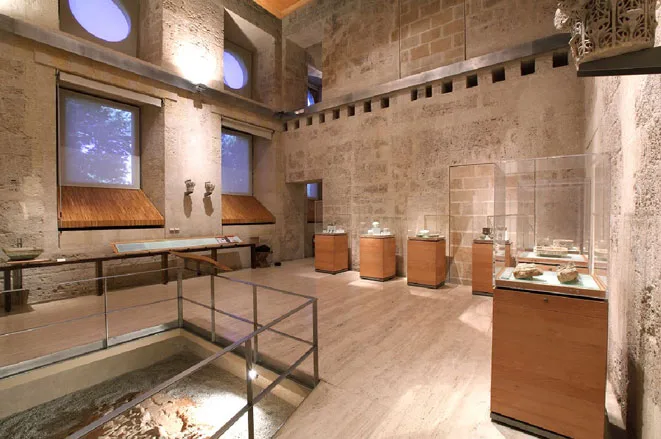
Located in the interior of the Palace of Charles V (Palacio de Carlos V), the Museum of the Alhambra offers visitors a unique possibility to see art or architecture objects from the Monument, bound to the Culture that originated it, by means of the most modern museum techniques.

The Museum possesses the best collection of Nasrid Art in the world, with specimens coming from artefacts found archaeological excavations and restored in the Alhambra, making a visit to it an ideal complement to a tour of the artistic-historical monumental complex.

The Museum in Honour of Ángel Barrios is a collection that gathers musical equipment, instruments, drawings, paintings, watercolors, scores and correspondence dedicated by different authors to this important musician and composer born in Granada, who passed away in 1964, and to the figure of his father, Antonio Barrios “the Polinario”, one of last “cicerones” of the Alhambra of the early 20th century, in whose now disappeared tavern, located where today is the Museum, met intellectuals and artists of the time.


Schedule


    • 15 OCTOBER – 31 MARCH

WEDNESDAY TO SATURDAY 8:30 – 18:00 H
SUNDAYS AND TUESDAY 8:30 – 14:30 H
MONDAYS CLOSED

  • 1 APRIL – 14 OCTOBER
    WEDNESDAY TO SATURDAY
    8:30 – 18:00 H
    SUNDAYS AND TUESDAY
    8:30 – 14:30 H
    MONDAYS CLOSED
  • SATURDAYS IN THE MUSEUM
    MAY TO SEPTEMBER
    8:30 – 21:30 H

Medina & Gate of Wine

Medina & Gate of Wine

Medina & Gate of Wine

To some extent the function of this Gate today is similar to what it had been during the Nasrid period. It is the main entrance gate to the Medina of the Alhambra and serves to enclose the residential and artisan district within the walled fortress. Because it was an inner gate, it provided direct access to the fortress, as opposed to the outer gates, which required more protection and were built as L-shaped passageways. Inside, however, there was room enough for benches for the guards that controlled all access to the fortress.

Architecturally one of the oldest structures in the Nasrid Alhambra , it was built during the time of the Sultan Muhammad III (1302-1309), although the decoration of both façades pertains to different periods

The door on the east side, carved in sand stone, probably belongs to the 13th century or the beginning of the 14th century, although the tombstone over the door lintel refers to Sultan Muhammad V, who ruled the fortress in the second half of the 14th century. This east façade was the outer side of the gate and, therefore, the traditional Islamic symbol of the key was engraved above the arch key.

The inner side, i.e. the west façade, even when it follows a similar structural pattern, was decorated during the second mandate of Sultan Muhammad V, more specifically after 1367, the date of the military campaigns of Jaen, Baeza and Ubeda. Remarkable are the beautifully decorated spandrels hanging from the arch, made up of dry-rope manufactured tiles, and the composition of the stucco walls that frame the upper floor’s window, and the rest of well-preserved polychromatic painting on the right side of the arch.