No Results Found
The page you requested could not be found. Try refining your search, or use the navigation above to locate the post.

What to see in Morocco: the 13 must-sees
Things to do in Morocco
FacebookTwitterEmailWhatsApp
Morocco is that magical and surprising country that never leaves anyone indifferent. The African country closest to Europe, union between the Mediterranean and the Atlantic, able to move from the mountains of the Atlas mountain range to the Sahara desert. Morocco hides cities with medinas that catch the visitor, amazing nature and a rich heritage. Discover in this article, as an introduction, what to see in Morocco and start preparing your next trip.
Morocco is a millenary kingdom that has important cities and an undoubted historical footprint. Four of them are called Imperial Cities, which are only the different capitals that the country has had at some point in its history. To travel them is to enter fully into the path of this kingdom throughout the last centuries. Of course, all of them are the most beautiful cities in Morocco.
Marrakech, the liveliest city
Fez, the cultural capital
Meknès, the beautiful stranger
Rabat, the capital of Morocco
The Mosque of Casablanca
Tangier, in the Strait of Gibraltar
Ksar by Ait Ben Haddou
Deserts of Zagora and Merzouga
Chefchaouen, the blue village of Morocco
Essaouira (Esauira), a surfing mecca
Ouzoud waterfalls
Volubilis, the ancient Roman city
Todra and Dadès Gorges
Marrakech, the liveliest city
Marrakech is an indispensable city in every trip to Morocco. Founded in 1062 by the Almoravids, it was capital between 1071 and 1244, as well as between 1511 and 1554, during the Almoravid, Almohad and Saadi dynasties. Marrakech, the Red City, is the southernmost of the large Moroccan cities. Far from Europe, inland and close to the Sahara, a privileged place of passage for Berber caravans and military camp that ended up being capital.
Free cancellation
Marrakech
since
117 €/night
RESERVE
But for one thing Marrakech is known for its Medina. The heart of the city, a World Heritage Site, is a host of labyrinthine and bustling streets where merchants, artisans, mosques, palaces and walls are concentrated. Getting lost in its alleys is the best way to get to know this incredible place.
Marrakech has many other attractions, such as the Bay Palace, the Koutoubia Mosque and the Menara Gardens. In short, visiting Marrakech you will understand why for many people it is the most beautiful city in Morocco.
Marrakech
Marrakech
Fez, the cultural capital
In the heart of Morocco, on the route linking Rabat and Algiers, lies Fez, the so-called cultural capital of the country. Fez was the capital of Morocco several times, between the 9th and 10th centuries, between 1244 and 1554, several times in the 17th century and between 1727 and 1912, when Rabat took the baton.
To visit Fez you will need two or three days, as it has an important legacy declared World Heritage by Unesco. Undoubtedly, its main reference is the medina Fez-el-Bali, a large medieval quarter of the 9th century that has a network of 9,000 streets where getting lost is the most common. It is considered the largest pedestrian area in the world.
The attractions of Fez are countless: the Al Karaouine mosque, the Attarine madrasa, the Royal Palace, the different souks, the city gates, the fountains… In addition, from Fez you can enter the desert of Merzouga to spend a night in a jaima.
Fez Morocco
Fez
Meknès, the beautiful stranger
Meknes, or Meknes, is 60 kilometres west of Fez, on the way to Rabat. It was capital between 1672 and 1727, which left an architectural and urban legacy that has earned it the declaration of World Heritage. Responsible for the city’s rise was Sultan Mulay Ismail, who established the capital in Meknès and ordered a city to be designed at will. 40 kilometers of walls, palaces, gates… The mausoleum with the tomb of Ismail is here.
Unlike the other imperial cities, Meknès is quieter. Its medina is much more digestible for the visitor than those of Marrakech or Fez. But if there is anything that impacts, that is the Bab el-Mansour Gate, from 1732 and considered one of the most beautiful in the world. Meknès will surprise you.
Meknès
Meknès
Rabat, the capital of Morocco
Rabat has been the capital of Morocco since 1912, when the French Protectorate of Morocco began. Although the capital of the country and having the appeal of the Atlantic Ocean, Rabat is less touristic than the other imperial cities.
Rabat combines antiquity and modernity. Its main monument is the Hassan Tower, a 12th-century minaret that was intended to be the tallest tower. Next to it, the mausoleum of Mohammed V, royal pantheon in white marble where the remains of him and Hassan II, father of the current king, lie. The Kasbah of the Udayas and the medina, with its famous walls, are also two places of special interest in the Moroccan capital.
Rabat
Rabat
The Mosque of Casablanca
It’s probably the most majestic mosque in Morocco. The Mosque of Hassan II of Casablanca impacts by its size, being the second largest in the world after that of Mecca. It has a 200-metre minaret with a laser beam pointing towards the holy city. Inside the temple, a room with capacity for 20,000 faithful and a retractable ceiling that allows you to see the sky.
The Casablanca Mosque (1993) is the only one in Morocco that allows entry to non-Muslims, a magnificent opportunity to enter such an important place for Islam. Its location, close to the sea, is striking.
Mosque of Casablanca
Mosque of Casablanca
Tangier, in the Strait of Gibraltar
Tangier is the northernmost city in Morocco and therefore the closest to Europe. In the heart of the Strait of Gibraltar, Tangier was a coveted city throughout history and has been in the hands of different empires and European countries.
Its proximity to Spain, with international port and airport, and its long coast, make Tangier a tourist city with multicultural touches, thanks to its European past. Among its essential landmarks are the Great Mosque, the medina, the square 9 April, Cape Espartel and the Caves of Hercules.
Tanger beach
Tanger
Ksar by Ait Ben Haddou
One of the most magical places in Morocco is the ksar of Ait Ben Haddou. A ksar is a fortified city, common in the southern part of the country. Inside, Ait Ben Haddou hides labyrinthine streets and buildings of traditional materials such as adobe, wood or straw. It is also an icon of cinema. There were scenes from countless films and series, such as Lawrence of Arabia, Gladiator or Game of Thrones.
Passing through the ksar of Ait Ben Haddou is also a great idea to make some of the best known routes, such as the Route of the Thousand Kasbahs, the traditional Moroccan construction of adobe so common in this area.
General view of Ait Ben Haddou
Ksar by Ait Ben Haddou
Deserts of Zagora and Merzouga
Hiking to the desert, or even sleeping in the desert, are two plans that anyone exploring Morocco should include in their wish list. Without having to go to the distant Sahara, from Marrakech there are two simpler possibilities to experience the feeling of the sands: the deserts of Zagora and Merzouga.
The Zagora desert is about 360 kilometers from Marrakech and has a rather rocky character. The Merzouga Desert is 560 kilometres from Marrakech and has large dunes, some of them over 150 metres high. Being further away, going to Merzouga is a three-day excursion, between journeys and night there. In addition to sleeping, in both you can do camel rides or quad.
Abandoned house in the Merzouga Desert
Merzouga Desert
Chefchaouen, the blue village of Morocco
Located in the interior of the northern part of Morocco, in the foothills of the Rif,…
The page you requested could not be found. Try refining your search, or use the navigation above to locate the post.
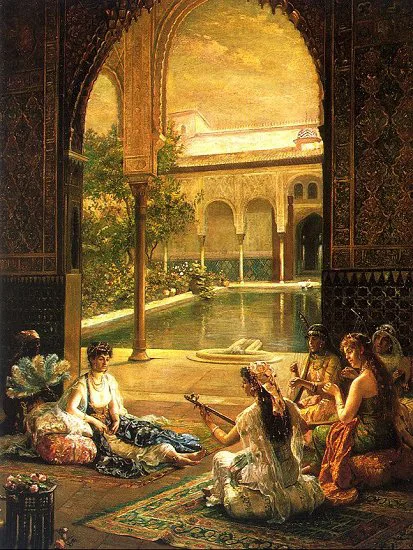
Centuries of history and the legacies of different cultures have transformed the urban layout of the city of Granada. The events that took place from the late 10th and early 11th centuries onwards led to a series of dramatic changes in which the region’s capital was moved from Madinat Ilbira to the hill of the Hishn Gharnata, which became the official seat of the Zirid Kingdom founded by Zawi ben Zirí around the year 1013. The consolidation of the kingdom in subsequent decades with the conquest of the neighbouring coras (territories) and the additional resources obtained by the new irrigation networks enabled the Zirid dynasty to consider building a city with a new layout. It could be argued that Granada only became genuinely urban in the Zirid period, a hypothesis borne out by archaeological excavations and the analysis of surviving structures. From this point onwards the city began to grow beyond its walls, a process that extended especially in the 14th Century, so creating what would become 15th Century Granada, of which we will be studying the perimeter, city walls and enclosures. This insight into life in Granada in the last years of the Nasrid Dynasty, who turned a blind eye on the events that signalled the end of a flourishing culture, will allow us to better understand what went on within the walls of Madinat Gharnata. A knowledge of some of the buildings (of which unfortunately few traces remain) that witnessed the amazing events of those final years is also an important part of this visit. Neither should we forget the last years of war, a medium through which to study the leading participants, above all the three Sultans Muley Hacén, el Zagal and Muhammad XII "Boabdil", about whom doubts still exist today as to whether their actions could have changed the destiny of their lost Kingdom. A tragic end to what had been a brilliant lineage, who in spite of their political ups-and-downs were responsible for the creation of the unforgettable Kingdom of Granada.
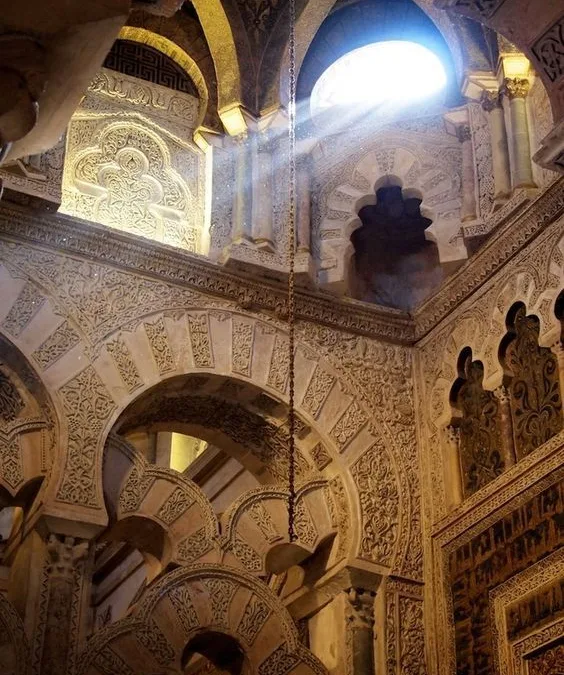
The Great Mosque of Córdoba, today the Mosque-Cathedral of Córdoba (Mezquita-Catedral de Córdoba), is one of the most extraordinary monuments of Al-Andalus and one of the great masterpieces of Islamic architecture in the Western world.
Located in the heart of Córdoba’s historic centre, the monument tells more than twelve centuries of history through its architecture. What visitors see today is not the result of a single building campaign, but a remarkable sequence of transformations: the original Umayyad mosque of Abd al-Rahman I, successive expansions under the rulers of Al-Andalus, the magnificent Caliphal extension of Al-Hakam II, the enlargement of Almanzor, and later Christian additions following the conquest of Córdoba in 1236.
The Great Mosque was inscribed on the UNESCO World Heritage List in 1984, with the designation later extended to Córdoba’s wider historic centre.
Long before the construction of the mosque, Córdoba had been an important Roman city and the capital of the province of Baetica. The site itself also preserves evidence associated with the Visigothic Basilica of San Vicente.
The decisive transformation came after the establishment of Muslim rule in the Iberian Peninsula. Córdoba — Madinat Qurtuba — became the political centre of Al-Andalus and, under the Umayyads, developed into one of the major cities of the medieval Mediterranean world.
In 756, Abd al-Rahman I, a survivor of the Umayyad dynasty of Damascus, established an independent emirate in Al-Andalus with Córdoba as its capital.
Towards the end of his reign, he began the construction of a new congregational or Aljama Mosque. This first mosque established an architectural language that would be preserved and developed by his successors for more than two centuries.
Construction of the original mosque began under Abd al-Rahman I in the late 8th century.
Its prayer hall consisted of eleven naves running perpendicular to the qibla wall. One of its most innovative characteristics was the system of superimposed arches that allowed the builders to create greater height while reusing columns from earlier Roman and Visigothic structures.
This produced what would become the most recognisable image of the Mosque of Córdoba: the extraordinary forest of columns and double-tiered arches.
The lower horseshoe arches support a second level of arches above them, creating a distinctive combination of rhythm, height and visual continuity.
Roman and Visigothic columns, capitals and other architectural elements were incorporated into the new building, illustrating both continuity with Córdoba's earlier history and the development of a new Andalusi architectural language.
As Córdoba's population grew, the original mosque was no longer large enough for the city's expanding Muslim community.
Between 833 and 848, Emir Abd al-Rahman II extended the prayer hall towards the south, adding eight new sections while maintaining the architectural system established by Abd al-Rahman I.
The original qibla wall was removed and a new one constructed further south.
Architecturally, this extension continued the characteristic double-arch system, while Córdoba's own workshops increasingly produced decorative architectural elements specifically for the mosque.
The courtyard was also enlarged during this period.
A major political transformation took place in 929, when Abd al-Rahman III proclaimed himself Caliph, establishing the Caliphate of Córdoba.
Rather than extending the prayer hall, Abd al-Rahman III concentrated his intervention on the northern part of the mosque complex.
In 951–952, he commissioned a monumental new minaret, reportedly reaching around 47 metres in height. Parts of this 10th-century minaret survive inside the structure of the present Bell Tower.
He also transformed the façade facing the courtyard.
This was the period when Córdoba reached extraordinary political, economic and cultural importance, while the nearby palatine city of Madinat al-Zahra became another powerful expression of Umayyad authority.
The most sophisticated artistic phase of the mosque came under Caliph Al-Hakam II, who ruled from 961 to 976.
Between 962 and 966, Al-Hakam II extended the prayer hall further south, adding twelve sections and creating the monumental area surrounding the maqsura and mihrab.
This part of the Mosque of Córdoba represents the artistic splendour of the Umayyad Caliphate at its height.
The maqsura was the privileged area close to the mihrab, associated with the presence and protection of the Caliph.
Here, the relatively repetitive rhythm of the earlier prayer hall becomes dramatically more elaborate. Intersecting and polylobed arches create complex architectural screens, while richly decorated domes mark the approach towards the qibla wall.
The result is one of the most sophisticated spaces in the entire monument.
The mihrab of the Great Mosque of Córdoba is one of the highlights of Islamic architecture in Spain.
Unlike a simple shallow prayer niche, Córdoba's mihrab opens into a small chamber. Its entrance is framed by a monumental horseshoe arch surrounded by exceptionally rich decoration.
Marble, carved vegetal ornament, Arabic inscriptions and brilliant mosaics transform this area into the visual and symbolic focal point of the mosque.
The mosaics belong to the remarkable artistic programme created during the reign of Al-Hakam II and demonstrate the cultural connections between Umayyad Córdoba and the wider Mediterranean world.
Another exceptional feature of Al-Hakam II's extension is its series of ribbed domes.
Intersecting arches create intricate geometric structures while allowing light to enter the most important areas of the prayer hall. Architecture, geometry, light and decoration combine here to distinguish the Caliphal zone from the earlier parts of the mosque.
The final major Islamic enlargement was undertaken under Almanzor (al-Mansur) between 991 and 994.
By this time, expansion towards the south was constrained by the proximity of the Guadalquivir River.
The solution was therefore radically different.
Instead of continuing southwards, Almanzor expanded the mosque towards the east, adding eight new naves and enlarging the courtyard accordingly.
This intervention dramatically increased the overall size of the mosque and created much of the vast rectangular plan visitors experience today.
Artistically, Almanzor's extension is more restrained than the extraordinarily rich work commissioned by Al-Hakam II. Its importance lies primarily in the monumental expansion of the building and the continuation of its established architectural vocabulary.
One of the fascinating aspects of the Mosque of Córdoba is its orientation.
The prayer hall leads towards the qibla wall, where the mihrab is located. However, the orientation of the Cordoban mosque differs from what many modern visitors might expect when comparing it with later mosques oriented more directly towards Mecca.
The question has generated considerable historical and scholarly discussion and forms part of the fascinating architectural story of the monument.
Before entering the prayer hall, visitors cross the famous Patio de los Naranjos, or Courtyard of the Orange Trees.
The courtyard developed from the mosque's original sahn, an essential component of the religious complex and historically associated with ablutions and circulation before entering the prayer hall.
It evolved alongside the successive enlargements of the mosque.
Its present appearance reflects later transformations, particularly from the Christian period, when the space developed into the garden courtyard seen today, with orange trees, cypresses, palms, fountains and water channels.
It remains one of the most atmospheric spaces of the monument.
The present Bell Tower of Córdoba Cathedral contains another important chapter of the mosque's history.
Inside the later Christian structure survive remains of the monumental 10th-century minaret built by Abd al-Rahman III.
From the 16th century onwards, the old minaret was gradually enclosed and transformed into the cathedral's bell tower.
The result is a remarkable architectural palimpsest: a Christian bell tower literally incorporating part of the former Umayyad minaret.
In 1236, Córdoba was conquered by the forces of Ferdinand III of Castile and the mosque was consecrated for Catholic worship.
Unlike many other religious buildings that disappeared following political and religious change, much of the vast Islamic structure survived.
Christian chapels and liturgical spaces were progressively inserted into the former mosque, creating the unusual architectural layering visible today.
Among the important medieval Christian additions are the Royal Chapel and the Villaviciosa Chapel, while other parts of the former prayer hall were adapted to new religious functions.
The most dramatic Christian intervention began in 1523, when work started on a monumental cathedral nave and transept within the former Islamic prayer hall.
Designed initially by Hernán Ruiz I and continued by later architects, the project introduced a soaring Renaissance Christian space into the horizontal forest of columns of the former mosque.
The contrast is striking.
Visitors move from the relatively low, rhythmic Andalusi prayer hall into a dramatically vertical cathedral space characterised by Renaissance and later architectural elements.
Rather than belonging to a single historical period, the building therefore allows visitors to physically experience the succession of cultures and architectural traditions that have shaped Córdoba.
When visiting the monument, some of its most important features can easily be missed because of its enormous scale.
Pay particular attention to:
The Mosque of Córdoba is much more than a beautiful historic monument.
Its architecture allows visitors to follow the transformation of Madinat Qurtuba from the capital of an independent Umayyad emirate into the centre of the powerful Caliphate of Córdoba.
Each ruler left a different architectural layer.
Abd al-Rahman I established the original mosque and its distinctive double-arch system. Abd al-Rahman II expanded it as the city grew. Abd al-Rahman III monumentalised the complex during the rise of the Caliphate. Al-Hakam II created its most sophisticated artistic spaces, including the celebrated maqsura and mihrab. Finally, Almanzor extended the building eastwards to give the mosque much of its present scale.
After 1236, Christian interventions added another architectural chapter rather than completely erasing the previous building.
This extraordinary accumulation of Roman, Visigothic, Andalusi Islamic, medieval Christian and Renaissance elements makes the Mosque-Cathedral of Córdoba one of the most complex and fascinating historic monuments in Spain.
The scale of the monument can make its architectural evolution difficult to understand without context. At first sight, its hundreds of columns and arches can appear almost uniform, yet different sections belong to different rulers and historical periods.
A specialist Córdoba Islamic Heritage Tour helps reveal these layers: from the original mosque of Abd al-Rahman I to the Caliphal masterpiece of Al-Hakam II, while placing the monument within the wider history of Al-Andalus and Madinat Qurtuba.
Exploring the Great Mosque in this way transforms the visit from simply seeing an extraordinary monument into understanding how Córdoba developed into one of the most important cities of medieval Al-Andalus.
The Great Mosque is only one part of Córdoba's extensive Andalusi heritage. A complete exploration of historic Qurtuba can also include the old medina, the Guadalquivir and Roman Bridge, the Calahorra area and, outside the historic centre, the extraordinary palatine city of Madinat al-Zahra.
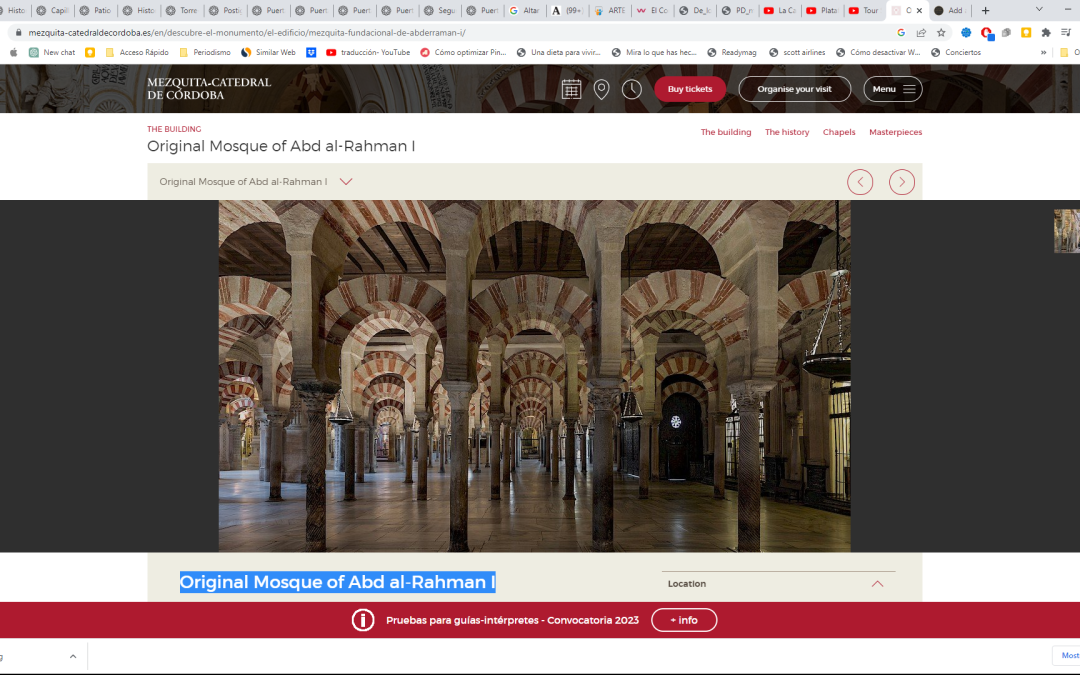
The Original Mosque of Abd al-Rahman I holds a unique place in history. Originally constructed as a small prayer space, it underwent multiple expansions over the centuries.
Visitors to the Original Mosque of Abd al-Rahman I are treated to a truly immersive experience. The vast prayer hall, supported by an impressive forest of columns, evokes a sense of serenity and awe. The iconic red and white double arches create a mesmerizing interplay of light and shadow, enhancing the spiritual ambiance.
The original Aljama adopted a basilica model for its floor plan, inspired by the mosques of Damascus and al-Aqsa in Jerusalem. The space, divided into eleven naves perpendicular to the qibla wall, is arranged into a system of superimposed arches. This construction system, in which the rich influences of Hellenistic, Roman and Visigoth art can be perceived, not only established the constructive development of this building but also exerted an enormous influence on the history of universal architecture.
The highly creative solution adopted also involved the reuse of the Roman and Visigoth materials belonging to other previous constructions, as in the case of the Basilica of San Vicente.
Moreover, whereas the walls are built from limestone ashlars, laid using the stretcher and header bond system, the original floor was formed of a thick layer of mortar over tamped earth. With regard to the roof, whilst the exterior has a gabled design, the interior was structured out of wooden beams with carved decoration.
The Original Mosque of Abd al-Rahman I stands as a remarkable testament to the intermingling of Islamic and Christian cultures, as it was converted into a Christian cathedral after the castillian conquest in 1236.
The site's historical and architectural significance has earned it a UNESCO World Heritage status. It attracts millions of tourists each year, eager to explore its intricate architectural details and soak in the centuries-old atmosphere.