
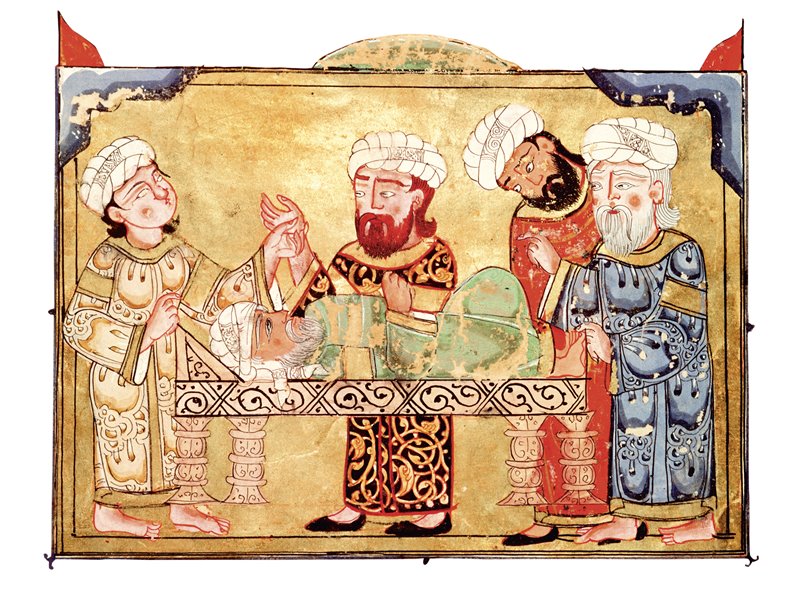
The Great Healers of Their Time
The physicians of Islamic lands enjoyed broad—and well-deserved—recognition throughout the Middle Ages, and were even sought after in the courts of Christian kings.
In the year 958, Sancho I of León was deposed by rebellious nobles, who used as a pretext the fact that the monarch could not fulfill royal duties with dignity due to his extreme obesity. His grandmother, Queen Toda of Navarre, sought help at the Caliphal court of Córdoba: she asked ʿAbd al-Raḥmān III for a cure for her grandson’s morbid obesity and for military support so he could regain the throne.
In the Andalusi capital, the physician Hasday ibn Shaprut, a Jew from Jaén, placed the Leonese monarch on a strict regimen and managed to reduce his weight. In this way, the sovereign could ride properly as expected, and the aid of Cordoban troops enabled him to recover the lost crown.
This anecdote illustrates the broad and justified recognition enjoyed by physicians in Islamic countries during the Middle Ages. Ibn Shaprut was not the only outstanding doctor at ʿAbd al-Raḥmān’s court; it also featured, for example, the wisdom of the surgeon Abū al-Qāsim al-Zahrāwī, known to Christians as Abulcasis. The excellent training of all these figures and the vast scope of knowledge available to them—shared with scholars from North Africa or the far reaches of Iran—can be explained by the building of a vast scientific community made possible through the use of a single language, Arabic, across the immense territories united by the dazzling expansion of Islam.
The Oldest Roots
Before Muhammad’s message spread beyond the Arabian Peninsula, the Arabs already possessed an early medical culture known as “Islamic” or “Prophetic medicine”, since its protagonist was Muhammad, the Prophet. Archaic and pious, it abounds in general exhortations. It says, for example: “Use medical treatments, for God has not created any disease without providing a remedy for it, with the exception of one illness: old age.”
Many of its remedies—such as the use of honey, olive oil, or suction with cups (ḥijāma)—belong to healing or prophylactic (preventive) practices that go back to ancient Arabia and bear Babylonian traits, so their roots extend to the 3rd millennium BCE. Even today they are still used in many Islamic countries.
In a parallel field lies the “interpretation of dreams” (taʾbīr al-anām), to which the Prophet himself attached great importance.
Already in the 8th century, Ibn Sīrīn composed the first major Arabic work on this subject, whose main source was the Oneirocritica by the Greek author Artemidorus of Ephesus, written eight centuries earlier. Without doubt, the Arabs’ intense attention to psychological life originates there. Moreover, recourse to spiritual healing is more common than one might think.
There were many pseudo-scientific and astrological medicines: in medical treatises there sometimes emerges an entire world of rituals, filled with seals and talismans. Islam did not reject this wholesale, and “white” magic was considered permissible within certain rules.
The Islamic elites soon understood the importance of adopting the most brilliant features of Greco-Roman culture, preserved in Egypt and the Near East, and they sought for themselves all the knowledge and technologies they called the “sciences of the ancients”, among which medicine was included.
But the limits of Arabic medicine expanded infinitely after, in 622, Muhammad proclaimed his message to the Arab tribes. The caliphs, his successors, extended their dominions from India to southern France in barely two centuries.
The Science of the Ancients
With the expansion of Islam, the cities where Greek science—radiating from Alexandria—was cultivated fell under Muslim rule: Edessa and Nisibis in Byzantine Syria, and Gundishapur in Sasanian Persia. Greek physicians had fled to the latter city after Emperor Justinian closed the Academy of Athens in 529. Christian doctors of Nestorian faith also settled there, expelled by the Byzantines from Edessa because their beliefs were contrary to religious orthodoxy.
The Greek science preserved in these territories became the foundation for the development of Arabic medicine, thanks to the work of polyglot physicians who, between the 9th and 10th centuries, served as teachers and translators. Among them were Yūḥannā ibn Māsawayh, known in the West as Ioannis Mesuae, born into a learned family from Gundishapur, and his disciple Ḥunayn ibn Isḥāq, called Iohannitius in Latin, responsible for around fifty high-quality translations. Both were Nestorian Christians, a Syriac-speaking community whose language was very similar to Arabic, which facilitated translation of Greek texts.
Physicians of different beliefs worked together, debating and studying in Arabic, just as today is done in English.
This work enjoyed broad patronage, reaching its peak with the founding of the famous House of Wisdom (Bayt al-Ḥikma) in Baghdad by Caliph al-Maʾmūn, who placed Ibn Isḥāq in charge of the translators. With the translation of works from Greek, Persian, and Sanskrit, Arabic medicine became the most informed and diverse in the world at the dawn of the 10th century.
Pagan, Christian, Jewish, Hindu, and many other scholars adopted Arabic as a scientific language. That is, physicians of different religions worked together, discussing and studying in Arabic, just as today people do in English. For this reason we speak here of “Arabic medicine”: we are not referring to an “Arab” ethnicity, but rather to an intellectual community that shared the language of the Qur’an, which became a common language of science and culture.
This phenomenon also flourished in al-Andalus, Muslim Spain, during the 10th century. There, a classic text—the De materia medica by Dioscorides—was translated for Caliph ʿAbd al-Raḥmān III, whose court included, as mentioned, Abulcasis, an eminent surgeon whose Book of the Arrangement (drawing on the work of the Byzantine physician Paul of Aegina) enjoyed extraordinary prestige. Córdoba, the capital of al-Andalus, rivaled the new Islamic teaching centers of the Mediterranean: Kairouan in Tunisia, Fez in Morocco, and Cairo in Egypt. We know of more than a hundred Arabic medical works written before the year 1000; the transmission of the past was a reality, and a science of its own was beginning to emerge.
The Era of Encyclopedias
Thanks to the prestige of knowledge and a certain intellectual freedom, during the period of splendor of the Abbasid Caliphate of Baghdad—between the 10th and 11th centuries—the compilation of great systematic works became the hallmark of universal scholars, who practiced medicine alongside philosophy, the sciences, and political tasks.
Among them, three names shone brightest. One was al-Rāzī (Rhazes for the Latins), a multifaceted Iranian and expert pharmacologist, who lived at court, directed the great hospital of Baghdad, and wrote almost two hundred works. The second was al-Majūsī, whose compilation, the Complete Book on the Art of Medicine, is a masterpiece for its balance between theory and practice. However, this text was overshadowed by the work of the third great figure of the age: Ibn Sīnā, whom we know as Avicenna.
Avicenna, the Sage
This extraordinary philosopher was already a physician at the age of eighteen. In those times, curing an emir could lead to directing a ministry—as happened in his case. He wrote extensively on all sciences, and his Canon (or “rule”) of medicine is one of the most famous medical works of all time. Its success is due to its theoretical strength and its effort at rationalization; for Avicenna, systematic and clear, logic is the foundation of diagnosis.
In the West, Arabic science shone through the work of two famous 12th-century Cordoban philosophers and physicians: Averroes (Ibn Rushd), whose Kulliyāt (“Totality”) became the Colliget of the Latins; and the Jew Maimonides (Mūsā ibn Maymūn), who became personal physician to the Muslim champion of the Crusades: Saladin, Sultan of Egypt.
His case was not unique: Jewish medicine flourished through involvement with Islamic rule; in fact, Arabic was the language of Jewish culture throughout the Middle Ages.
Theory and Practice
The theoretical basis of Arabic medicine does not differ essentially from Greek and Roman medicine. At its core lies humoral medicine, attributed to Hippocrates (who lived in the 4th century BCE), which divides the four basic human fluids into: blood, phlegm, yellow bile, and black bile. Health and illness depend on the balance among them. Thus, those who suffer an excess of black bile are sad people, said to have “black humor”, which is exactly what “melancholic” means in Greek.
Similarly, “sanguine,” “phlegmatic,” and “choleric” temperaments reflect imbalances in the other humors. Health is achieved by restoring the balance through diets and purges; hence the importance of hygiene and diet in Arabic medicine.
Despite the predominance of this “theoretical” medicine, new therapies and anatomical observations were developed. Above all, ophthalmology stood out. The use of a hollow syringe to suction out cataracts was a remarkable innovation attributed to ʿAmmār ibn ʿAlī in the 10th century, who also developed a method for diagnosing operable cataracts based on the pupil’s reaction to light.
Nevertheless, the greatest specialist in surgery was the Andalusi Abulcasis, who employed an extremely wide range of instruments: forceps, tweezers, trepans, scalpels, probes, cauteries, lancets, and specula, whose drawings illustrate his Book of the Arrangement.
During the 16th century, Western surgeons continued to study this true encyclopedia of medical knowledge, which gave as much importance to techniques for combating pain (with cold or with soporific sponges) as to sutures and bandages.
Special mention should be made of practical surgeons or empirical physicians, experts in treating inflammations and tumors, as well as in extracting arrows and healing wounds, fractures, and dislocations. Pharmacology and toxicology evolved alongside alchemy, to which we owe, among other contributions, the alembic, ammonia, and alcohol.
Caring for the Sick
A distinctive feature of Islamic culture was the construction of centers of study (madrasas) and public hospitals (bīmāristāns), maintained through donations—though they should not be seen as a novelty compared to the Christian or Buddhist world. Every great city competed to host both institutions, between which there was constant movement of teachers and books. Hospitals allowed the poorest to benefit from the knowledge of physicians as notable as al-Rāzī, director of the Baghdad hospital.
The best-known bīmāristān is the one Sultan al-Qalāwūn built in Cairo in 1285: it could care for eight thousand patients in four pavilions devoted to different pathologies and arranged around a climate-controlled courtyard with fountains. Some of these institutions still operate, such as the bīmāristān founded by Nūr al-Dīn in Damascus in 1154. There were also hospitals that received mentally ill patients—something unknown in the West. In the 12th century, the Jewish traveler Benjamin of Tudela described the Baghdad hospital: “They detain there all the madmen found in the city during the summer, who have lost their reason due to excessive heat, fastening each of them with iron chains; all the time they remain there they are fed by the royal household, and when they regain their reason they are released and each returns to his home and household. […] Each month the king’s officials question them to see whether some have recovered their reason.”
Hospitals allowed the poorest to benefit from the knowledge of physicians as notable as al-Rāzī, director of the hospital of Baghdad.
Although Arabic medicine shines on its own, in Christian Western Europe only about forty texts were known out of roughly a thousand recorded medical writings. The last well-known authors were the Andalusi physicians Ibn Zuhr (Avenzoar)—who improved tracheotomy and discovered the cause of scabies and pericarditis—and Averroes. But nothing more was known of the great botanist Ibn al-Bayṭār or the epidemiologist Ibn al-Khaṭīb (who left testimony of the Black Death), even though they too were Andalusis living on the very frontier of Christendom. Thus, it is exaggerated to believe—as was once thought—that Islamic medicine stagnated after the 13th century; we still remain unaware of a great many later writings.