What to see & Do in Madrid?

What to see & Do in Madrid?

Explore Madrid as a Local with this Itinerary


The Spanish capital is one of Europe’s liveliest, friendliest and most engaging cities. Come for the show-stopping galleries, marvelous palaces and buzzing barrios (neighborhoods). Stay for the fabulous food, dynamic markets, revitalized green spaces and non-stop nightlife.


A taste of Madrid’s history, arts and culture

Sample a taste of Madrid by exploring its opulent palace and its grandest square. Shop your way through its unique boutiques and fuel up on goodies from the market before savoring one of Madrid’s favorite indulgences, chocolate con churros. Admire the city’s most beloved church and finish with a flamenco show paired with Michelin-starred food.


With more than 3000 rooms, El Palacio Real is one of the largest palaces in the world. You’ll only see a fraction of these on your visit, but it’s more than enough to satisfy. From its swirling chinoiserie to its sky-blue ceilings populated by cherubs, eagles and subjects from around the globe, the experience is the visual equivalent of swallowing an entire Black Forest gateau at once.

Though the current royal family doesn’t live here, the presence of the Bourbons is keenly felt in royal portraits hung up on damask walls. The best canvas on display, however, is Caravaggio’s haunting Salome with the Head of John the Baptist, which can be found towards the end of the tour before you get to the magnificent throne room.

Madrid is the capital and the largest city of Spain. It spans across an area of over 600 square kilometres and is home to a population of over 3 million residents, with about 15% of the population comprising immigrants from other countries. The city is separated into 21 different districts that are further divided into a number of sub-wards, and each district is handled by a Junta Municipal de Distrito.

A typical Mediterranean climate is found in Madrid, with summers that are pleasantly warm and winters that are quite cold. Madrid also offers the most number of trees and greenery per inhabitant in Europe and is home to several parks, gardens and places of natural wonder. Museums and art centres are amongst the other popular tourist attractions in the city.

The city is located towards the North East of the Iberian Peninsula, over the Manzanares River. Most of the tourist-attractions are located within the city centre, with must-visit spots including the Puerta del Sol, Plaza Mayor, Palacio Real and Plaza de Colón.

Plaza Mayor is the hub of Madrid’s most medieval quarter. It’s a place both to admire and to get your bearings, where so many explorations of the neighborhood (and city) begin. It’s at once the hub of local life and the topographical high point of the barrio (district).

Plaza Mayor was built in the 17th century during the reign of Philip III. The surrounding architecture is in a uniform Herrerian style, with slate spires, ochre apartments and 237 wrought-iron balconies. Over the centuries, the plaza has witnessed many historic events and public spectacles, like bullfights, executions and theatrical performances. During the Spanish Inquisition, heretics were condemned in autos-da-fé rituals, followed by public executions. More joyous events like royal weddings also took place in the plaza.

Now, locals and tourists alike gather here to dine at outdoor cafes, watch street performers, or attend concerts and festivals. Some highlights of Plaza Mayor include the frescoes of the Real Casa de la Panadería, with mythological figures against a backdrop of zodiac signs. The equestrian statue of Philip III in the center is a popular meeting point. Stop by Chocolatería de San Ginés, which is famous for serving chocolate con churros any time of day. Major landmarks near the plaza include the Mercado de San Miguel, the Royal Palace, the Cathedral of Almudena, the Muralla Árabe (Arab Wall) and Plaza de Oriente.


Mercado de San Miguel is one of Madrid’s oldest markets and its most varied gastronomic hub. Behind its century-old glass-and-wrought-iron facade near Plaza Mayor, you’ll find an inviting space strewn with tables and a breathtaking array of food on display. This is a gourmand’s paradise. The market offers tapas, with a few stands providing more substantial plates. Begin with the fine fishy pintxos (Basque tapas) at La Casa de Bacalao (Stalls 16-17), follow it up with some jamón or other cured meats at Carrasco Guijuelo (Stall 18), cheeses at Stalls 20-21, all manner of pickled goodies at Stall 22, or the gourmet tapas of Lhardy (Stalls 61-62).

There are also plenty of places to buy wine, Asturian cider and the like. Mercado de San Miguel has become one of the coolest places to eat and mingle with locals in downtown Madrid.


Perched high above the city in a leafy setting, this ancient temple is an arresting sight. A gift to thank Spain for its help preserving the Abu Simbel temples in Egypt, this 2nd-century BCE temple is dedicated to the god Amun and the goddess Isis. Incredibly, the entire structure was taken from the Nile and reconstructed stone by stone in Cuartel de la Montaña Park before being opened to the public in 1972.

The interior is rather cramped, but entry is free and a visit won’t take any longer than 30 minutes. If you time it right, you’ll be able to catch the last rays of the sun turning the palace and cathedral a pretty pink from the nearby viewpoint.


Nearby Airports


The Madrid Barajas International Airport is amongst the largest airports in Europe and is located around 10 kilometres from the Madrid city centre. Established in 1928, it is one of the most prominent aviation centres in the continent and serves millions of passengers every year. Two other airports in Madrid are the Torrejón de Ardoz Airport – which mainly handles private aviation – and the Cuatro Vientos Airport which deals with flying schools and state services.


Halal Restaurants


Several Halal restaurants in Madrid are available for Muslim travellers, serving cuisine ranging from Middle Eastern to South Asian fare. Popular spots in the city include Cappadocia Kebap, Al Zahra and Bombay Palace. Another must-try spot is the Restaurante Farah Bagdad – one of the few certified Halal restaurants in Madrid – which is hidden on a small street near the El Carmen metro, serving delectable Middle Eastern food.


Mosques


Madrid offers a few mosques for Muslim travellers. Amongst the most prominent is the Madrid Central Mosque – also known as the Abu-Bakr Mosque – which is located in the vicinity of the Cuatro Caminos neighbourhood, as well as the Islamic Cultural Center of Madrid which is one of the largest mosques in Europe and offers various facilities to visitors.


Things to Do and See in Madrid

  • Palacio Real  
  • Plaza Mayor   
  • Prado Museum  
  • Retiro Park  
  • Gran Via   
  • Puerta del Sol  
  • Plaza de Cibeles   
  • Temple of Debod   
  • Museo Reina Sofia

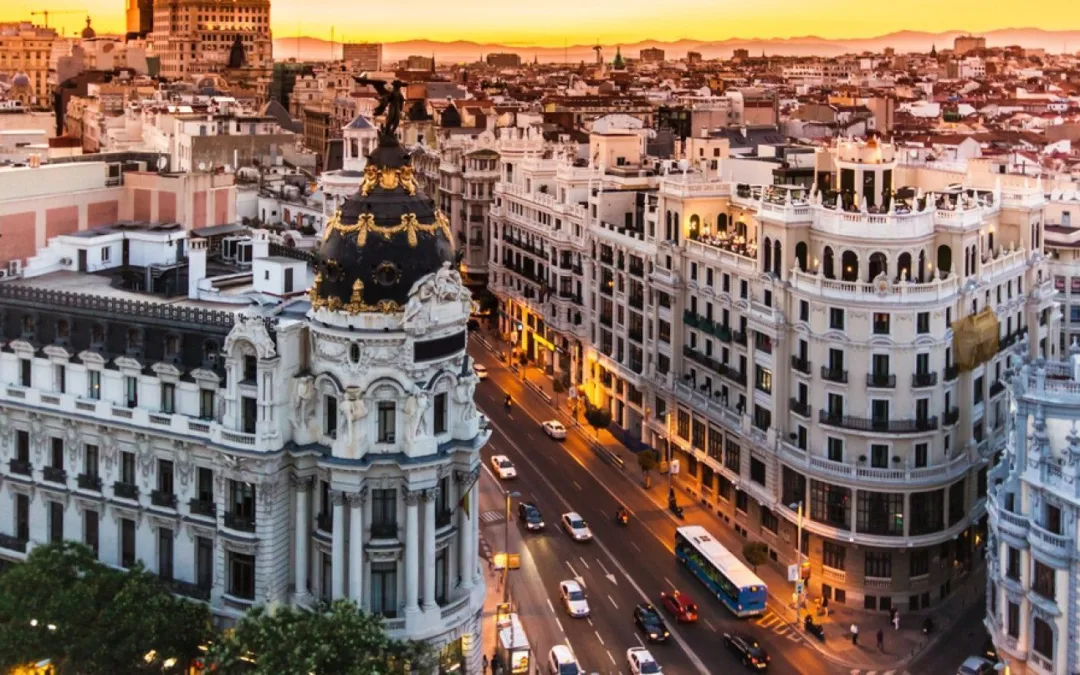
Top: Puerta del Sol © Valery Bareta. Bottom left: Metropolis building. Bottom right: Royal Palace © Álvaro López. Destination Madrid

Top: Puerta del Sol © Valery Bareta. Bottom left: Metropolis building. Bottom right: Royal Palace © Álvaro López. Destination Madrid

1. Puerta del Sol

Flanked by the Real Casa, the statue of the Bear and the Strawberry Tree and the giant Tío Pepe sign. A classic? Taking a picture of your feet on the Kilometre Zero plaque, the starting point of all distances on Spanish roads.

2. Gran Vía

A vibrant city thoroughfare and a hub for the theatre scene, day and night. The “Broadway” of Madrid.

3. Plaza de España.

Here you have to look for the imposing building of Torre de Madrid and the monument to Cervantes.

4. Plaza de Oriente

Several interesting sights are here: the Royal Palace, the Sabatini Gardens, the Teatro Real opera house, and the Cathedral of La Almudena.

5. Plaza Mayor square

Be sure to see the Casa de la Panadería (the baker’s), the Casa de la Carnicería (the butcher’s) and the terraces where you can try the legendary “calamari sandwich”. 

6. Plaza de Santa Ana

A good area for tapas, usually served with “una caña bien tirada”, which is how you should ask for a small glass of beer. By the way: Serving beer is an art form in the bars of Madrid!

7. El Retiro park

A city garden full of idyllic spots. The must-sees: The Palacio de Cristal and the boating pond. Together with the Paseo del Prado and the surrounding area, it has been awarded UNESCO World Heritage status.

8. Plaza de Cibeles

Cibeles Palace (Madrid City Hall) and Círculo de Bellas Artes.

Both with rooftops for a magnificent view of the city from above.

9. Temple of Debod 

A gift from Egypt to Spain and a magical place to enjoy the sunset.


Top: Temple of Debod. Bottom left: Plaza de Cibeles and City Hall. Bottom right: Crystal Palace in Buen Retiro Park

Top: Temple of Debod. Bottom left: Plaza de Cibeles and City Hall. Bottom right: Crystal Palace in Buen Retiro Park

10. Barrio de las Letras

Another option is to lose track of time and have a wander around the streets. Iconic bars, vintage signs, urban art, unique shops, shopping around  Callao, Fuencarral or Barrio de las Letras, and seeing how the locals live. The streets are the best museum in Madrid and walking through them is the best way to capture its essence.

You can also take the opportunity to see the Santiago Bernabéu Stadium, or visit the Museo del Prado with important works such as Las Meninas or The Garden of Earthly Delights.

Velázquez gallery in the Prado Museum Madrid

88A day in Madrid in 10 essential visits


First, can Madrid be visited in one day? It’s obvious that the capital has much more to give. But if you only have one day, we’ve come up with a selection of must-sees.Ready for that?

Top: Puerta del Sol © Valery Bareta. Bottom left: Metropolis building. Bottom right: Royal Palace © Álvaro López. Destination Madrid

Top: Puerta del Sol © Valery Bareta. Bottom left: Metropolis building. Bottom right: Royal Palace © Álvaro López. Destination Madrid

1. Puerta del Sol

Flanked by the Real Casa, the statue of the Bear and the Strawberry Tree and the giant Tío Pepe sign. A classic? Taking a picture of your feet on the Kilometre Zero plaque, the starting point of all distances on Spanish roads.

2. Gran Vía

A vibrant city thoroughfare and a hub for the theatre scene, day and night. The “Broadway” of Madrid.

3. Plaza de España.

Here you have to look for the imposing building of Torre de Madrid and the monument to Cervantes.

4. Plaza de Oriente

Several interesting sights are here: the Royal Palace, the Sabatini Gardens, the Teatro Real opera house, and the Cathedral of La Almudena.

5. Plaza Mayor square

Be sure to see the Casa de la Panadería (the baker’s), the Casa de la Carnicería (the butcher’s) and the terraces where you can try the legendary “calamari sandwich”. 

6. Plaza de Santa Ana

A good area for tapas, usually served with “una caña bien tirada”, which is how you should ask for a small glass of beer. By the way: Serving beer is an art form in the bars of Madrid!

7. El Retiro park

A city garden full of idyllic spots. The must-sees: The Palacio de Cristal and the boating pond. Together with the Paseo del Prado and the surrounding area, it has been awarded UNESCO World Heritage status.

8. Plaza de Cibeles

Cibeles Palace (Madrid City Hall) and Círculo de Bellas Artes.

Both with rooftops for a magnificent view of the city from above.

9. Temple of Debod 

A gift from Egypt to Spain and a magical place to enjoy the sunset.


Top: Temple of Debod. Bottom left: Plaza de Cibeles and City Hall. Bottom right: Crystal Palace in Buen Retiro Park

Top: Temple of Debod. Bottom left: Plaza de Cibeles and City Hall. Bottom right: Crystal Palace in Buen Retiro Park

10. Barrio de las Letras

Another option is to lose track of time and have a wander around the streets. Iconic bars, vintage signs, urban art, unique shops, shopping around  Callao, Fuencarral or Barrio de las Letras, and seeing how the locals live. The streets are the best museum in Madrid and walking through them is the best way to capture its essence.

You can also take the opportunity to see the Santiago Bernabéu Stadium, or visit the Museo del Prado with important works such as Las Meninas or The Garden of Earthly Delights.
Velázquez gallery in the Prado Museum Madrid

Where to go Shopping in the major cities of Spain?

Where to go Shopping in the major cities of Spain?

Where to go shopping in the major cities of Spain?

Shopping in Spain is concentrated in the two largest cities Madrid and Barcelona. These cities have the best malls and shopping centers in the country where you can find things of any price. Collections are represented by international and local brands, however, are also known throughout the world.

In other cities like Sevilla, Valencia, Malaga, and Zaragoza, shoppers will be
able to find everything they need. The famous Spanish markets deserve special attention. Unique products and souvenirs can be bought there. In outlets, travelers will be able to find things from old collections with nice discounts.

Most major cities of Spain have El Corte Ingles Malls. You can find goods of any category in these huge shopping centers. Tourists will enjoy the unforgettable shopping

Madrid

You can do good shopping in several areas, depending on the purpose and budget. Shopping streets start from the central city square. There are also numerous shops of local craftsmen with traditional souvenirs.  Excellent shopping for everyone is waiting for tourists in the Gran Vía area. And in Cuatro Caminos you can buy exclusive fabrics and even order an outfit. Among the most amazing shopping centers of the capital, it’s worth noting Plenilunio, Principe Pio and Moda Shopping. There you can buy inexpensive clothing from the world famous Spanish and foreign brands.

Not far from Madrid, there a fairly large outlet, Las Rozas Village, where you can buy clothes of expensive brands with discounts up to 70%. The season of sales in Spain runs twice a year. Winter sales start in early January and last until March; by the end of it, discounts may reach even 80%. Summer sales also last about two months, from early July to late August. This time is considered the best for shopping in Spain.

Products of elite brands can be searched in the most prestigious area of ​​the city, Barrio de Salamanca.

Barcelona

Barcelona has prepared a real present for shoppers. Monday to Friday, during the working hours, a bus runs along the streets of the city and takes tourists to the most important places for shopping. The length of the route is 5 kilometers; the ticket price is 10 euros. Most of the shops are located in the city center. You can find boutiques of famous Spanish brands, including Zara, Massimo Dutti, and Stradivarius with rather democratic prices on the Passeig de Gracia avenue. The same street features shops of elite brands – Chanel, D&G, and Yves Saint Laurent. One of the largest shopping centers in the capital of Catalonia is Diagonal Mar. It has more than 150 shops of various brands, children’s areas, and restaurant patios. No less exciting is shopping in the areas of Raval and Gracia. Here, you can find something vintage and exclusive.One of Spain’s largest outlets, La Roca Village, is located near Barcelona. It has more than 100 stores; discounts there can reach 60%. The village has a very special design, so you can visit it even as part of the tour.

Valencia

Valencia, go for shopping to Carrer Colon, which is the main trade artery of the city. There are shops of different brands, including Lacoste, Zara, H&M, and Nike. The budget-saving shopping can be done at El Saler, where clothes, toys, cosmetics, and accessories are sold. In Seville, it is obligatory to buy something local. The homeland of flamenco produces luxurious colored scarves, dresses for dancing, shoes, and castanets. You can buy inexpensive souvenirs on Bazar Arjona. In Malaga, there is the oldest shopping center in the country, Felix, where you can find a large number of different shops.

Vacationers will also be able to make nice purchases on the Canary Islands. In the south of the island, in the resort of Las Americas, it is worth to go to the main street, which is called the Golden Mile. There, you can buy clothes of both elite designers and inexpensive brands. The largest city of the islands, Santa Cruz de Tenerife, has somewhat wider choice. Shopping centers like Carrefour and Meridiano are recommended to make purchases

Some of the best shopping malls in Madrid

Some of the best shopping malls in Madrid

Madrid is home to some great outdoor shopping areas like the Gran Vía, but sometimes, especially when the weather is bad, a shopping mall is a much nicer shopping prospect. Read on to discover some of the city’s best shopping centres.

Centro Comercial La Gavia

If you need some furniture or just have an urge to stock up on cheap candles, then La Gavia is for you: it is home to one of Madrid’s two IKEAs (top tip: try to go on a weekday to avoid the crowds). As well as Scandi furniture, the shopping centre, located on the end of Line 1 on the metro, has a huge range of shops, from women’s and men’s fashion, to toy shops and tech stores, as well as a cinema. There are a good number of food options too: popular burger chain Five Guys is one of the latest fast food options to open here.

Opening times:

Shops: Monday–Sunday 10am–10pm

Restaurants: Sunday–Thursday 10am–1am; Fridays, Saturdays and public holidays 10am–3am

IKEA: Monday–Sunday 10am–10pm

Centro Comercial La Gavia, Calle Adolfo Bioy Casares, 2, 28051 Madrid, Spain, +34 914 25 54 01


Principe Pio

The Centro Comercial Príncipe Pío is a good option if you don’t want to stray too far from the city centre; it is located in the former Estación Norte train station just to the west – and within easy walking distance – of the centre. There is a good range of high street brands, from Spanish favourites like Zara and Mango to international names like H&M and Levi’s. There is a Cinesa cinema and a food court packed full of different dining options.

Opening times:

Shops: Monday–Saturday 10am–10pm; Sunday 11am–10pm

Restaurants: Sunday–Thursday until 1am, Fridays and Saturdays until 2am

Principe Pio, Paseo de la Florida, 2, 28008 Madrid, Spain, +34 917 58 00 40

14652305301_d45d09feaf_k

Príncipe Pío shopping centre | © Sharon Mollerus/Flickr

ABC Serrano

Set in the historic former headquarters of Spanish newspaper ABC, this shopping centre is located right in the heart of Madrid’s most exclusive neighbourhood: Salamanca. It holds regular events, from art exhibitions to tie ins with Madrid fashion week. Don’t miss exploring the nearby Golden Mile of designer stores, even if you’re just window shopping!

Opening times:

Monday–Saturday, 10am–9pm

ABC Serrano, Calle de Serrano, 61, 28006 Madrid, Spain, +34 915 77 50 31

Centro Comercial Madrid Xanadú

Madrid Xanadú, to the south-west of Madrid, is much more than just a shopping centre. As well as a good range of shops and restaurants, it is home to the biggest indoor ski slope in Spain, Madrid Snowzone. There is also a cinema, bowling alley, and mini golf – so it’ll have you covered for activities for all the family.

Opening times:

Shops: Monday–Sunday 10am–10pm

Restaurants: Sunday–Thursday 10am–1am; Fridays and Saturdays 12pm–3am

Centro Comercial Madrid Xanadú, Autovía A-5, Km. 23,5, 28939 Arroyomolinos, Madrid, Spain, +34 902 26 30 26

ski-932188_1920

Go skiing indoors in Madrid | © tookapic/Pixabay

Parquesur

Located in Leganés, seven kilometres south of Madrid but easily accessible on the cercanías commuter train, Parquesur is one of the biggest shopping malls in Spain. It has 153 shops and 47 restaurants, as well as an IMAX cinema and bowling alley.

Opening times:

Monday–Saturday 10am–10pm; Sundays 11am–9pm

Parquesur, Av. de Gran Bretaña, 28916 Leganés, Madrid, Spain, +34 916 87 36 00

Plaza Norte 2

This shopping centre is located in San Sebastián de los Reyes, to the north-east of Madrid. It is the location of the second IKEA in Madrid so a useful option if you’re looking for some new furniture or homeware. As well as all the usual Spanish and international high street stores, there is also a cinema.

Opening times:

Shops: Monday–Saturday 10am–10pm; Sunday 11am–9pm

Restaurants: Sunday–Thursday 10am–1am; Friday and Saturday 10am–3am

Plaza Norte 2, Plaza del Comercio, 11-12, 28703 San Sebastián de los Reyes, Madrid, Spain, +34 916 59 39 67

4270206560_7bbe02cb25_b

Plaza Norte 2 | © M.Peinado/Flickr

Las Rozas Village

In the town of Las Rozas on the outskirts of Madrid is Las Rozas Village, a designer fashion outlet with lots of top brands at bargain prices. There is a direct bus line from Plaza de España, right in the centre of Madrid. Non-EU residents can also claim back the tax on purchases by asking for a tax-free receipt and showing it to customs when leaving Spain.

Opening times:

Sunday–Friday 10am–9pm; Saturday 10am–10pm

Las Rozas Village, Calle Juan Ramón Jiménez, 3, 28232 Las Rozas, Madrid, Spain, +34 916 40 49 00

6926664573_3c071045ae_b

Las Rozas Village | © jacinta lluch valero/Flickr

Original post from The Culture Trip 

El Retiro Park, green oasis in the heart of Madrid

El Retiro Park, green oasis in the heart of Madrid

 El Retiro Park, a green oasis in the heart of Madrid

Covering over 125 hectares and comprising more than 15,000 trees, El Retiro Park is a green oasis in the heart of the city. In it you’ll find all kinds of interesting monuments and gardens, including the Jardín de Vivaces, the Jardines de Cecilio Rodríguez (Andalusian-inspired classicistic gardens), the Jardines del Arquitecto Herrero Palacios, the Rosaleda rose garden and the Parterre Francés, which holds a Mexican conifer that is nearly 400 years old and is believed to be Madrid’s oldest tree.

In addition to its role as one of the city’s green lungs, it is also a popular spot among Madrileños who likes to go there for a stroll, to do some sport, visit an exhibition or take the kids to a puppet show. The park is home to a large artificial lake, where you can rent a rowing boat, and to the Velázquez Palace and Glass Palace which are both currently used as exhibition halls by the Reina Sofía Museum. The latter is a beautiful glass pavilion built in 1887 to house exotic plants for an exhibition in the Philippines. It is one of the finest examples of cast-iron architecture in Spain.

El Retiro is also filled with interesting sculptures and fountains such as the magnificent Monument to Alfonso XII, which watches over the lake and in the spring of 2018 opened to the public an observation deck offering wonderful vistas. Near the Rose Garden, you’ll encounter the statue of the Fallen Angel, the only sculpture in the world dedicated to the devil which curiously enough sits 666m above sea level.

Other spots worth visiting are the Galápagos Fountain, built in honor of the then princess Isabella II, the Teatro de Títeres, the only theatre in Europe that stages puppet shows every weekend, and the large area known as Reservado de Fernando VII which King Ferdinand VII decided to keep for himself and his family when the rest of the park was opened to the public.

In this section of El Retiro, between Calle O’Donnell and Calle Menéndez Pelayo, you’ll find some of the king’s “whims”, small buildings or monuments designed as little retreats for the monarchs to rest and relax: Casa del Pescador, the Montaña Artificial and the Casa del Contrabandista which accommodates Florida Retiro, a modern venue with a restaurant that hosts all kinds of events.

A firm favorite with both locals and tourists, El Retiro is a great place to go rollerblading, for a long walk or a jog. Dotted with playgrounds of different sizes, it’s just as popular with the little ones.

The park is also home to La Chopera municipal sports center, the Eugenio Trias Public Library and the Casa de Vacas Cultural Centre, as well as to what is believed to be Madrid’s oldest tree. An exotic species that doesn’t lose its leaves every year, the Ahuehuete (or Montezuma cypress) has been there since around 1630. Used by Napoleon’s soldiers as a support for their cannons when they turned their park into the army’s headquarters, it was one of the few lucky trees to survive the Spanish War of Independence against France.

If you fancy pedaling around the park, you can rent a bicycle from one of the bike rentals in the area. In El Retiro you’ll also find a number of outdoor cafés and kiosks when you can get a drink or bite to eat.

Every year the Retiro plays host to popular events such as the Book Fair and the fireworks display held in honor of San Isidro, the city’s patron saint.

Things to Do in Madrid, Spain

Things to Do in Madrid, Spain

The top things to Do  in Madrid, Spain

Madrid is a city so full of life and culture that it’s hard to do justice to it in a few paragraphs. Artistically the city holds its own against any in Europe, with the of the best art museums on the continent where renaissance masterworks and seminal 20th-century pieces are waiting to captivate you.

Take in all the historic sights and get the background on the Spanish Empire that spanned the globe in the 16th and 17th-centuries. There are also countless little things that make Madrid memorable, whether that’s a café con leche in a stately square, drinks at a rooftop bar or a wander through the Retiro or Casa de Campo on a sunny day.

Puerta del Sol

Puerta del Sol Madrid Tour Spain

Eduardo Ortín Madrid, Puerta del Sol

This grand square next to the Casa de Correos (Post Office Building) is a popular meeting place, suffused with meaning for both city and country. Nearly every Spanish person will recognize the clock at the top of the Casa de Correos, as this marks the televised countdown on New Year’s Eve. There’s a tricky ritual involved too: With every chime, you’re supposed to eat a grape for good luck (12 in total). Also in the square is El Oso y El Madroño statue, a symbol for Madrid since the Middle Ages.


Gran Vía

Gran Vía

Source: flickr

If you’d like to get a sense of the city,  a walk along the Gran Vía is a superb place to start. It’s Madrid’s entertainment, shopping, and cultural nerve center, a buzzing avenue often full of life until dawn. By day it throngs with shoppers stopping by the many malls, high-street stores like H&M and Zara and luxury boutiques. In the evenings there are couples arm-in-arm, stepping out to the cinema or a musical. And after dark the street pulses with many of Madrid’s top nightclubs. Sights to spot as you stroll include the vast Telefónica Building, dated in 1928 and an early example of a skyscraper.


Plaza Mayor Square

Plaza Mayor

Source: flick

Another of Madrid’s “musts”, Plaza Mayor is a handsome renaissance square, laid out in the early-1600s and completely sequestered by historic three-story-high residential buildings. There are nine entrances to the square and within the porticoes at the bottom of the buildings are several cafes. Order a coffee (overpriced but necessary because of the location) at an outdoor table and watch Madrid in action for a few minutes. After that you could wander up to the 400-year-old bronze statue of King Philip III, who was in power at the height of the Spanish empire.


Churros at Chocolate Shop

San Ginés

Source: bidaiahmadrid

Perfect in winter, Spanish hot chocolate is one of the most luxurious things you’ll ever taste. It can be so rich and thick you sometimes need a spoon to drink it. And the perfect pairing is a sugary churro, which if you don’t know, is piped dough, deep-fried. Just off the Puerta del Sol, visit the Chocolatería San Ginés, which has been serving churros and hot chocolate since the 19th century and does it as well as any joint in the city. If you can’t make it to San Ginés there are loads of stalls on the streets in the cooler months of the year.


Visit the 18th-century Royal Palace

Royal Palace Madrid

Paulo Valdivieso Palacio Real de Madrid View from the Plaza de Almería

Built-in the mid 18th century for King Philip V the Royal Palace is on the site of Madrid’s Moorish Alcázar fortress-palace, which burned down in 1734. It’s the largest royal palace in western Europe and has a blend of baroque and neoclassical styles. You have to go inside for the full experience because the royal collections and frescoes are sublime.  Here are works by Goya, Caravaggio and Velázquez, as well as stunning displays of watches, tapestries, porcelain and silverware.You can see the only string quartet of Stradivarius instruments in the world, and the Royal Armoury that includes the personal weapons used by Charles V in the 16th Century.


Have a drink at Santiago Bernabeu Stadium Café

Santiago Bernabeu Stadium, Madrid

Gilbert Sopakuwa Santiago Bernabeu Stadium, Madrid

Whether you’re a supporter of the club or not, the truth remains that Real Madrid C.F. is Europe’s most successful football team with record-breaking 11 European Cups to their name. So any fan of the game should consider a pilgrimage to their gargantuan 85,000-seater stadium, where history has been made many times down the seasons. A tour will grant you panoramic views of the stadium, you’ll step inside the dressing room, visit the dugouts and see all sorts of interesting bits including the trophy collection, press room and presidential box.


Relax at “El Retiro” Park

Retiro Park

Madrid’s green heart and full of elegant gardens, the Retiro is just a few steps east from the Prado and was a royal property up to the end of the 19th century when it was opened to the public. If you’re visiting with little ones, paddling on the Grand Pond next to the monument of Alfonso XII is a fun option on a sunny afternoon. The iron and glass pavilion built to house the Philippine Exhibition in 1887 is magnificent and growing in the pond in front of it are bald cypresses, strange swamp trees that turn  a lovely golden brown in summer. The oldest tree in the city is close by: It’s a Montezuma Cypress planted in 1633 and ringed by an iron fence.


Visit the National Museum “El Prado”

Museo del Prado

Source: wikipedia

Absolutely essential, the Prado is one of the best and most popular art museums in the world. There’s an overwhelming collection of masterpieces by renaissance and baroque masters. Spain is represented by Velázquez and El Greco, the low countries by Rembrandt, Brueghel, van Dyck and Rubens, while Titian, Caravaggio, Botticelli and Tintoretto form the Italian contingent. Of the many must-see works are Bosch’s Garden of Earthly Delights and David with Head of Goliath by Caravaggio. The artist with most works hanging at the Prado is the Spanish Romantic Goya, whose 14 Black Paintings are a Spanish cultural reference point.


Explore the Archaeological Museum

National Archaeological Museum, Madrid

Carole Raddato National Archaeological Museum of Spain, Madrid

With invaluable pieces gathered from across Spain, this museum is a trip through Spain’s rich history. What may surprise you is the wealth of magnificent items that predate the Roman period. The best of these Iberian treasures and sculptures look almost new, despite being at least 2,500 years old. The Lady of Elche is a bust of a woman with an incredibly detailed headdress and coils over her ears. Much later but no less impressive is the Treasure of Guarrazar a Visigothic set of crosses and votive crowns dating to the 600s.


 Mercado San Miguel

Mercado San Miguel

Source: flickr

Mercado San Miguel

An easy walk from Plaza Mayor is this gorgeous art nouveau marketplace that dates to 1916. It’s less of a fresh produce market (although there are grocery stalls) and more of a gastronomic destination to purchase the best that Spain has to offer, like cava,  Paprika spice and saffron. There’s a host of tapas bars here serving all the favorites like patatas bravas, gambas al ajillo and boquerones… To do your food shopping like a real Madrileño head to the vast Mercado de Maravillas in Cuatro Caminos. It’s Europe’s largest municipal market with 200 stalls.


El Rastro

El Rastro

Source: flickr

On Sundays, it will seem like the entire city has descended on Ribera de Coritodores and Plaza de Cascorro. This is when some 3,500 stalls are open, hawking pretty much anything you can think of, whether used or new. It’s the largest flea market in Madrid and gets pretty hectic, so it’s always a good idea to show up early. Even though it’s a Sunday the antique shops on the streets branching off Ribera de Cortidores will be open, and there are also cafes if you’re in need of a pick-me-up after wading through the crowds.


Thyssen-Bornemisza Museum of Art

Thyssen-Bornemisza Museum of Art

Source: wikipedia

If you still have an appetite for art after the Prado, amble over to this museum, which is also part of Madrid’s Golden Triangle of Art. You shouldn’t get bogged down, because the attractions in the Triangle are complementary, each covering schools and periods that the others do not. Here you can see works from the English and German schools by artists like Hans Holbein, Hans Baldung Grien and Albrecht Dürer. These are accompanied by pieces from other renaissance masters like Tintoretto, Veronese, Rembrandt, van Dyck and many more. There’s also a big collection of American abstract expressionism, and a host of impressionist and post-expressionist pieces by the likes of Monet, Renoir and Degas.


Reina Sofia Museum

Reina Sofia Museum

Source: wikipedia

Round off your journey through Madrid’s art collections with the third museum on the Golden Triangle. This museum focuses mainly on Spanish art and is more modern in scope than the others. The best reason to come is to the many works by the 20th-century artists Picasso and Dalí. Just to show that isn’t overkilled: Picasso’s epoch-making Guernica is on display, so it’s an opportunity you really shouldn’t miss. Among the other Spanish greats represented at Reina Sofía are Joan Miró, Juan Gris and the important abstract sculptor Eduardo Chillida.


Flamenco tablaos

Flamenco tablaos

Source: flickr

Flamenco is a dance that originated in Andalusia, Murcia and Extremadura, and even if it’s not strictly native to Madrid the city has some of the most famous tablaos in the country. These are special halls that cropped up in the 1960s, and here you see a show over a candlelit meal with sangria. It’s a fine way of killing two birds with one stone: Tucking into Spanish specialties while seeing one of the country’s most famous art-forms expressed by some of the best dancers in the flamenco world.

Top 20 Madrid Attractions You Need to Visit

Top 20 Madrid Attractions You Need to Visit

Top 20 Madrid Attractions You Need to Visit

Madrid might not have the status of Rome or Paris in terms of sights, but the Spanish capital is a pleasure to explore. From historical gems and world-class art, to an incredible food scene and picturesque parks, we take a look at the top attractions in Madrid to visit.

Plaza Mayor

Madrid’s main square holds centuries of history in its cobbles and has been the scene of everything from coronations to bullfights and beheadings. These days it’s a nice place to stroll and sample one of the city’s famed foods: a calamari sandwich (bocadillo de calamares) from one of the bars surrounding the square.

Royal Palace

The official residence of Spain’s royal family is these days used for official ceremonies only (King Felipe and Queen Letizia live in the more modest Zarzuela Palace just outside Madrid). Members of the public can visit the palace and check out centuries worth of paintings, furniture and armor.

Retiro Park

Madrid’s most beautiful park is the ideal place to spend a lazy afternoon enjoying a picnic and messing about in a rowing boat on the lake.

Templo de Debod

Madrid’s very own Egyptian temple was bestowed on the country by Egypt and moved, piece by piece, in the early 1970s. It is one of the best places to watch the sun set in Madrid.

KIO Towers

The seemingly gravity-defying KIO towers in Madrid’s financial district lean at a 15-degree angle and were the first leaning skyscrapers in the world.

Gran Vía

Madrid’s most iconic street has a cinematic scope that has seen it star in Abre Los Ojos (the original Spanish language movie of the 2001 Tom Cruise remake Vanilla Sky). Head to the top of the Corte Inglés Gourmet Experience for a great view of the street’s famous Schweppes sign.


Rooftop bars

Head to one of Madrid’s rooftop bars for an unforgettable view over the city’s rooftops. We recommend Circulo de Bellas Artes for one of the best panoramas of the capital.

Puerta del Sol

All roads in Spain lead to the Puerta del Sol, known as kilometer zero and the very center of the country. It is also home to the famous statue of the bear and the strawberry tree, the official symbol of Madrid.


The Golden Triangle of art galleries

Madrid is home to some of the world’s best art galleries, and the three most famous are handily located close to each other in a triangle. The Prado (classical paintings), The Reina Sofia (modern art) and the Thyssen-Bornemisza (a little bit of everything) are full of artistic riches well worth exploring.


Palacio de Cibeles

This grand building was, amazingly, the headquarters of Madrid’s post office until 2011. Today it is the home of Madrid’s City Council and a visitor attraction because of the incredible views from its observation deck.


Calle de Cava Baja

The ideal spot for a tapas crawl, Cava Baja is Madrid’s famous ‘tapas street’ and on an evening is teeming with people enjoying a drink and a bite. Some of our favorite spots are La Perejila, Txakolina and El Tempranillo.

Sobrino de Botín

Madrid is home to what is officially the oldest restaurant in the world – it has the Guinness World Record certificate in the window to prove it. Sobrino de Botín was founded in 1725 and has been going strong ever since. Its specialty is roast suckling pig and it appears in Ernest Hemingway’s The Sun Also Rises.

Cine Doré

This old cinema shows classic Hollywood and modern films from around the world for a bargain €2.50. Its tumultuous history saw it bombed during the Spanish Civil War but today it is home to the Filmoteca Española, which restores and preserves old films as part of Spain’s Ministry of Culture. It appears in Pedro Almodóvar’s Hable con Ella (Talk to Her).

Plaza Dos de Mayo

This square is in the heart of the hip neighborhood of Malasaña and is surrounded by a host of excellent bars, restaurants and shops. One of Madrid’s best nightlife spots.

Find more places to eat & drink in Madrid

The Rastro

Madrid’s famous flea market is held every Sunday morning when the streets come to life with stalls, bars open out onto the streets and locals and tourists alike enjoy the fiesta atmosphere around the area of Lavapiés.


Almudena Cathedral

Madrid’s cathedral was consecrated by Pope John Paul on its opening in 1993. Its Baroque exterior matches the older Royal Palace next door, and it was where King Felipe and Queen Letizia married.

Literary Quarter

Barrio de Las Letras is one of Madrid’s most beautiful and coolest neighborhoods. It was the home of Spanish literary giant and Don Quixote author, Miguel de Cervantes and these days are full of quirky bars and restaurants. Make sure to look down once in a while; the streets are peppered with famous literary quotes.

Atocha train station

Madrid’s main train has a very unusual feature – it’s very own indoor rainforest, home to dozens of turtles.

Matadero

This former slaughterhouse (‘matadero‘ in Spanish) situated along the River Manzanares was converted into an arts center in the early 2000s. It has its own cinema and exhibition spaces and holds regular performances and food markets.

San Ginés for churros

You cannot possibly leave Madrid without trying churros con chocolate (sugar-drenched deep-fried dough sticks with hot chocolate) from San Ginés, which has been serving since 1894. It is open all night long, so it is a great pitstop on the way home from a night on the town.

Written by Jessica Jones theculturetrip.com