Madrid might not have the status of Rome or Paris in terms of sights, but the Spanish capital is a pleasure to explore. From historical gems and world-class art, to an incredible food scene and picturesque parks, we take a look at the top attractions in Madrid to visit.
Plaza Mayor
Madrid’s main square holds centuries of history in its cobbles and has been the scene of everything from coronations to bullfights and beheadings. These days it’s a nice place to stroll and sample one of the city’s famed foods: a calamari sandwich (bocadillo de calamares) from one of the bars surrounding the square.
Royal Palace
The official residence of Spain’s royal family is these days used for official ceremonies only (King Felipe and Queen Letizia live in the more modest Zarzuela Palace just outside Madrid). Members of the public can visit the palace and check out centuries worth of paintings, furniture and armor.
Retiro Park
Madrid’s most beautiful park is the ideal place to spend a lazy afternoon enjoying a picnic and messing about in a rowing boat on the lake.
Templo de Debod
Madrid’s very own Egyptian temple was bestowed on the country by Egypt and moved, piece by piece, in the early 1970s. It is one of the best places to watch the sun set in Madrid.
KIO Towers
The seemingly gravity-defying KIO towers in Madrid’s financial district lean at a 15-degree angle and were the first leaning skyscrapers in the world.
Gran Vía
Madrid’s most iconic street has a cinematic scope that has seen it star in Abre Los Ojos (the original Spanish language movie of the 2001 Tom Cruise remake Vanilla Sky). Head to the top of the Corte Inglés Gourmet Experience for a great view of the street’s famous Schweppes sign.
Rooftop bars
Head to one of Madrid’s rooftop bars for an unforgettable view over the city’s rooftops. We recommend Circulo de Bellas Artes for one of the best panoramas of the capital.
Puerta del Sol
All roads in Spain lead to the Puerta del Sol, known as kilometer zero and the very center of the country. It is also home to the famous statue of the bear and the strawberry tree, the official symbol of Madrid.
The Golden Triangle of art galleries
Madrid is home to some of the world’s best art galleries, and the three most famous are handily located close to each other in a triangle. The Prado (classical paintings), The Reina Sofia (modern art) and the Thyssen-Bornemisza (a little bit of everything) are full of artistic riches well worth exploring.
Palacio de Cibeles
This grand building was, amazingly, the headquarters of Madrid’s post office until 2011. Today it is the home of Madrid’s City Council and a visitor attraction because of the incredible views from its observation deck.
Calle de Cava Baja
The ideal spot for a tapas crawl, Cava Baja is Madrid’s famous ‘tapas street’ and on an evening is teeming with people enjoying a drink and a bite. Some of our favorite spots are La Perejila, Txakolina and El Tempranillo.
Sobrino de Botín
Madrid is home to what is officially the oldest restaurant in the world – it has the Guinness World Record certificate in the window to prove it. Sobrino de Botín was founded in 1725 and has been going strong ever since. Its specialty is roast suckling pig and it appears in Ernest Hemingway’s The Sun Also Rises.
Cine Doré
This old cinema shows classic Hollywood and modern films from around the world for a bargain €2.50. Its tumultuous history saw it bombed during the Spanish Civil War but today it is home to the Filmoteca Española, which restores and preserves old films as part of Spain’s Ministry of Culture. It appears in Pedro Almodóvar’s Hable con Ella (Talk to Her).
Plaza Dos de Mayo
This square is in the heart of the hip neighborhood of Malasaña and is surrounded by a host of excellent bars, restaurants and shops. One of Madrid’s best nightlife spots.
Find more places to eat & drink in Madrid
The Rastro
Madrid’s famous flea market is held every Sunday morning when the streets come to life with stalls, bars open out onto the streets and locals and tourists alike enjoy the fiesta atmosphere around the area of Lavapiés.
Almudena Cathedral
Madrid’s cathedral was consecrated by Pope John Paul on its opening in 1993. Its Baroque exterior matches the older Royal Palace next door, and it was where King Felipe and Queen Letizia married.
Literary Quarter
Barrio de Las Letras is one of Madrid’s most beautiful and coolest neighborhoods. It was the home of Spanish literary giant and Don Quixote author, Miguel de Cervantes and these days are full of quirky bars and restaurants. Make sure to look down once in a while; the streets are peppered with famous literary quotes.
Atocha train station
Madrid’s main train has a very unusual feature – it’s very own indoor rainforest, home to dozens of turtles.
Matadero
This former slaughterhouse (‘matadero‘ in Spanish) situated along the River Manzanares was converted into an arts center in the early 2000s. It has its own cinema and exhibition spaces and holds regular performances and food markets.
San Ginés for churros
You cannot possibly leave Madrid without trying churros con chocolate (sugar-drenched deep-fried dough sticks with hot chocolate) from San Ginés, which has been serving since 1894. It is open all night long, so it is a great pitstop on the way home from a night on the town.
Spain is one of the world’s most popular holiday destinations and is home to incredible architecture, history and beaches, as well as some distinctly unique souvenirs. From handmade fans and flamenco guitars to Esencia de Ibiza, we guide you through 15 things you can only buy in Spain.
A bota
A bota, or wineskin, is a traditional Spanish drinking vessel, usually used for wine, but it can hold any liquid. The method of drinking from a bota usually involves angling the wineskin so that the liquid can shoot out into the drinker’s mouth, without the mouth having to touch the bota. This way, people can easily share wine without all putting their mouths on the same part of the wineskin.
Follow in the footsteps of Bob Dylan, Cat Stevens and Leonard Cohen, as well as flamenco legends including Paco de Lucía, by purchasing a guitar from Felipe Conde – the Conde family are master guitar makers who have been handcrafting their instruments for over 100 years. They’re not cheap – starting at €2,500 (£2,186) and reaching over €11,000 (£9,620) – but for a lifetime investment and a piece of rock history, they’re well worth the price tag.
Espadrilles
You might be able to pick up versions of this popular summer shoe abroad, but the genuine article can only be purchased in Spain. Casa Hernanz in Madrid has been making espadrilles, a rope-soled shoe, since 1840 and is one of the longest-running espadrille manufacturers in Spain. Originally the shoe of the poor and working-class, the espadrille came to worldwide attention when Lauren Bacall sported a pair in the 1948 film Key Largo. They have been a summer fashion staple ever since.
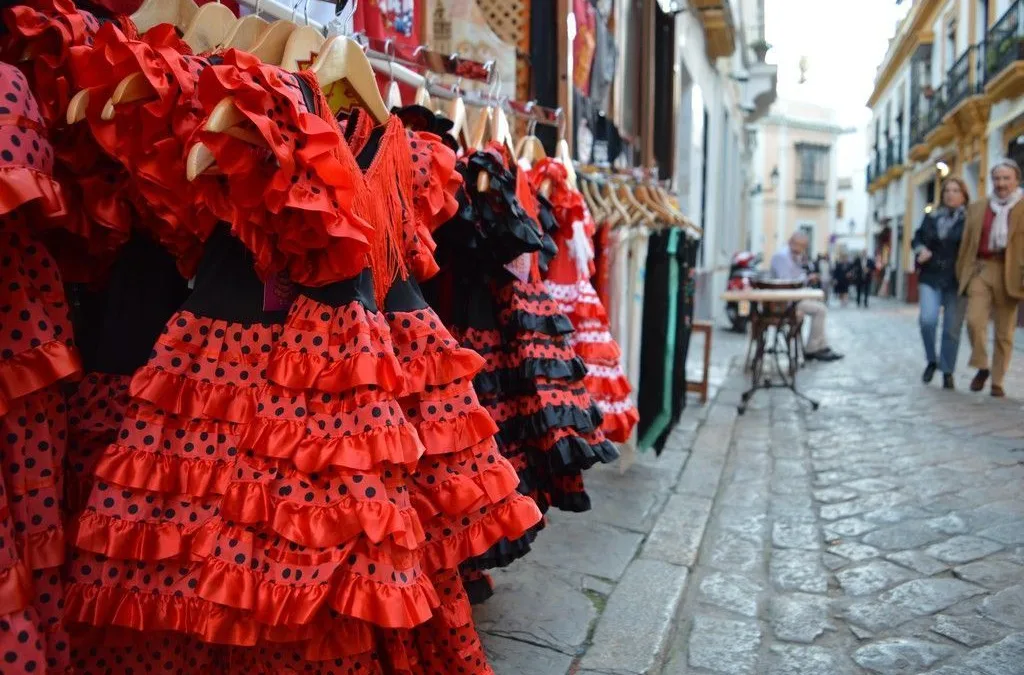
Spain is home to the dramatic and passionate music and dance style of flamenco, making it the perfect place to buy a flamenco dress, shawl or shoes. If you want something a little smaller, pick up some castanets, wooden concave shells that flamenco dancers clack together as a percussion instrument.
If you want to take a part of Spain’s party island home with you after your holiday, why not buy a can of Aire de Ibiza, ‘Ibiza Air’, a bottled sample of the island’s most abundant commodity? A couple of friends on the island began selling the product from an ice-cream parlor in summer 2016, and the product has been a hit with tourists ever since.
Firewater from northern Spain
Orujo (nicknamed ‘firewater’ by locals) is a spirit with over 50% alcohol content from northern Spain. It is particularly popular in Cantabria, Asturias and Galicia, where some local families have been making the drink for generations.
Paella pan
Buy an authentic Spanish paella pan (and some saffron, the key ingredient of paella) and you can perfect the Spanish classic in your own home. There is a booming trade in paella pans in Valencia, home of paella, but you should be able to buy them throughout the country at markets and cookware shops.
This nougat-like sweet is sold around Spain in the run up to Christmas time and is a popular gift and souvenir. It is made from almonds, honey, sugar and egg whites and is served in a rectangular slab. Casa Mira, founded in 1842 in Madrid, was the capital’s first turrón shop and today is still extremely popular with locals.
Gazpacho at McDonald’s
The Spanish classic cold tomato soup appears on many restaurant menus, but you might be surprised to see it also features on the menu at the popular fast food chain. So make sure to sample some gazpacho alongside your Big Mac and you can even enjoy a beer too – Spanish McDonald’s sells cerveza, unlike chains in many other countries.
Spanish fans
They might seem like a bit of a stereotype, but a handmade Spanish fan, or abanico, is a beautiful gift to take home and a useful cooling down method during Spain’s stifling summers. It is a common sight in the country’s big cities to see women of all ages carrying a fan as it’s one of the cheapest, quickest and easiest ways to cool down.
A Catalan Christmas tradition like no other, the caganer, or ‘Christmas pooper’, is a longstanding staple of every nativity scene in the northeastern region of Catalonia. Originally the figure, who has his trousers down and is defecating, is a little boy dressed in traditional clothes. Today, however, there is a booming industry in making poopers who look like famous people. You can pick up everyone from Donald Trump and the Pope to Cristiano Ronaldo and Lady Gaga. The figure is meant to symbolize good fortune for the year ahead.
Original post was written on https://theculturetrip.com/authors/jessica-jones/
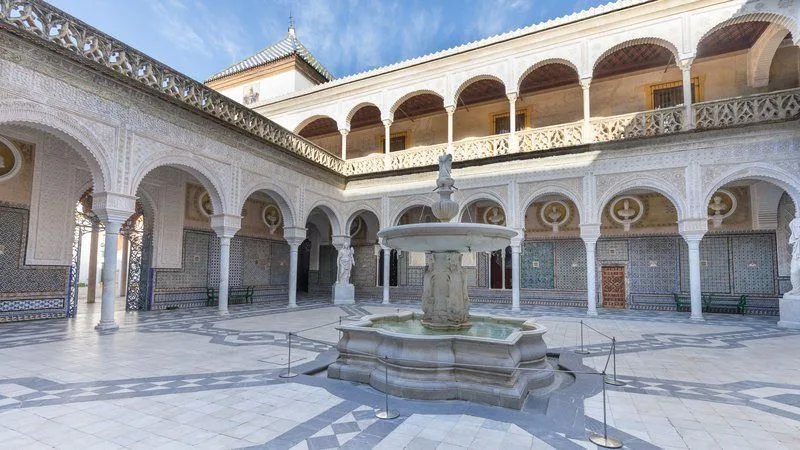
Seville’s Casa de Pilatos was built in the 16th century and is an outstanding example of Seville’s civil palace architecture. It is a splendid blend of the Renaissance, Mudejar and Baroque styles. The humanist character of the building makes it a quintessential Renaissance mansion, with a fascinating interior and some of the finest classical and marble sculptures.
This palace dates from the union of the Enríquez and Ribera families in the last quarter of the 15th century. During the 16th century, it underwent profound changes as a result of the close relationship of leading family members with Italy, serving as a conduit for the new forms and tastes of the Renaissance to enter Seville.
Remodeling in the mid-19th century to reflect romantic tastes added to its picturesque appearance, a harmonious synthesis of the Gothic-Mudejar, the Renaissance and Romanticism.
The Alcazar of Cordoba (Andalusia, Spain) with its thick defensive walls, served both as a fortress and a palace and is a perfect illustration of the development of Cordoban architecture through the ages.
Roman and Visigoth ruins lie side by side with Arabic remain in this magnificent building, which was once the favorite residence of the different rulers of the city.
However, when Cordoba was taken by Fernando III «the Saint» in 1236, the former Caliphal Palace was in a pitiful, ruinous state. Alfonso X «the Wise» began the restoration work, which was finished off during the reign of Alfonso XI.
It has fulfilled many different functions over the years, such as Headquarters of the Inquisition, or a prison (first half of the 20th century).At first sight, one of the most surprising features of the fortress is its almost rectangular shape with its long walls made of solid blocks of stone (ashlars) and four corner towers (the tower of the Lions, the main keep, the tower of the Inquisition and the tower of the Doves).
Inside, the different halls are distributed around courtyards with an exotic array of flowers, aromatic herbs and mature trees. Both rooms and corridors are covered by stone cupolas in the Gothic style.In one of the galleries leading to the halls, there is a Roman sarcophagus on display, a pagan work dating from the early 3rd Century, on the front of which there is a sculpture in relief depicting the journey of the dead to the underworld through a half-opened door.
The most interesting hall is the small Baroque chapel, the Hall of the Mosaics, where a series of Roman mosaics, discovered underneath the Corredera, are displayed around the walls. Below this hill are the baths, built-in Arabic style, which are divided into three rooms with vaulted ceilings containing the familiar star-shaped openings.
The boiler which provided water for the baths was situated below the Main Keep.There are two courtyards, but the one in Mudejar style is by far the most attractive. The cool marble floors and the murmur of water, running down the channels and into the ponds, refresh the hot summer air and soothes the weary visitor’s spirits. The spacious gardens, stretching out to the west, give this Alcazar, or castle, an air of monumental grandeur.
The Alcázar of the Christian Monarchs is one of the most important and representative monuments in Córdoba, although almost every culture living in the city has intervened and lived there, since the Romans to our date. Hence, we have decided to dedicate a special section to its history, distinguishing each of the stages the building has been through.
The analysis of the Alcázar of the Christian Monarchs has been organized as a tour, as it is currently shown to the visitor. We will start talking about the walls, while we enter the Main Gate, a great quality image, as it is dominated by a sculpture of King Alfonso X the Wise. After it, a small access takes us to the Main Gallery connecting to the Northern wall and, therefore, to the Tribute Tower and the Tower of the Lions, as well as the Hall of the Mosaics and the Hall of the Ocean. We go down to the ground floor to appreciate the singularity of the Royal Baths, as well as the Moorish Courtyard, which ultimately leads us to the Gardens.
Main door of the Christian Monarchs AlcazarThe collection of mosaics of the Alcázar of the Christian Monarchs is of great quality. All of them were taken from the Corredera Square, which was at the time the entrance to the Roman circus in our city, one of the biggest and most important in the peninsula, and to which we will dedicate a section on the website.
The Alcazar of the Christian Monarchs is one of the most important monument of Córdoba
Another topic we have paid special attention to is the treatment of the gardens, which already showed its greatest splendor in caliphal times, supplied by water from the river and the mountain. The Gardens of the Alcázar of the Christian Monarchs are a symbol of the history of our city, a source of inspiration for our men of letters and a place which was very close to the daily lives of the people of Córdoba.
Marrakech is a former imperial city and one of the most popular cities for tourists in the Maghreb. It is home to beautiful mosques, palaces and gardens, as well as the famous Jemaa el-Fnaa square and souk market. With plenty of things to do and see in both the medieval and modern parts of town, Marrakech is a captivating city. Here is our list explores the Must-See Attractions every traveler needs to do in Marrakech.
[/et_pb_text][/et_pb_column][/et_pb_row]
Jemaa el-Fnaa Market
Jemaa el-Fnaa is the main pulse of Marrakech. By day, the square buzzes with snake charmers, henna tattoo artists and various other entertainers, while at night there are countless stalls boasting traditional lamb dishes and fresh orange juice, among other culinary delights. Tourists flock here all year round to experience the true heart of the city and to discover the intriguing things the locals have to offer in this magical Moroccan square.
One of the most popular locations in Morocco, the Jardin Majorelle is the creation of French painter Jacques Majorelle, who spent 40 years injecting his passion and creativity into this magical garden. Complete with enchanting little lanes, tranquil streams and over 300 species of stunning plants, Jardin Majorelle is perfect for those who need a break from the busy city.
A visit to a hammam (local bathhouse) will usually involve stripping down and immersing yourself in experiences such as a visit to the sauna, an exfoliating massage and a dip in an ice-cold pool. There are a number of bathhouses throughout Marrakech, and a typical price for tourists is between 50 and 100 dirhams. Don’t forget to bring your own towel just in case!
Given the importance of mosques in Moroccan culture, the Koutoubia Mosque is a must-see for those in the area. The largest mosque in Marrakech, the Koutoubia is not only a spiritual center but a point of reference for international architecture. Setting the trend for buildings in Spain and Rabat, the beautiful 12th-century minaret is an example of ornamental expertise, with characterful arches and rigid proportions, it’s an admirable piece of architecture. Enjoy the call to prayer coming from the top of the minaret five times a day and appreciate the architecture of this important building.
Riads are hidden treasures often tucked away in the narrow streets of the old part of town. Those staying in Marrakech should ensure they spend at least one night in the heart of the old town in a spectacular riad. Take Dar Hanane, for example, where guests are transported from the bustling medina streets into a house of relaxation and tranquillity. With en-suite bedrooms and a roof terrace offering panoramic views of Marrakech, this is just one example of the incredible riads in the imperial city.
These tombs were created to stand as the final resting place for the many rulers and members of the Saadi dynasty. Rich in history, the Saadian tombs were rediscovered in 1917 after being sealed for centuries. Magnificently decorated with bright tiles, Arabic calligraphy, and intricate carvings, Saadian Sultan Ahmed al-Mansour Eddahbi certainly spared no expense on his tomb, making for a beautiful site for tourists. Located just outside of Marrakech, the tombs are easy to reach, and a fantastic alternative to the bustling city. Carefully restored and well preserved, they now stand as one of the most popular things to see in Morocco.
Situated in the northeast of the medina, the tanneries cannot be missed. With an overwhelming smell and many invitations from people in the streets, you’ll easily find your way there. Everything from bags to dresses is found here, and it’s wonderful to watch just how all the treasures are made. Visitors can watch workers as they hand dye material in preparation for trade in the city. Offering up an alternative to modern factories, the tanneries are an intriguing feast for all the senses.
Marrakech is full of delightful museums, including the Dar si Said, which displays fantastic Moroccan architecture and objects. The Musée de Marrakech, house in the Dar Menebhi Palace, boasts embroidery, weapons and contemporary art. For historical imagery of the city, visit the Maison de la Photgraphie. In the new part of town, visitors can find many contemporary art galleries displaying work from local talent.
On a trip to any Moroccan city, the enchanting souks are a must on the agenda. Marrakech is no exception. Labeled one of the most magical cities in the country, Marrakech boasts a full medina with traditional winding souks and countless treasures. Whether you’re looking for literature, handicrafts, or food, there’s a street and an alleyway for everything. Visitors can get lost for hours in the labyrinth of enticing streets. So relax, explore, and discover some locally made treasures.
Madrasas, translating to ‘schools’, now stand all around Morocco as historical representations of the education of the past. This particular Quranic school, once the largest in North Africa, was dedicated to the teaching of Islamic law and has stood since the 14th century. Guests can explore more than 100 tiny, windowless student chambers and admire the stunning architecture, from the great courtyard to the richly decorated prayer halls. After almost six centuries, this medieval madrasa stands as one of the key tourist attractions of the city.
Original post was written by Rebecca Wilkinson for Culturetrip
The archaeological site of the old Caliphal city of Madinat al-Zahra is located approximately 5.5 km west of Cordoba in Andalucia
The city was founded in 940 or 941, by the Caliph Abd al-Rahman III as the seat of the newly created Caliphate of Córdoba. However, it was short-lived being destroyed in 1010 during the riots which brought about the end of this Caliphate. After slowly being abandoned and after the Christian occupation, the city fell into oblivion, so much so, that even its very existence was forgotten, thus converting it into an intangible mythical reference to the Golden Age in a faraway western point of Islam.
Madinat al-Zahra is currently part of the Tentative List in order to qualify for inclusion in the World Heritage List.
The remains of a 10th-century city were hidden and their integrity has been unaltered. The Caliphs, Abd al-Rahman III and al-Hakam II were actually building the most monumental part of the Mosque in Córdoba (declared World Heritage in 1984) at the same time. In fact, the first excavations that took place were started by the architect who was actually restoring the Mosque in Córdoba, Velázquez Bosco. He began this work in order to have more insight into Andalusian Caliphal architecture to be able to better restore the Mosque.
Its unique values in the field of art, architecture, town planning and territorial layout. It includes some of the first and most important Islamic gardens ever known, as well as the fact that it represents a testimony, without comparison, of the culture and urban life at a time when al- Andalus was the most important cultural focal point in Western Europe and the Maghreb.
It is a good example of the perfect combination of urban planning with the environment. It is a city with buildings and structured gardens for the population to be able to enjoy the natural characteristics of the surrounding area. This unison with the landscape is shown in the modeling of the territory as well as in the way the local stone, water supply and plants were taken advantage of. The fact that the place has stayed just as it was, affected only by its natural deterioration, without any new constructions being built, has meant that its value concerning its environment, has been conserved.
Its sudden disappearance turned Madinat al-Zahra into a myth. This myth fed rich literature, in which the fortune of a lost paradise was evoked throughout the Arab speaking world.
Museum
The Madinat al-Zahra Museum has been open since 2009. It is located 1.5 km. away from the archaeological site and is not visible from the site, thus avoiding any impact on the landscape. Due to the quality of its architecture, the building has in fact been awarded some international prizes. The Museum comprises of reception areas and spaces to explain about the city to the visitors: a presentation room, an auditorium, an information center, etc. There are also areas devoted to the continual conservation and research work carried out by the managing body of the site: restoration workshops, storehouses for goods, a library, research rooms, offices, etc.
Visit
Carretera de Palma del Río, Km. 8 – 14029 Córdoba General Information: 957 10 49 33 Booking for Visits: 957 10 36 28 / 957 10 36 37 Email: madinatalzahra.ccd@juntadeandalucia.es
Opening times
16 September-31 March: Tuesday to Saturday: 09.00-17.30 Sunday and public holidays: 09.00-15.30
1 April-15 June: Tuesday to Saturday: 09.00-19.30 Sunday and public holidays: 10.00-15.30
16 June-15 September: Tuesday to Sunday and public holidays: 09.00-15.30
The monument is closed on Mondays, 1 and 6 january, 1 may, 24, 25 and 31 december. Local holidays (opening times 09:00-15:30): 8 September, 24 october.