No Results Found
The page you requested could not be found. Try refining your search, or use the navigation above to locate the post.


Everything in this building is curved and undulating. Its originality and the techniques used in its construction are surprising throughout.
This is one of the best-known works of the architect Gaudí, and is one of the symbols of Barcelona. It was built between 1906 and 1912, and consists of a succession of stone walls on the outside, while the interior has two painted courtyards, columns and a range of rooms. There are large windows and iron balconies set into the undulating façade.

On the roof, meanwhile, there are chimneys and sculptures which are works of art in themselves, as well as a splendid view of the Paseo de Gràcia avenue. The building has been declared a World Heritage and is the pinnacle of Modernist techniques and tendencies.
In the year 1900, Passeig de Gràcia was the most important avenue in Barcelona. It was here that iconic buildings began to spring up, and the finest theatres and cinemas, and the most exclusive shops, restaurants and cafés opened.
It was also the boulevard on which the wealthiest and most ambitious members of the bourgeoisie decided to build their homes, vying with each other in a bold and exhibitionist manner by commissioning the most eminent architects of the day to undertake their projects.

In 1905, Pere Milà and Roser Segimon married. Attracted by the fame of Passeig de Gràcia, they purchased a detached house with garden situated on a plot measuring 1,835 square metres and they commissioned the architect Antoni Gaudi to build their new property.
The main floor of this new building, Casa Mila, was to be their home and they would rent out the other apartments.

There was considerable interest in the construction of Casa Mila and various reports about it were published, such as the piece in L’Edificació Moderna, magazine, the publication of the construction employers’ association.
The article stated that Gaudi was determined to meet the needs of modern life “without the nature of the materials or their resistance being an obstacle that limits his freedom of action”, and it described the structure of columns as an innovation that would result in large and well-lit spaces.
The construction of the building was complex and was fraught with financial and legal problems. Nor was it free from controversy. Gaudi kept changing his projects to shape the appearance of the structures of the building as the work advanced. He went well over the expected budget and did not abide by the City Council’s building codes: the built volume was illegal; the attic and the rooftop exceeded the permitted maximums; and one of the pillars of the façade occupied part of the pavement on Passeig de Gràcia.
When Gaudi discovered that an inspector had been by to alert the builder, Mr. Bayó, to these illegalities, he left very precise instructions. If the inspector came back and the column had to be cut, Gaudi would have a plaque put up, stating “the section of column that is missing was cut at the order of the City Council”.
After many years of neglect, Casa Mila, popularly known as La Pedrera and declared a World Heritage Site in 1984 by UNESCO, was restored and opened to the public in 1996.
Monday to Sunday
9:00 AM to 8:30 PM
9:00 PM to 11:00 PM
From Nov 05 to Feb 28
Monday to Sunday
9:00 AM to 6:30 PM
7:00 PM to 9:00 PM
From Dec 26 to Jan 03
Monday to Sunday
9:00 AM to 8:30 PM
9:00 PM to 11:00 PM<
Audio guide, Cafe, Guided tours
Provença, 261 – 265
08008 Barcelona (Catalonia)
info@lapedrera.com
www.lapedrera.com/es/home
Tel.:+ 34 932142576

Known for its winding streets and hidden squares steeped in history, El Barri Gòtic is ideal for a historic walk followed by a rest at one of the many trendy bars or cafes.
A trip through this colorful neighborhood is a trip through time, as this old city center is still largely intact, retaining much of its labyrinthine medieval street plan, with a multitude of small streets opening into bustling squares.
Most of the quarter is closed to regular traffic, though service vehicles and taxis are allowed to pass through. Many of the landmark buildings located here date from the Middle Ages, with several sites harking back to the Roman times. El Cali, the medieval Jewish quarter, is also located within this area.
Brimming with Old World charm, the Barri Gòtic of Barcelona captures the ambience of centuries ago. This medieval quarter is a quaint, traffic-free world where almost every architectural detail seems frozen in the Middle Ages. Imposing Gothic buildings with magnificent facades have stood the test of time, and amazingly narrow pedestrian streets show the wear on their smoothed-down cobblestones. Anywhere one wanders, hidden surprises abound, from tiny arcaded alleyways to inviting patios with peaceful fountains. Street musicians find quiet courtyards where the acoustics are perfect for playing melodies of classical Spanish guitar. Many of the quarter's little squares have pleasant outdoor cafés, and children often use the uncrowded plazas for impromptu football games. As if the atmosphere itself is not enough of a draw, the Gothic Quarter is packed with cultural attractions and fun things to do. Begin with the cathedral and then continue on a leisurely tour of the churches and museums, soaking up the history along the way.
This splendid Gothic cathedral stands on the highest point in the Gothic Quarter, surrounded by a delightful maze of narrow medieval lanes. The cathedral was constructed during the Romanesque period (13th century), but it was finished in the medieval era, and the exterior was renovated in the late 19th to early 20th centuries.
Admire the grandiose facade, adorned with an arched doorway and an abundance of spires and vertical buttresses. Step inside to be inspired by the bright and spacious sanctuary. The layout of the interior is unusual for a Gothic cathedral because it was built on the site of a Paleo-Christian basilica. Be sure to see the crypt with its ancient tombs and the museum in the Sala Capitular that displays paintings by Spanish masters from the 15th and 16th centuries. Other highlights include the cloister's entrance door and the Chapel of Santa Lucía.
Address: Plaza de la Seu, Barcelona

The Plaça del Rei is one of the most beautiful squares in Barcelona's old town. It is surrounded by impressive medieval buildings and opens up to the quarter's narrow streets on its southern side. On the Plaça del Rei stands the Casa Clariana Padellás, a typical medieval urban palace. Important remains of the old Roman town were discovered when excavating for the foundations for rebuilding the palace. Since that discovery, the town decided to house the Historical Museum in the building. The basement of the museum reveals the archaeological site. Visitors will see fascinating Roman ruins, including parts of a heating system, mosaic floors, remnants of surrounding walls, and the water and drainage systems. The rest of the museum is devoted to historical paintings and the Galeria de Catalans, which presents the work of famous historical figures and artists of the Catalonia region.

Built in the 14th century on the site of the old Roman town wall, this Gothic chapel was once the chapel of the Palazzo Reale Maggiore (Royal Palace). The chapel is renowned for the Altare del Connestabile (altarpiece) by Jaume Huguet, which is considered among the finest works of Catalan painting. Also notice the windows in the choir and gallery, which show the various coats-of-arms of the counts of Barcelona. The sacristy contains an interesting iron mechanical clock dating from 1576. A small room in the chapel leads up to the 17th-century tower of Martín el Humano (Martin the Humanist). The chapel is no longer used for religious services, but the monument is open to the public for visits.
Address: Plaza del Rey, Barcelona

The Picasso Museum is on one of the most atmospheric streets in the Gothic Quarter. The museum occupies the Palau Berenguer d'Aguilar, an impressive Late Gothic palace with grandiose halls and a charming inner courtyard. The museum's exhibits are arranged in chronological order, showing the different phases of Pablo Picasso's artistic development. This extensive collection includes paintings and drawings as well as prints (lithographs and etchings) from all of Picasso's artistic periods, and is the largest collection anywhere of his early works. Highlights of the museum include the Cubist paintings, the enormous painting of Ciéncia y Caridad (Science and Charity), and Los Pichones (The Doves).
Address: 15 - 23 Carrer Montcada, Barcelona

Near the Picasso Museum, the 14th-century Iglesia de Santa Maria del Mar is a stunning Gothic church. Take time to admire the richly decorated facade, especially the main doorway. Illuminated by a splendid rose window and other stained-glass windows, the sumptuous interior gives a harmonious impression of space. After the cathedral, this church is considered the most important religious building in the city. A precious icon of a Black Madonna is found in the chapel near the left side door.
Address: Plaza de Santa María, Barcelona

The striking Gothic church of Santa Maria del Pí (Blessed Lady of the Pine Tree) features an austere fortress-like facade. The only adornment on the exterior is the pointed-arch doorway featuring a statue of the Madonna and a large rose window. The simple single-aisled interior is flanked by chapels and illuminated by 15th- to 18th-century stained-glass windows. Near the door to the sacristy is the 14th-century tomb of Arnau Ferre, who died at the Siege of Catania in Sicily. The treasury contains a noteworthy collection of sacred art as well as goldsmith and silversmith work.
Address: Plaza del Pí, Barcelona

Tucked away in a quiet square of the Gothic Quarter, this museum is a hidden treasure. The museum occupies a beautiful space in the marvelous Salò del Tinell reception hall that was part of the 12th-century Palau Reial Major (Royal Palace). On display is the private collection donated by sculptor Frederic Marès Deulovol to the city. The collection includes ancient Roman sculptures as well as Romanesque and Gothic religious art and Baroque decorative objects. To arrive at the museum, walk through the archway from the Carrer dels Comtes de Barcelona, which leads into a picturesque inner courtyard.
Address: 5 - 6 Plaça Sant Iu, Barcelona

Barcelona Confectioners' Guild created the Museum of Chocolate in the year 2000. This delightful museum is housed in the former Convent of Sant Agustí, an exquisite historic building with a lovely Gothic cloister. The museum discusses the history and art of chocolate. Visitors learn about the discovery of the cocoa bean by New World explorers, the commerce of chocolate, and chocolate as an art form.
Address: Carrer del Comerç, 36, 08003 Barcelona

This tiny museum has one of the most unique collections in Barcelona, entirely dedicated to the craft of shoemaking. The museum is housed in the Renaissance building, which belonged to the medieval Guild of Master Shoemakers. The museum traces the historical development of shoes and shoemaking in Catalonia. Exhibits display antique shoes and tools used in the trade. A highlight of the collection is the display of shoes worn by famous people.
Address: Plaza Sant Felip Neri, Barcelona
Adjoining the cathedral on the west side, the Episcopal Palace was founded in the 10th century. The present building dates from the 12th and 13th centuries but incorporates architectural elements from Roman times - the two round towers on the Portal del Bisbe. In the 15th century, the building was enhanced, and in the 19th century, it was renovated. The splendid inner courtyard is occasionally open to tourists. This area features a Romanesque arcaded gallery and contains a modern statue of Our Lady of Montserrat.
Address: 5 Calle del Bisbe, Barcelona

Barcelona's Holographic Museum is the first of its kind in Spain. The small museum, resembling a gallery, is dedicated to the art of holography - works created using three-dimensional pattern-producing techniques that originated with the development of lasers. According to the position of the observer and the angle at which the light falls, the hologram presents different images. When the observer moves, there is the illusion that the artwork has magically transformed. The most striking feature of the museum is the hologram on the first floor, a design of spirals and flowers, which is truly breathtaking. To find the Holographic Museum, walk to the Carrer de Jaume by way of the Plaça Sant Jaume.
Address: 1 Carrer de Jaume I, Barcelona
On the northwestern side of the Plaça de Sant Jaume, the Palau de la Generalitat is a relatively modern building for the Gothic Quarter. Built in the 15th century, this medieval palace was once the seat of the provincial representatives. Today, the building houses the Generalitat de Catalunya, the autonomous government of Catalonia.
Address: 4 Plaza de Sant Jaume, Barcelona


The Palace of Pena stands atop a rocky peak, which is the second-highest point in the Sintra hills (the only place higher than the palace itself is the Cruz Alta, 528 meters above sea level). The palace is situated in the eastern part of the Park of Pena, which one has to pass through to reach the steep ramp built by the Baron of Eschwege that provides access to the castle-like building.
The palace itself is composed of two wings: the former Manueline monastery of the Order of St. Jerome and the wing built in the 19th century by King Ferdinand II. These wings are ringed by a third architectural structure that is a fantasised version of an imaginary castle, whose walls one can walk around and which comprises battlements, watchtowers, an entrance tunnel and even a drawbridge.

In 1838, King Ferdinand II acquired the former Hieronymite monastery of Our Lady of Pena, which had been built by King Manuel I in 1511 on the top of the hill above Sintra and had been left unoccupied since 1834 when the religious orders were suppressed in Portugal.
The monastery consisted of the cloister and its outbuildings, the chapel, the sacristy and the bell tower, which today form the northern section of the Palace of Pena, or the Old Palace as it is known.
King Ferdinand began by making repairs to the former monastery, which, according to the historical sources of that time, was in very bad condition. He refurbished the whole of the upper floor, replacing the fourteen cells used by the monks with larger-sized rooms and covering them with the vaulted ceilings that can still be seen today. In roughly 1843, the king decided to enlarge the palace by building a new wing (the New Palace) with even larger rooms (the Great Hall is a good example of this), ending in a circular tower next to the new kitchens. The building work was directed by the Baron of Eschwege.
The 1994 repair works restored the original colours of the Palace’s exterior: pink for the former monastery and ochre for the New Palace.
In transforming a former monastery into a castle-like residence, King Ferdinand showed that he was heavily influenced by German Romanticism, and that he probably found his inspiration in the Stolzenfels and Rheinstein castles on the banks of the Rhine, as well as Babelsberg Palace in Potsdam. This building works at the Palace of Pena ended in the mid-1860s, although further work was also undertaken at later dates for the decoration of the interiors.
King Ferdinand also ordered the Park of Pena to be planted in the Palace’s surrounding areas in the style of the romantic gardens of that time, with winding paths, pavilions and stone benches placed at different points along its routes, as well as trees and other plants originating from the four corners of the earth. In this way, the king took advantage of the mild and damp climate of the Sintra hills to create an entirely new and exotic park with over five hundred different species of trees.
The most fascinating construction in the Park of Pena is the Chalet of the Countess of Edla, also known as the House of Indulgence (Casa do Regalo), which is located at the park’s western end. Its building was commissioned by King Ferdinand II and his future second wife, Elise Hensler (the Countess of Edla), as a private summer residence. It is a two-story building with a very scenic appearance, denoting a distinctive alpine inspiration and maintaining an expressive visual relationship with the Palace.
The Palace of Pena was designated a National Monument in 1910 and forms part of the Cultural Landscape of Sintra, which has been classified by UNESCO as World Heritage since 1995. In 2013, the Palace was integrated into the Network of European Royal Residences.

King Ferdinand began by making repairs to the former monastery, which, according to the historical sources of that time, was in very bad condition. He refurbished the whole of the upper floor, replacing the fourteen cells used by the monks with larger-sized rooms and covering them with the vaulted ceilings that can still be seen today. In roughly 1843, the king decided to enlarge the palace by building a new wing (the New Palace) with even larger rooms (the Great Hall is a good example of this), ending in a circular tower next to the new kitchens. The building work was directed by the Baron of Eschwege.
The 1994 repair works restored the original colours of the Palace’s exterior: pink for the former monastery and ochre for the New Palace.
In transforming a former monastery into a castle-like residence, King Ferdinand showed that he was heavily influenced by German Romanticism, and that he probably found his inspiration in the Stolzenfels and Rheinstein castles on the banks of the Rhine, as well as Babelsberg Palace in Potsdam. This building works at the Palace of Pena ended in the mid-1860s, although further work was also undertaken at later dates for the decoration of the interiors.

King Ferdinand also ordered the Park of Pena to be planted in the Palace’s surrounding areas in the style of the romantic gardens of that time, with winding paths, pavilions and stone benches placed at different points along its routes, as well as trees and other plants originating from the four corners of the earth. In this way, the king took advantage of the mild and damp climate of the Sintra hills to create an entirely new and exotic park with over five hundred different species of trees.
The most fascinating construction in the Park of Pena is the Chalet of the Countess of Edla, also known as the House of Indulgence (Casa do Regalo), which is located at the park’s western end. Its building was commissioned by King Ferdinand II and his future second wife, Elise Hensler (the Countess of Edla), as a private summer residence. It is a two-story building with a very scenic appearance, denoting a distinctive alpine inspiration and maintaining an expressive visual relationship with the Palace.
The Palace of Pena was designated a National Monument in 1910 and forms part of the Cultural Landscape of Sintra, which has been classified by UNESCO as World Heritage since 1995. In 2013, the Palace was integrated into the Network of European Royal Residences.
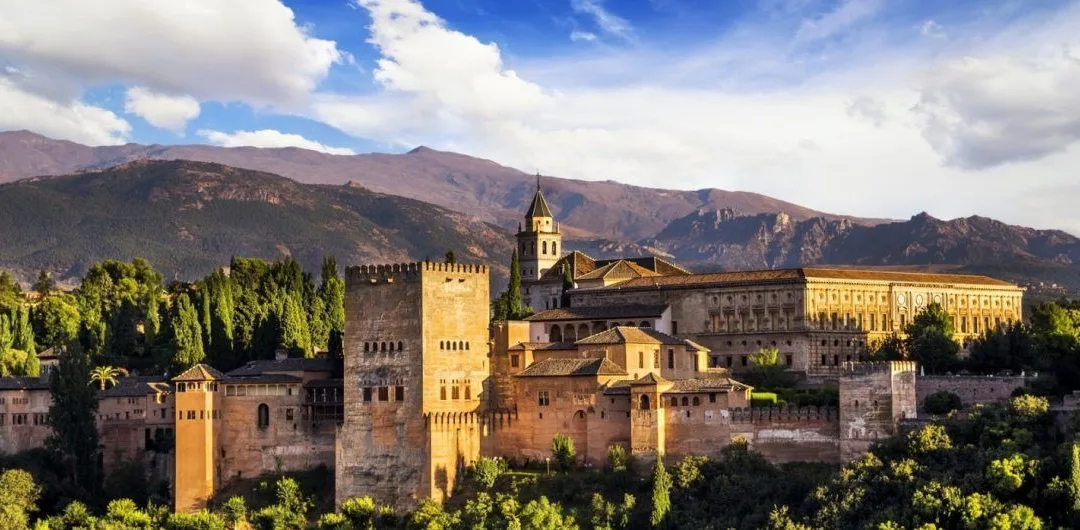
The Alhambra was so-called because of its reddish walls, in Arabic "qa’lat al-Hamra" means Red Castle. It is located on top of the hill al-Sabika, on the left bank of the river Darro, to the west of the city of Granada and in front of the neighborhoods of the Albaicin and of the Alcazaba.
The Alhambra is located on a strategic point, with a view over the whole city and the meadow La Vega, and this fact leads to believe that other buildings were already on that site before the Muslims arrived. The complex is surrounded by ramparts and has an irregular shape. It limits with the valley of the river Darro on its northern side, with the valley of al-Sabika on its southern side and with the street Cuesta del Rey Chico on the eastern side. The Cuesta del Rey Chico is also the border between the neighbourhood of the Albaicin and the gardens of the Generalife, located on top of the Hill of the Sun (Cerro del Sol).
The first historical documents are known about the Alhambra date from the 9th century and they refer to Sawwar ben Hamdun who, in the year 889, had to seek refuge in the Alcazaba, a fortress, and had to repair it due to the civil rights that were destroying the Caliphate of Cordoba, to which Granada then belonged. This site subsequently started to be extended and populated, although not yet as much as it would be later on because the Ziri kings established their residence on the hill of the Albaicin.

The castle of the Alhambra was added to the city’s area within the ramparts in the 9th century, which implied that the castle became a military fortress with a view over the whole city. In spite of this, it was not until the arrival of the first king of the Nasrid dynasty, Mohammed ben Al-Hamar (Mohammed I, 1238-1273), in the 13th century, that the royal residence was established in the Alhambra. This event marked the beginning of the Alhambra’s most glorious period.
First of all, the old part of the Alcazaba was reinforced and the Watch Tower (Torre de la Vela) and the Keep (Torre del Homenaje) were built. Water was canalized from the river Darro, warehouses and deposits were built and the palace and the ramparts were started. These two elements were carried on by Mohammed II (1273-1302) and Mohammed III (1302-1309), who apparently also built public baths and the Mosque (Mezquita), on the site of which the current Church of Saint Mary was later built.

Yusuf I (1333-1353) and Mohammed V (1353-1391) are responsible for most of the constructions of the Alhambra that we can still admire today. From the improvements of the Alcazaba and the palaces, to the Patio of the Lions (Patio de los Leones) and its annexed rooms, including the extension of the area within the ramparts, the Justice Gate (Puerta de la Justicia), the extension and decoration of the towers, the building of the Baths (Baños), the Comares Room (Cuarto de Comares) and the Hall of the Boat (Sala de la Barca). Hardly anything remains from what the later Nasrid Kings did.
From the time of the Catholic Monarchs until today we must underline that Charles V ordered the demolition of a part of the complex in order to build the palace which bears his name.
We must also remember the construction of the Emperor’s Chambers (Habitaciones del Emperador) and the Queen’s Dressing Room (Peinador de la Reina) and that from the 18th century the Alhambra was abandoned. During the French domination part of the fortress was blown up and it was not until the 19th century that the process of repairing, restoring and preserving the complex started and is still maintained nowadays.

Spain has dozens of them spread all over the country but only six are Royal. They are located in Seville, Madrid, Córdoba, Segovia, Toledo and Guadalajara (the three last ones are towns close to Madrid). I’ve visited all six and the most impressive and beautiful is the Sevillian one.
Seville Alcazar was initially built by the Arabs in the early 8th century and has been expanded by further Spanish Kings, converting it into their royal residence. One of the coolest things about the Alcazar is the mixture of architectural styles that can be observed. An Alcazar is a palace-fortress built by the Arabs during the time of the Moorish invasion.
The word is a synonym of "castle" and it comes from the Arabic word al qasr. Although the Alcázar has some astonishing courtyards and artistic details, The highlight is the Mudejar Palace. Don’t miss the gardens where the fountains and other water features, the smell of orange trees (azahar) and the light on a sunny day will be wonderful.
The Mudejar Palace, also known as the Palacio del Rey Don Pedro, was built by Pedro I of Castile in 1364. He employed Jewish and Moorish workers and craftsmen from Seville, Granada and Toledo.
The palace was completed adding elements of other buildings, mainly from Cordoba, Granada -very important cities at the time- and even rests of the Roman ruins of Italica, nearby. It is located inside the Alcázar walls and you can access it through the main entrance located at the Courtyard of the Hunt (Patio de la Montería).
The Palace is basically divided into two. The first part is dedicated to what we can call the official life with the Maidens Courtyard (Patio de las Doncellas) as the center, whereas the other is for the private occasions with the Dolls Courtyard (Patio de las Muñecas) being the main space.
From the main hall, go straight and you’ll end up at the Maidens Courtyard. The hall has also a narrow corridor from where you can get to the Dolls Courtyard, allowing you to walk around the official rooms.
The Maidens Courtyard is the main patio of the palace and gives access to the most important rooms. It’s named after the Moorish annual tradition of demanding a hundred virgins from their Christian kingdoms.
It has a reflective pool with sunken gardens on either side. The lower arches are a classic of the Mudejar style, with very thin columns and an impressive decoration at the top. There are a bunch of small but delightful details, like the symmetry of each arch and the carvings, similar to an elaborated lace.
In 2002, an archeological research unveiled the pool and the patio was under restoration. Actually, the pool and paving were covered at the end of the 16th century (around 1580) because a counselor of Felipe II thought it was “dirty and ugly”.
The upper floor was added in the later 16th century (between 1540 and 1572) and it is easy to recognize the Renaissance style in it. Despite the differences, both elements end up creating a patio with an amazing harmony.
Take a look at the rich decorations of the wooden doors. And before you really enter the patio, stop below the main arch and look up, the carvings and colors are impressive.
On the right hand side of the patio you’ll find the Bedroom of the Moorish Kings. This used to be the summer bedroom because it was fresh and protected from the heat, as Seville can be very hot. The wooden ceiling is a combination of the geometric elements of the Arabic style and some Renaissance decorations.
Also known as the Throne Room, this is the most important room of the palace and it was used for public events and affairs of state. You’ll enter the room walking through a gorgeous arch that still has the original wooden doors built in 1366.The room is extravagantly decorated with beautiful tiled walls (typically Moorish) and a magnificent cedarwood cupola with elaborated carvings and geometrical patterns (stars, circles, tears and other shapes). Actually, the cupola was an inspiration for the staircase ceiling of the Casa de Pilatos. Don’t miss the plaster details of the walls, just above the tiles, and he Peacocks Arch separating the Ambassador’s Hall from the Peacocks Hall.
The Dolls Courtyard is much smaller that the Maidens one. The origin of its name comes from the small faces that decorate some of the arches. Actually, you should look for them as it is said to bring good fortune when found. The columns date back to the Caliph times and come from the destroyed palace of Medina Azahara in Cordoba. The upper floor was added in the 19th century.
The page you requested could not be found. Try refining your search, or use the navigation above to locate the post.

The two main international airports are in Lisbon and Porto; the third is in Faro, but consider entering the country through one of the first two and then catching a connecting flight to Faro. There are also trains and buses that head into the Algarve, but some travelers may prefer flying to get there more quickly (flights from Lisbon take about 45 minutes).
In the Algarve, the coast is the shining star and the region is lined with stunning beaches that look too beautiful to be true. Lagos, Albufeira, Portimão, and Tavira are a few of the more popular city stops highlighted by spectacular beaches, seaside caves, and multi-toned cliffs. We suggest stopping at Camilo Beach, Benagil Cave, the Beach of Three Brothers (Praia dos Três Irmãos), and the lighthouse at Piedade Point. Renting a car is the easiest way to jump from one site to the next.


Some visitors like to get in the water as soon as possible, while others prefer enjoying the coast from afar. Trekking, surfing, sunbathing, and kayaking are just a few of the popular activities on offer.
Another gem in the Algarve is the Ria Formosa lagoon system and its islands, a natural treasure that is listed as one of Portugal’s Seven Natural Wonders and located around Faro’s coast. In the Ria Formosa, birdwatching is a unique treat and there are more than 200 bird species here.
Do you consider yourself a seafood connoisseur? Portugal’s charming fishing villages are filled with excellent restaurants offering freshly caught fish and seafood on their daily menus. The best seafood dish to try in the Algarve is the mixed seafood cataplana: steam-cooked fish and shellfish in a traditional copper pot.

Drive or hop on a train and head north to Lisbon, Portugal’s lively and artistic capital city. After arriving and sampling your first pastel da nata, spend a few hours meandering through and exploring the winding streets of Alfama, the oldest neighborhood in the city and the most popular spot to hear fado, Portugal’s magically melancholic traditional music.

For snapping photos and embracing stunning panoramic views, try visiting the São Jorge Castle and a few local neighborhood miradouros (viewpoints).

Where should you eat amidst all that sightseeing? Finding a nice spot is sometimes as easy as closing your eyes and pointing (the restaurants are everywhere), but these restaurants stand out from the rest. If you’re in the mood for something quick and budget-friendly, a popular suggestion is finding a churrasqueira and ordering frango assado, Portugal’s take on spicy grilled chicken.; or head to Cais do Sodré and choose one of the tascas or riverside cafés for a quick meal with a view.
An afternoon in Lisbon is an excellent time to head to Belém, where it’s possible to tour magnificent buildings with significant heritage importance. The Jeronimos Monastery, the Belém Tower, and the Discoveries Monument are three key landmarks not to miss.

No doubt, Sintra deserves a full day dedicated to it, so visit the day after arriving in Lisbon. The easiest way to get there is by train from Lisbon’s Rossio Station (don’t forget to snap a few photos of the station’s ornate entrance). The train ride lasts about an hour and costs €2.25 each way.
It’s best to visit Sintra with a plan and know which castles and palaces you want to see most. The Pena Palace, Quinta da Regaleira, and Castle of the Moors may arguably be the three most popular landmarks for first-time visitors.

Make your way to Porto, but fit in enough time for one stop first. Two great locations to choose from are the historic riverside city of Coimbra, located in central Portugal and home to the country’s oldest university, and Portugal’s Art Nouveau capital, Aveiro, a romantic city nicknamed “The Venice of Portugal.”


Finally, wrap up your trip in traditional Porto, home of delicious croissants (just ask the locals about their love of Porto’s croissants), the francesinha calorie bomb, and amazing landmarks that give the city its own special personality.

By the end of a busy week-long voyage through this amazing country, it’s probably time for a little rest and relaxation, but first, make sure to visit the Ribeira District for some more sightseeing. History buffs may like seeing the house where Henry the Navigator was born, called the Casa do Infante, and you can also check out some of the incredible displays of azulejo mosaics that Porto is home to.
A few last-minute activities to fit in before saying adeus to Portugal include going for a walk along a nearby beach, taking in a spectacular view from a rooftop terrace and shopping in one of the local markets.
Original Post written by NINA SANTOS for The Culture Trip