The 10 Best Halal Restaurant in Paris

The 10 Best Halal Restaurant in Paris

Looking for a good halal restaurant in Frankfurt?

Planning a trip to Paris? Wonder where to find Halal restaurants in Paris in between all that sightseeing? Cuisine from India to Japan, Kebabs, mezze, sushi, tandoori chicken and couscous.

Here a selection of the 10 best Halal Restaurants in Frankfurt.

Falafel 1818
Order Online
Pistazie
#3 of 21 Results
Order Online
Doy Doy Kebab Restaurant
N.º 10 de 21 resultados
Halal Restaurants in Spain

Halal Restaurants in Spain

Halal places in Spain

A list of restaurants with halal options in Spain

Andalucia  Includes Seville, Granada, Córdoba, Málaga
Aragon  Includes Zaragoza, Huesca
Asturias  Includes Oveido
Balearic Islands  Includes Palma de Mallorca, Minorca, Ibiza
Canary Islands  Includes Santa Cruz de Tenerife, Las Palmas
Cantabria  Includes Santander
Castile-La Mancha  Includes Toledo, Guadalajara
Castille and León  Includes León, Valladolid, Ávila, Zamora
Catalonia  Includes Barcelona, Girona
Ceuta and Melilla
Euskadi  Includes Bilbao, San Sebastián, Vitoria
Extremadura  Includes Mérida
Foral Community of Navarre  Includes Pamplona
Galicia
La Rioja  Includes Logroño
Madrid Metro  The Madrid metropolitan area
Murcia
Valencian Community  Includes Valencia, Alicante
Islamic Heritage in Spain: The Essential Guide to Al-Andalus

Islamic Heritage in Spain: The Essential Guide to Al-Andalus

Few places in Europe preserve an Islamic heritage as rich, diverse and influential as Spain. For centuries, large areas of the Iberian Peninsula formed part of Al-Andalus, a succession of Muslim-ruled territories whose cities became major centres of architecture, science, philosophy, craftsmanship, agriculture and trade.

Today, this history can still be explored through some of Spain’s most extraordinary monuments: the Alhambra and Generalife in Granada, the Great Mosque of Córdoba, the palatine city of Madinat al-Zahra, the Giralda and Alcázar of Seville, the fortifications of Málaga, the surviving mosques of Toledo and the Aljafería Palace in Zaragoza.

Yet the Islamic heritage of Spain goes far beyond individual landmarks. It survives in medieval street plans, irrigation systems, gardens, decorative arts, craftsmanship, place names and architectural traditions that continued long after Muslim political rule had ended. For travellers interested in the history and culture of Muslim Spain, these places offer one of the most rewarding ways to understand the country.

What Was Al-Andalus?

The history of Al-Andalus began in 711, when Muslim forces crossed the Strait of Gibraltar and rapidly established control over much of the Iberian Peninsula. Its boundaries changed repeatedly over the following centuries, so Al-Andalus should not be understood simply as modern-day Andalusia: at different times it extended across large areas of present-day Spain and Portugal.

One of its most influential periods began with the establishment of the Umayyad Emirate of Córdoba in 756. In 929, Abd al-Rahman III proclaimed the Caliphate of Córdoba, making the city the political centre of a sophisticated state with influence throughout the western Mediterranean.

After the collapse of the Caliphate in 1031, Al-Andalus fragmented into independent Taifa kingdoms. Later centuries saw the arrival of the Almoravid and Almohad dynasties from North Africa and the gradual expansion of the Christian kingdoms from the north.

By the 13th century, the Nasrid Kingdom of Granada had become the last Muslim-ruled territory in the Iberian Peninsula. It survived for more than two and a half centuries until Granada passed to the Catholic Monarchs in 1492.

This long history explains why Spain contains Islamic monuments belonging to very different periods and artistic traditions: Umayyad, Caliphal, Taifa, Almoravid, Almohad and Nasrid. It also explains why later Christian buildings often preserve Islamic structures or were created by Muslim and Mudéjar craftsmen.

Granada: The Last Kingdom of Al-Andalus

No city provides a more complete introduction to the final centuries of Al-Andalus than Granada. The city became the capital of the Nasrid Kingdom in the 13th century and remained the centre of the last Muslim state in Iberia until 1492.

Its Islamic heritage is not limited to the Alhambra. Across the hills overlooking the Darro River, visitors can still explore a medieval urban landscape of palaces, walls, gates, cisterns, baths and narrow streets.

The Alhambra and Nasrid Palaces

Alhambra Granada Islamic heritage in Spain

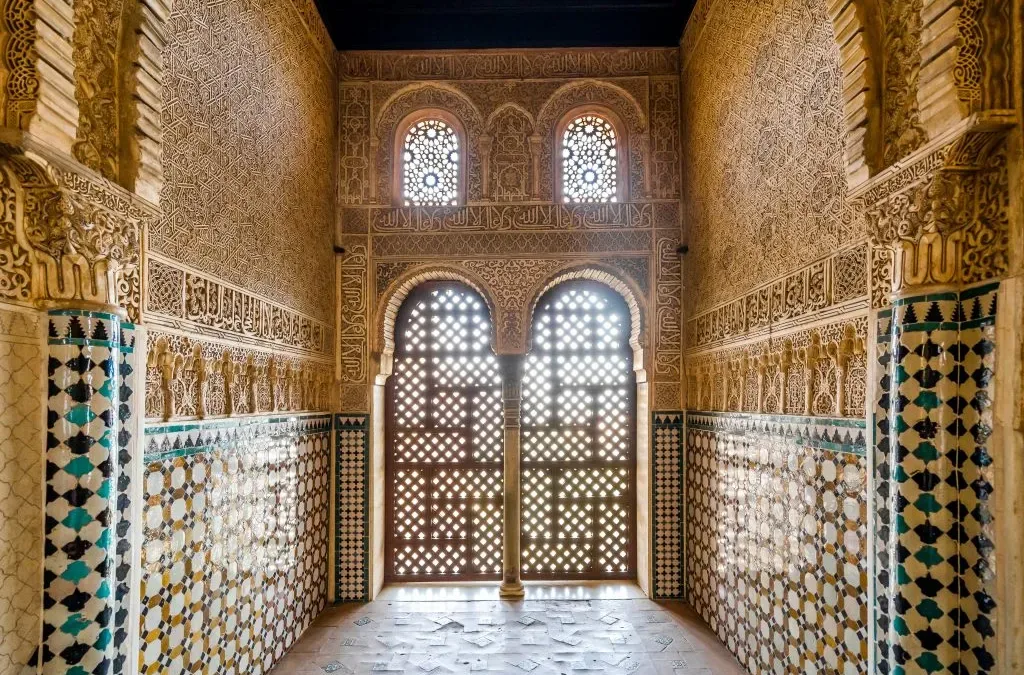
The Alhambra is the masterpiece of Nasrid architecture and one of the most extraordinary surviving palace cities of the medieval Islamic world. Built and transformed over several centuries, the complex served simultaneously as royal residence, administrative centre, fortress and city.

Its greatest period of artistic development took place during the 14th century under sultans such as Yusuf I and Muhammad V. Inside the Nasrid Palaces, architecture, water, poetry, geometry and light form a remarkably sophisticated decorative language.

The Court of the Myrtles, Hall of the Ambassadors, Court of the Lions, muqarnas vaults, carved plasterwork, glazed tiles and Arabic inscriptions reveal the refinement reached by Nasrid art. But the Alhambra should not be understood simply as a collection of beautiful palaces: it was an entire palatine city with defensive towers, royal residences, workshops, streets, baths, gardens, administrative buildings and residential areas.

Explore our Alhambra Private Tour with an official guide.

The Generalife

Beside the Alhambra lies the Generalife, the country estate used by the Nasrid rulers as a place of retreat. Its architecture is deliberately more intimate than that of the royal palaces. Courtyards, orchards, terraces, water channels and gardens demonstrate how landscape and hydraulic engineering formed an essential part of Andalusi architecture.

Water was not merely decorative. It irrigated orchards and gardens while simultaneously creating sound, movement, reflections and cooler spaces. The sophisticated relationship between architecture, agriculture and water is one of the most distinctive features of Granada’s Andalusi heritage.

The Albaicín

Across the Darro Valley from the Alhambra stands the Albaicín, one of the best places in Spain to understand the urban character of a medieval Muslim city. Its irregular network of narrow streets, small squares, hillside houses, walls and ancient water cisterns preserves much of the morphology inherited from Islamic Granada.

The quarter predates much of the Alhambra and played an especially important role during the Zirid and Nasrid periods. Walking through the Albaicín therefore provides a very different experience from visiting the royal architecture of the Alhambra: here the history of Al-Andalus can be read through the structure of the city itself.

Discover the Albaicín and Sacromonte on a private guided tour.

Lesser-Known Andalusi Monuments in Granada

Travellers who want to explore beyond the Alhambra should also look for Granada’s smaller surviving monuments. El Bañuelo is one of the best-preserved medieval Islamic public baths in the Iberian Peninsula. The Corral del Carbón, originally a Nasrid funduq or merchants’ inn, recalls Granada’s importance as a commercial city. Dar al-Horra Palace, hidden within the Albaicín, preserves an intimate example of Nasrid domestic and palatial architecture.

These monuments reveal aspects of everyday urban life that the monumental Alhambra alone cannot explain.

Córdoba: Capital of the Umayyads in Al-Andalus

If Granada represents the final flourishing of Muslim Spain, Córdoba takes visitors back to the height of Umayyad power. Under the Umayyad emirs and caliphs, Córdoba became one of the great cities of the medieval Mediterranean world.

Two sites are indispensable for understanding this period: the Great Mosque of Córdoba and Madinat al-Zahra.

The Great Mosque of Córdoba

Construction of the Great Mosque began under Abd al-Rahman I in the 8th century and continued through several major expansions under later Umayyad rulers. Its famous prayer hall creates an almost endless perspective of columns and red-and-white double arches.

Later Caliphal additions produced some of the building’s most sophisticated spaces, particularly the richly decorated mihrab and maqsura. After Córdoba came under Christian rule in 1236, the former mosque became a cathedral. Further transformations followed, culminating in the construction of the Renaissance cathedral nave within the former prayer hall.

The result is an extraordinary building in which different historical periods coexist visibly. For anyone interested in Islamic architecture in Spain, the Mosque-Cathedral is essential.

See our Córdoba Islamic Heritage Private Tour.

Madinat al-Zahra

Approximately eight kilometres outside Córdoba lie the remains of Madinat al-Zahra, the enormous palace-city founded by Caliph Abd al-Rahman III during the 10th century.

Unlike a single palace, Madinat al-Zahra was conceived as an entire centre of government. Palaces, reception halls, administrative buildings, gardens, residences and infrastructure were distributed across terraces overlooking the Guadalquivir Valley.

Its political life was brief. The city was destroyed during the upheavals that accompanied the collapse of the Caliphate in the early 11th century. Its archaeological remains nevertheless provide an exceptional opportunity to understand the organisation, ceremonial architecture and power of Umayyad Córdoba.

Seville: The Legacy of the Almohads

Seville became particularly important during the Almohad period in the 12th and early 13th centuries. Although much of the medieval Islamic city disappeared or was transformed after the Christian conquest of 1248, several exceptional structures survive.

The Giralda

The Giralda, now the bell tower of Seville Cathedral, was originally constructed as the minaret of the Almohad congregational mosque. Its brick decoration and monumental proportions make it one of the greatest surviving examples of Almohad architecture.

After the mosque was replaced by the Gothic cathedral, the former minaret was retained and eventually crowned with a Renaissance bell tower. This combination of Islamic and later Christian architecture has become one of the most recognisable landmarks in Spain.

The Real Alcázar of Seville

Real Alcazar Seville Islamic and Mudejar heritage

The Real Alcázar requires a more nuanced explanation than it often receives. Its origins as a royal and governmental complex reach back to the Islamic period, and an important palace enclosure was established here in the 10th century. However, much of what visitors admire today was transformed or built after the Christian conquest.

The spectacular Palace of Pedro I, for example, was constructed in the 14th century for a Christian king using craftsmen and artistic traditions deeply influenced by Andalusi architecture. The Alcázar therefore provides an exceptional introduction not only to Islamic Spain but also to Mudéjar art — the continuation and adaptation of Andalusi artistic techniques under Christian rule.

Explore Seville’s Al-Andalus heritage with a private official guide.

Torre del Oro

Torre del Oro Seville Almohad Islamic heritage

Standing beside the Guadalquivir, the Torre del Oro formed part of Seville’s Almohad defensive system. Built in the early 13th century, the tower helped control access to the city from the river.

Its position reminds visitors that medieval Seville was closely connected to the Guadalquivir and to trade routes linking the Iberian Peninsula with North Africa and the wider Mediterranean.

Málaga: Alcazaba and Gibralfaro

Alcazaba and Gibralfaro Malaga Islamic heritage Spain

Málaga was one of the important Mediterranean ports of Al-Andalus. The city’s Islamic past remains particularly visible on the hillside above the historic centre.

The Alcazaba of Málaga combines military and palatial architecture within a complex defensive enclosure. Gardens, courtyards, gates and residential spaces reveal the transformation of the fortress during different periods of Muslim rule.

Higher on the hill, Gibralfaro Castle formed part of the city’s later defensive system and provided strategic protection for the port and Alcazaba below. Together they create one of southern Spain’s most impressive Islamic fortified landscapes.

Discover Málaga’s Al-Andalus heritage on a private tour.

Toledo: Islamic Heritage Beyond Andalusia

Some of Spain’s most interesting Islamic monuments lie far beyond modern Andalusia. Toledo, approximately one hour from Madrid, was an important city of Al-Andalus before its conquest by Alfonso VI in 1085.

Although much of the medieval Islamic city was subsequently transformed, the street plan, walls, gates and surviving religious buildings still reveal its Andalusi past.

Mosque of Cristo de la Luz

The most important surviving Islamic monument in Toledo is the former Bab al-Mardum Mosque, today known as the Mosque of Cristo de la Luz. An Arabic inscription dates its construction to 999.

The small square prayer hall is divided into nine bays by horseshoe arches, each covered by a different vault. After the Christian conquest, an apse was added to transform the building into a church. The result is particularly valuable because it allows visitors to see both a surviving Caliphal-period mosque and the emergence of the later Mudéjar tradition.

Toledo also preserves other traces of its Muslim period, including the former Mosque of Tornerías, stretches of walls and gates, archaeological remains and buildings that continued to incorporate Andalusi forms long after Christian rule had begun.

Explore Toledo’s Al-Andalus heritage on a private tour.

The Aljafería Palace in Zaragoza

The heritage of Al-Andalus extends even farther north. In Zaragoza, the Aljafería Palace preserves one of the finest surviving examples of palace architecture from the Taifa period.

Constructed during the 11th century for the rulers of the Taifa of Zaragoza, it reflects the sophisticated court culture that developed after the fragmentation of the Caliphate of Córdoba. Its courtyards, interlacing arches and richly decorated interiors demonstrate how Islamic artistic traditions flourished in independent regional courts.

Later Christian rulers transformed and expanded the palace, creating another remarkable example of the layered history characteristic of Spanish architecture.

Gormaz: A Caliphal Fortress in Castile

The fortress of Gormaz, in the province of Soria, is another reminder that the frontier of Al-Andalus once extended much farther north than modern Andalusia.

Its vast fortified enclosure dominates the surrounding landscape from a long ridge above the Duero Valley. Developed as an important defensive position during the Caliphal period, Gormaz formed part of the contested frontier between Muslim and Christian territories.

For travellers willing to leave the classic Andalusian itinerary, it offers a very different perspective on Muslim Spain: not palaces and gardens, but frontier warfare, territorial control and monumental military architecture.

Islamic Architecture, Andalusi Architecture and Mudéjar: What Is the Difference?

These terms are often used interchangeably, but they describe different historical realities.

Andalusi architecture refers broadly to architecture produced within Al-Andalus under Muslim rule. The Great Mosque of Córdoba, Madinat al-Zahra, the Almohad Giralda and the Nasrid Alhambra belong to different periods but all form part of this architectural tradition.

Mudéjar architecture, by contrast, developed predominantly under Christian rule. Muslim craftsmen, techniques and decorative traditions continued to be employed, producing buildings that combined Christian functions and patrons with architectural forms inherited from Al-Andalus.

The Palace of Pedro I in Seville’s Real Alcázar is one of the most celebrated examples. Understanding this distinction makes exploring Spain’s heritage considerably more rewarding.

More Than Monuments: The Living Legacy of Al-Andalus

The legacy of Al-Andalus is not confined to palaces, mosques and fortresses. It can also be found in Spanish vocabulary derived from Arabic, traditional irrigation systems, agricultural practices, ceramics, leatherwork, geometric decoration, courtyard architecture and aspects of music and cuisine.

Historic cities such as Granada, Córdoba, Seville and Toledo also preserve urban landscapes shaped by medieval Islamic concepts of neighbourhood, privacy, water management and commerce.

This is why exploring the Islamic heritage of Spain is best approached as a journey through a civilisation rather than simply a checklist of monuments.

Where Is the Best Place to Discover Islamic Heritage in Spain?

For a first journey, Andalusia offers the greatest concentration of major sites. Granada and Córdoba are indispensable.

Granada provides the most complete surviving Nasrid landscape through the Alhambra, Generalife and Albaicín, while Córdoba represents the extraordinary achievements of the Umayyad period through its Mosque-Cathedral and Madinat al-Zahra.

Seville adds the monumental legacy of the Almohads and the later development of Mudéjar art. Málaga complements the route with its Mediterranean fortifications and port history.

Travellers beginning or ending their journey in Madrid can add Toledo, while those continuing towards northeastern Spain can explore the Aljafería in Zaragoza.

A Suggested Al-Andalus Heritage Route

A carefully planned journey can connect the major periods of Islamic Spain chronologically as well as geographically.

Begin in Córdoba, where the Great Mosque and Madinat al-Zahra introduce the Umayyad emirate and caliphate. Continue to Seville to discover the Almohad Giralda, Torre del Oro and the historical layers of the Real Alcázar.

Travel onwards to Granada, where the Alhambra, Generalife, Albaicín and smaller Andalusi monuments reveal the final centuries of Muslim rule in Iberia. Málaga can be added before or after Granada, particularly for travellers arriving through the Costa del Sol.

For a broader journey across Spain, combine Andalusia with Toledo and Madrid, adding the surviving Islamic monuments of central Spain.

Rather than simply moving between famous landmarks, the most rewarding itineraries connect the monuments to the political dynasties, people and ideas that created them.

Discover Al-Andalus with Specialist Local Guides

Understanding these monuments changes the experience of visiting them. An arch, inscription, garden or city wall becomes far more significant when placed within the history of the Umayyads, Almohads, Nasrids and the societies that succeeded them.

Safar Salama Tours specialises in private journeys through the heritage of Al-Andalus, working with official local guides and carefully designed itineraries in Granada, Córdoba, Seville, Málaga, Toledo and other historic destinations in Spain.

Our approach is designed for travellers who want more than a conventional sightseeing tour: a deeper understanding of the history, architecture and cultural legacy behind the places they visit.

Explore our Andalucia Al-Andalus Heritage Private Tour or contact Safar Salama Tours to create a private itinerary adapted to your dates and interests.

Frequently Asked Questions About Islamic Heritage in Spain

What are the most important Islamic monuments in Spain?

The Alhambra and Generalife in Granada, the Great Mosque of Córdoba, Madinat al-Zahra, the Giralda and Real Alcázar of Seville are among the most important. Other significant sites include Málaga’s Alcazaba, Toledo’s Mosque of Cristo de la Luz and Zaragoza’s Aljafería Palace.

What was Al-Andalus?

Al-Andalus was the name used for Muslim-ruled territories of the Iberian Peninsula between the 8th and 15th centuries. Its geographical boundaries changed considerably throughout its history and were not limited to present-day Andalusia.

Which Spanish city has the most Islamic heritage?

Granada and Córdoba are the two essential cities. Córdoba represents the great Umayyad period, while Granada preserves the most complete heritage of the Nasrid Kingdom and the final centuries of Al-Andalus.

Is the Alhambra an Islamic palace?

Yes. The Alhambra developed principally as a Nasrid palatine city between the 13th and 15th centuries, although the site also contains earlier structures and important additions from the Christian period.

Is the Alcázar of Seville an Islamic palace?

Its origins and some elements date from Islamic Seville, but the complex evolved over many centuries. Much of the celebrated decoration seen today, particularly the Palace of Pedro I, belongs to the Mudéjar period under Christian rule and was created using artistic traditions derived from Al-Andalus.

Can you find Islamic heritage outside Andalusia?

Yes. Important examples include the Mosque of Cristo de la Luz in Toledo, the Aljafería Palace in Zaragoza and the fortress of Gormaz in Soria. Al-Andalus extended across much larger areas of the Iberian Peninsula at different moments in its history.

How many days are needed for an Al-Andalus heritage trip?

A journey through Granada, Córdoba and Seville deserves at least five to seven days. Adding Málaga, Toledo or Madrid creates a more complete itinerary of approximately seven to ten days.

Costa Brava: A route through its wild coast of Catalonia

Costa Brava: A route through its wild coast of Catalonia

Costa Brava: A route through its wild coast of Catalonia

Driving throughout this route, you will see Impressive cliffs, beaches and coves of golden sand, and typical Mediterranean landscapes, essential features of the Costa Brava, Girona’s wild coast.

These are some of the most beautiful places in Catalonia, where travellers can explore old fishing villages by the sea, medieval inland towns, and the fascinating legacy of the artist Salvador Dalí.

The best way to visit is by driving around the area at your own pace and stopping anywhere that attracts your attention. Travelling from north to south, we suggest 10 of the nicest towns and villages of the Costa Brava, although the list could be much longer.

Cadaques

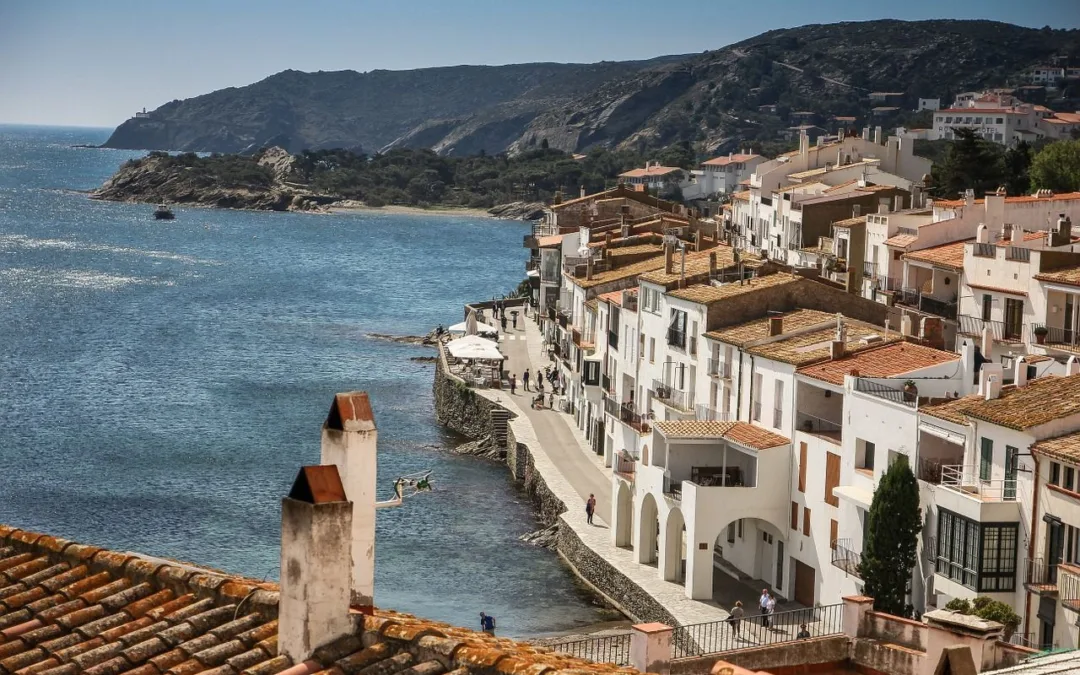
Cadaques, Villages of Costa Brava by Joaquin Aranoa | pixabay

Walking through the narrow streets of this village of whitewashed houses to any of its pretty coves is simply a delight. In the 20th century, this charming and picturesque place beguiled bohemians and artists like Salvador Dalí, whose Museum House is next door in Portlligat. As well its little beaches, a visit to Cadaqués is an opportunity to discover Cap de Creus Natural Park and enjoy a delicious fish “suquet”.

ROSES

This area boasts kilometres of beaches between two Natural Parks, and it is special for many more reasons. For example, in Roses you can see the oldest dolmen in Catalonia, the Visigothic settlement of Puig Rom, and the walled enclosure of the Citadel.

FIGUERES

Dali Museum Figueres Catalonia

Dali Museum Figueres Catalonia by Julia Casado | Pixabay

Now we go inland to another essential location for fans of Dalí. The artist was born here, and chose the town to create the unique Dalí Theatre-Museum, often called the world’s largest Surrealist object, where he is buried. Highly recommended. Other interesting sights: Sant Ferran castle and the Jewish quarter.


PERALADA

Also inland, this village is another must-see, for two important reasons. First, you can visit the beautiful castle where an International Music Festival is held every summer. And second, you will have the chance to try the exquisite local wines, from the vineyards of the Empordà region.


 Besalú


It’s worth the trip slightly further inland to discover one of Catalonia’s best conserved medieval sites. Any traveller will be enchanted by its churches, the Monastery of Sant Pere, its bath-house, and most of all, its monumental fortified bridge.


PALS

Let’s go back to the coast to enjoy the long beach of Pals. After a swim, be sure to take a walk around the cobbled streets and squares and the little craft shops of the amazing Gothic-period town centre, which feels like something from a fairy tale. It’s like travelling back in time to the Middle Ages.


BEGUR

The village of Begur sits at the foot of an 11th-century castle on a hill. The view from the top is stunning, and the walk down to the beach takes you past traditional fishermen’s cottages to the intense blue of the Mediterranean.


PALAFRUGELL

One of the most magical places on this coast is Calella and its beach at Port Bo. The village preserves the original layout of the streets and its white houses on the shore. And the brightly coloured boats moored in the harbour are all traditional types, like the Catalan dinghy. You’ll want to take plenty of photos. Also, in early July there is a famous song festival, Canto de Habaneras.


PALAMÓS

Trees almost touching the sea, sailboats on the shore... The landscape of Palamós is fascinating. And it is very pleasant to stroll around its streets and enjoy the different views, to visit the Fishing Museum, and of course, try the famous prawns, gambas de Palamós, on the seafront promenade.


TOSSA DE MAR

The bay, Platja Gran beach and the town’s other beaches are worth the visit in themselves. But you can also have the experience of climbing the beautiful medieval walls to the lighthouse, Faro de Tossa, to enjoy the views, or trying local dishes like cimitomba, made with fish and vegetables.

Guide to Mosques, Prayer rooms and Musallahs in Spain

Guide to Mosques, Prayer rooms & Musallahs in Spain

Find a Masjid near you


Barcelona

Mosque Abi Ayoub Elansari Barcelona
Carrer de Massanet, 5 , 326 , Barcelona ,Spain

Mosque Hanza Barcelona
Mosque Hanza
Carrer de Almenara Alta, 12 , 326 , Barcelona ,Spain

Mosque Madni Barcelona
Mosque Madni
Carrer de Paloma, 7, Barcelona ,Spain

Mezquita Tariq Bin Ziyad Barcelona
Mezquita Tariq Bin Ziyad
Carrer de l’Hospital, 91 08001 Barcelona Spain

Mosque Rahma Barcelona
Mosque Rahma
Camí Cadena, 17, 08907 L’Hospitalet de Llobregat, B…

Sufa­ Centre Barcelona
Sufa­ Centre
Carrer de Pere Llobet, 3, Barcelona, Spain

Mezquita de las Tornerías Toledo
Mezquita de las Tornerías Travesía de la JuderÅ

Al Risalat Masjid, Marbella Marbella
Al Risalat Masjid 58 Calle de la Apartada Marbella 29…

Al Iman Masjid, Madrid Villalba
Al Iman Masjid C / Francisco Martin 12 Collado Villal…

Tarek Ibn Ziad Masjid, Madrid Madrid
Tarek Ibn Ziad Masjid C/ Nalderasa Madrid 28001 Madr…

Al Taqwa Mosque Granada
Placenta del Correo Viejo, 4 18010 Granada, Spain

Mezquita de Granada Granada
Pz. San Nicolas, S / N | 18010 – Granada

Fundaciónn Mezquita de Sevilla Seville
Plaza Ponce de León, 9, Sevilla

M-30 Mosque. Madrid
Salvador de Madariaga, 4

Carrer de les Mosques Barcelona
08003 Barcelona Spain

La Gran Mezquita de Valencia Valencia
Calle Palancia, 5 46021 Valencia Spain

Centro Islámico de Torrent Valencia
Calle San Ernesto, 12-16 46900 Torrent, Valencia Spain


Fermín Font Mezquita Valencia
Fermín Font Mezquita
Calle de Sicilia, 9 12540 Villarreal Castellón, Spa…

Carrer Lluis Mezquida Valencia
Carrer Lluis Mezquida
46132 Almà ssera Valencia, Spain

Centro Cultural Islámico de Valencia Valencia
Centro Cultural Islámico …
Calle Arquitecto Rodríguez, 19 46019 Valencia Spain

Mezquita Ishbilia Seville
Mezquita Ishbilia
Edf. Amate Av. Carlos Marx, 1 41006 Sevilla, Spain

Centro Islamico de calpe Benidorm
Centro Islamico de calpe
Calle Delfín, 1 03710 Calpe Alicante, Spain

Mezquita de Málaga Malpica
Mezquita de Málaga
Calle Ingeniero de la Torre Acosta, 3 29007 Málaga …

Mezquita de Fuengirola Malpica
Mezquita de Fuengirola
Av de Santa Amalia, s/n 29640 Fuengirola Málaga, Sp…

Cathedral-Mosque of Córdoba Cordido
Cathedral-Mosque of Córdoba
Calle del Cardenal Herrero, 1 14003 Córdoba Spain

Mezquita Ihsan Palma de Mallorca
Mezquita Ihsan
Carrer del Regal, 99 07008 Palma Illes Balears, Spain

Comunidad Musulmana de Tenerife Playa de las Americas
Comunidad Musulmana de Tener…
Av Juan Carlos I, 30 38650 Cristianos (los) Santa Cruz…

Masjid Assalam Bilbao
Masjid Assalam
Begoñazpi, 1, Bilbao, 48006, SPAIN

Badr Mosque Bilbao
Badr Mosque
C/ Fica, 12-14-16, Bilbao, BIZKAIA 48006, SPAIN

Masjid De Renteria San Sebastián
Masjid De Renteria
Errenteria, Gipuzkoa, Spain

MASJID AL Momin Torremolinos
MASJID AL Momin
C/ Hoyo, Edir el Congreso, local 11, 12, 13, Malaga, T…

MASJID YOUSEF IBN TACHAFIN Ibiza Town
MASJID YOUSEF IBN TACHAFIN
C/ Carres de Baleras, 30, Baleares, Ibiza, SPAIN

Moulvi Idris Mosque Ibiza Town
Moulvi Idris Mosque
Ibiza, Spain

Comunidad Islámica Elche Alicante
Comunidad Islámica Elche
Lope de Vega, 75, bajo

Mezquita de Fuengirola Marbella
Mezquita de Fuengirola
Av de Santa Amalia, s/n 29640 Fuengirola Málaga, Sp…

Centro Islamico de Barcelona Barcelona
Centro Islamico de Barcelona
Carrer de Rafael Capdevila, 1, 08018 Barcelona

Mesquieta Sant Pere de Ribes
Mesquieta
Carrer Salvador Dalí, 57, 08810 Sant Pere de Ri…

Mosque of Cordoba – Cordoba, Spain Córdoba
Mosque of Cordoba – Cordoba,…
Calle del Cardenal Herrero, 1, 14003 Córdoba, S…

King Abdul Aziz Mosque Marbella
King Abdul Aziz Mosque
Urbanizacion Lomas Marbella, 5, 29602 Marbella, Málag…

Comunidad Islamica Jovenes Lloret de Mar Lloret de Mar
Comunidad Islamica Jovenes L…
Carrer Camí de les Cabres, 30, 17310 Lloret de Mar, G…

Fundación Mezquita de Sevilla Spain
Fundación Mezquita de Sevilla
Fundación Mezquita de Sevilla, Plaza Ponce de León, …

Mosque of Cristo de la Luz Toledo
Mosque of Cristo de la Luz
Calle Cristo de la Luz, 22, 45003 Toledo, Spain

Mezquita de Jerez Cádiz
Mezquita de Jerez
Calle Miguel Hue, 1, 11408 Jerez de la Frontera, Cádi…

Basharat Mosque Córdoba
Basharat Mosque
Mezquita Basharat, 14630 Pedro Abad, Córdoba, Spain

Madrid Central Mosque A Airoa
Madrid Central Mosque
Calle Anastasio Herrero, 5, 28020 Madrid, Spain

Andalusia: Explore The Greatest Spain Islamic Heritage

Andalusia: Explore The Greatest Spain Islamic Heritage

Andalusia: Explore The Greatest Spain Islamic Heritage


Spain today is a country with a majority population of Christians. But a lesser known fact is that Muslims conquered and ruled a region of the country called Andalusia or Al-Andalus, at the time, for several centuries. These days were some of the most prosperous times in the history of Al-Andalus, and one of the best examples of minorities -the Christians and Jews- living peacefully in the Andalusian Umayyad dynasty, which lasted from 756 to 1031, and was referred to as “the golden age of tolerance”.


A Brief History of Moorish Spain

Andalusia, known as Al-Andalus was a Muslim territory in today's Spain and Portugal. The era of Muslim rule began when Tariq Ben Ziyad conquered Andalusia in 711 AD in an attempt to free the region from the Visigoths who were wreaking havoc in the area. History states that he arrived with 7000 of his men and claimed victory, after which followed a period of Islamic rule, which lasted from the eighth to the fifteenth century. This time period Is also often referred to as “Moorish Spain”.


What to see

Andalusia is situated in the southern region of the Iberian peninsula and is made up of several cities, such as Seville, Malaga, Jaen, Almeria, Cordoba, Cadiz, Granada, and Huelva. Seville is the capital of Al-Andalus. Andalusia is a region that has it all, from ancient cities to mountainous ranges, picturesque beaches to deserts.There are also several historical attractions and landmarks that one could visit to get an insight into the days of Islamic rule on Muslim-friendly travel to Andalusia. Islamic architecture in Spain is intricate and ornamental, with delicate designs and high arches. The outside walls are usually made of stone, stucco, and plaster.


The Alhambra Palaces in Granada

This beautiful historic palace is set against a backdrop of the Sierra Nevada mountains. Al Hambara is known as “red fort” or “red palace”, because of the color of its surroundings. It was originally built in 889 AD on Roman ruins as a small fortress during the Muslim rule. Afterward, it remained abandoned until its renovations in the mid-13th century.

Today, it is one of Spain's most famous attractions, and definitely a place not to be missed on an Andalusian holiday. Here, you can so many amazing things like the Patio of Lions, the Justice Gate, and more. Depending on the time of visit, you might have to book your spot in advance as it can get pretty busy. Tickets cost 14 euros for adults, and 9 euros for disabled persons. Children under 12 are allowed free admission.Address: Calle Real de la Alhambra, s/n, 18009 Granada, Spain.
Open Hours: Tuesday – Saturday: 9 am – 6 pm, Sunday: 9 am to 3 pm (Mondays closed)
+34 958 02 79 71
https://www.alhambra.org/en/

Alhambra de Granada Private Tour Muslim friendly travel

The Royal Alcazar of Seville

This is an ancient royal palace in Spain that was built by the Muslim kings of Moorish Spain. Even today, this is considered to be one of the most beautiful palaces in Spain and is one of the most outstanding examples of Mudejar architecture in the Iberian peninsula. It is also aUNESCO World Heritage Site. The upper levels of the castle are still occupied by Spain's royal family as the official Seville residence currently.Tickets to visit the Alcazar of Seville cost about 10 euros normally. You do not have to book ahead, although you might experience long queues at times.

Address: Patio de Banderas, s/n, 41004 Sevilla, Spain.
Hours: Monday – Saturday: 9:30AM–5PM
+34 954 50 23 24
www.alcazarsevilla.org/english-version/

Alcazar Seville Andalusia Islamic Heritage Tour


The Giralda Tower in Seville

Originally built as a minaret of the Aljama Mosque during Moorish Spain, today the Giralda serves as the bell tower for the Seville Cathedral. It is one of the most iconic landmarks in all of Spain, but few know the Islamic history it holds. It was gazetted as a UNESCO World Heritage Site in the year 1987. The building remained the tallest in the city for over 800 years. Although it no longer holds the title, you can climb to the top and experience amazing views of the city.

Address: Av. de la Constitución, s/n, 41004 Sevilla, Spain.
http://www.andalucia.com/cities/seville/giralda.html


 Plaza De España in Seville

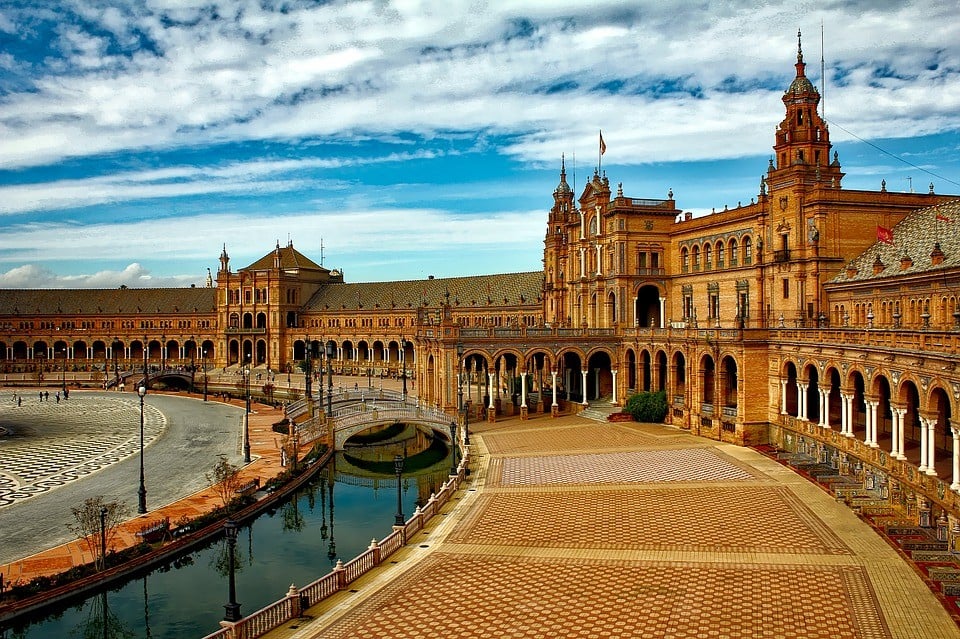
The Plaza De Espana in Seville is one of the best symbols built for the Ibero-American Exposition World Fair in 1929, along with being one of the most beautiful pieces of Neo-Mudejar architecture. This grand building is definitely something you cannot miss on your Andalusian travel itinerary.Not only is the Plaza De Espana an amazing sight to see, there are also plenty of things to see around it, including a beautiful park with ponds and birds. There is also plenty of activity going around at various times of the day, like flamenco dancers!

Address: Av de Isabel la Católica, 41004 Sevilla, Spain


La torre Del oro

Torre Del Oro, translating to “Tower of Gold”, was constructed in the early 13th century by the Almohad Caliphate. The top of the building served as a military watchtower in Seville while the actual tower was used as a prison in the Middle Ages. It is one of the most popular Andalusian attractions for visitors of all kinds, and a great place to witness a bit of history of Moorish Spain.
Address: Paseo de Cristóbal Colón, s/n, 41001 Sevilla, Spain.
Hours: Monday – Sunday: 10:30AM–6:45PM.
Phone: +34 954 22 24 19


Albaicin

Albaicin or Albayzin as it was known during the Muslim rule of Spain is a region of Andalusia that that is a great place to visit. Even today, you can see the narrow winding streets as it existed during the days of the Nasrid Kingdom of Granada. This is often known as “the Arab quarter” or Granada and is one of the best places to witness Moorish architecture. Other attractions you can visit in Albaicin include Carrera Del Darro, one of the oldest streets in the region, Church of San Salvador, a 16th-century mosque that was built over an Albayzin mosque, and numerous 11th-century Arab baths that used to be part of the Mosque of the Walnut Tree. This is also one of the best places to find Halal food in Andalusia.


The old Mosque of Cordoba

The Mosque-Cathedral of Cordoba is also known as the Great Mosque of Cordoba and Mezquita. Although its name contains the word “mosque”, it is also a Catholic Cathedral called the Cathedral of Our Lady of the Assumption. It was one of the biggest mosques in the world, and it's unique design reflecting the harmony between the Muslims, Christians, and Jews.The history of the building goes even beyond Moorish Spain. It was originally a small Visigoth temple that was converted and expanded into a mosque by Abd al-Rahman in 784. But when the rule of Cordoba returned to the Christians, it was converted back to a Roman Catholic Church. Still, it is known as one of the most accomplished achievements of Moorish Spain and its architecture is something to see on your Andalusian holiday.

Address: Calle Cardenal Herrero, 1, 14003 Córdoba, Spain


The Alcazaba fortress of Malaga

The Alcazaba is a beautiful Moorish fortress in Malaga that was built in the 11th century by the Hammudid dynasty. It is known to be the best-preserved Alcazaba in Spain today, and one of the two Moorish fortresses in the city.This fortress whose name translates from Arabic to “citadel” is located at the base of the Gibralfaro hill. The view from the top overlooks the busy port city and has a gorgeous garden to explore as well. There is also a small archaeological museum located at the former servants' quarters where you can see exhibits of Moorish pottery and ceramics.
Address: Calle Alcazabilla, 2, 29012 Málaga, Spain.
Phone: +34 630 93 29 87


Toledo's Old City

The city of Toledo is built atop a rugged hill atop the plains of Castilla-La Mancha in central Spain. This city has a long and winding history, starting from the pre-Islamic era of the Romans, to the Visigoths, the Muslims, and then finally, the Christians. As such, the city holds pieces of each of these times in history. There are a number of ancient buildings to visit where you can witness the remnants of Moorish Spain, like the Bisagra Gate and the Sol Gate.


Archeological site of Madinat Al-Zahra

Situated little ways outside Cordoba, this was a Moorish city built by Abd ar-Rahman III, the first Umayyad Caliphate of Cordoba. It took him 25 years to build the city, and it was magnificent in its day. He chose this place to build his palace because of its beautiful landscape, as it lay facing the valley of Guadalquivir river.

Today, most of the city that remains are the ruins of the once majestic city-palace, but there are several fragments of the buildings remaining. You can visit the palaces, the offices of former government heads, the sprawling gardens and the Abd ar-Rahman III hall, one of the most beautiful and ornamental places in the entire city. It is one of the most important Andalusian attractions to see on your Muslim-friendly holiday to get an insight into Moorish Spain. If you are an EU resident, entrance is free. Otherwise, a ticket cost 1.5o euros. There is shuttle service at the bottom of the hill to take you to the site entrance

Address: Ctra. Palma del Río, km 5.5, 14005 Córdoba, Spain.
Hours: Sunday: 9AM–3PM, Tuesday - Saturday: 9AM–6PM (Mondays closed)
Phone: +34 957 10 36 37
Website:http://www.medinaazahara.org/en/

Medina Al Zahra archeological site Cordoba Travel