Seville, Spain, is a city with a rich Islamic history, as it was once a significant center of Al-Andalus, the Islamic rule in the Iberian Peninsula. While much of the Islamic architecture has been altered or repurposed over the centuries, there are still several landmarks and sites of historical and cultural significance for Muslim travelers to explore:
Alcázar of Seville (Real Alcázar de Sevilla): The Alcázar is a stunning palace complex that showcases a blend of Islamic, Mudejar, Gothic, Renaissance, and Baroque architecture. The Patio de las Doncellas and the intricate plasterwork in various rooms are particularly noteworthy.
Giralda Tower (La Giralda): Originally built as a minaret for the Great Mosque of Seville, the Giralda is now the bell tower of Seville Cathedral. You can climb to the top for panoramic views of the city.
Archaeological Ensemble of Itálica (Conjunto Arqueológico de Itálica): Located just outside Seville, Itálica was a Roman city with significant Moorish influence. Explore the Roman ruins and see the remains of a Roman amphitheater.
Santa Paula Mosque (Mezquita de Santa Paula): This mosque serves the Muslim community of Seville and is open to visitors. It offers a peaceful place for prayer and reflection.
Plaza de España: While not directly associated with Islamic history, this iconic square features a mixture of architectural styles, including some Moorish influences in its azulejo (ceramic tile) designs.
Barrio Santa Cruz: This historic Jewish and Moorish quarter features winding streets, charming courtyards, and remnants of Seville’s Islamic past.
Triana Neighborhood: Cross the Guadalquivir River to visit Triana, where you’ll find the Castillo de San Jorge, which has Islamic origins and was later transformed into a Christian fortress.
Casa de Pilatos: This palace combines Mudejar, Gothic, Renaissance, and Roman elements. While not a mosque, it showcases the architectural fusion characteristic of Andalusia during Islamic rule.
Casa de la Memoria de Al-Andalus: This cultural center offers live performances of traditional Andalusian music and dance, providing insights into the region’s Islamic heritage.
While Seville has transformed over the centuries, these landmarks and areas allow Muslim travelers to connect with the city’s Islamic history and experience its unique architectural and cultural legacy. Please note that some of these sites may have restricted access or specific visiting hours, so it’s advisable to check in advance.
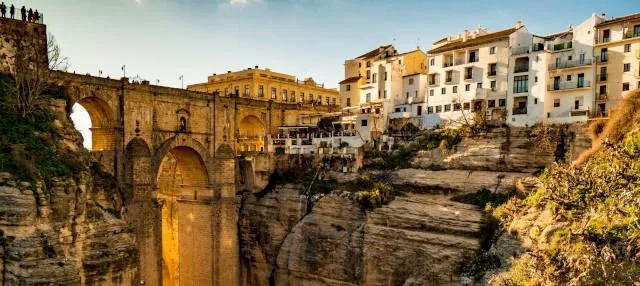
One of southern Spain’s most famous attractions, Ronda’s epic Puente Nuevo or New Bridge, spans the 328-feet-deep El Tajo gorge, linking El Mercadillo (The Little Market), the newer part of town, with the old Moorish quarter. Completed in 1793, it took some forty years and the lives of 50 construction workers to build.
For just 2.50 euros you can visit the museum in a little stone-walled cavern in the middle of the bridge, which was used as a prison throughout the 19th century and during Spain’s Civil War (1936-1939). It is also said, that during the Civil War both Republican and Nationalist prisoners whose luck had run out were thrown from the bridge to their deaths. For a searing fictionalization of a massacre which it is said was loosely-based on events in Ronda, see Hemingway’s For Whom the Bell Tolls.
18th-century bullring
Opened in 1785, Ronda’s stately bullring is now used just once a year for the exclusive annual bullfight of the town’s September Feria. It was on the pale sands of this historic arena that a new kind of bullfighting was forged by Francisco Romero in the 18th century. Romero introduced the now iconic red capeknown as “the muleta”and faced the bull on foot, whereas before matadors had performed on horseback.
Outside the arena are statues of Antonio Ordonez, another important Ronda bullfighter and of a life-size fighting bull, which better enables you to understand how hard it must be to keep still when one of these half-ton animals is running at you. There are several daily tours of the bullring and you can learn more about the controversial spectacle that takes place within it, at the excellent museum.
Plaza de Toros de Ronda, 15 Calle Virgen de la Paz, Ronda, Spain, 0034 952 87 41 32
Ernest Hemingway Pathway
Ronda’s bullfighting culture-inspired not one but two works by the Nobel Prize-winning author Ernest Hemingway. Ronda-born Cayetano Ordonez (1904-1961) was the model for the swaggering bullfighter Pedro Romero in Hemingway´s Fiesta – a novel which also made the bull-running fiesta of Pamplona world-famous (some would say much for the worse). Cayetano’s son, Antonio Ordonez (1932-1998), became a great torero as well and his intense rivalry with matador Luis Miguel Dominguín during the 1959-60 season was documented by Hemingway in A Dangerous Summer.
The writer is remembered in Ronda by thePaseo de Ernest Hemingway, a pathway that runs alongside the top of El Tajo river in the ‘new’ part of town and which offers some of the best views of the surrounding landscape.
Hemingway was inspired by Ronda´s great bullfighters; Encarni Novillo
The Moorish Palace
La Casa del Rey Moro was in fact built in the 18th century, long after the town fell to the Christians in 1485. It sits atop El Tajo gorge on the old Moorish side of town and, although the palace is closed to the public, you can still walk down the steep stone staircase of the Water Mine – which actually does date from the city’s time under Muslim rule – all the way to the bottom of El Tajo.
Ronda´s “Water Mine” Matt Blackwell, flickr
During Ronda’s Moorish occupation, it was to this perilous staircase that Christian slaves are said to have been chained in order to pass containers of water up to the town from the river Guadalevin. The neck-craning views of Puente Nuevo from the bottom of the gorge are well worth the 300-step trek back to the top.
Casa del Rey Moro, 9 Calle Cuesta de Santo Domingo, Ronda, Spain, 0034 952 18 71 19
Walking in El Tajo
On either side of the New Bridge, there are scenic walking routes to the bottom of El Tajo canyon. On the side of the old town, a little country path takes you down the hillside and under the great bridge itself, via some slightly hairy sections that resemble a much lower but less well-maintained version of Malaga’s terrifying Caminito del Rey.
On the side of the newer part of town, a better-maintained pathway takes you across one of the quaint older bridges that New Bridge was meant to improve upon, and back up the other side of the gorge past the Casa del Rey Moro. Both of these undemanding walks provide an abundance of spots from which to contemplate the untamed beauty of Ronda’s location.
One of the pathways leading down into Ronda´s “El Tajo” gorge; Encarni Novillo
Old and New Town
El Tajo canyon not only rendered necessary Ronda’s most iconic attraction, but it also divides the town into two separate halves, each with its own style and atmosphere. La Ciudad – or The Town – is the original Moorish part and weaves around one central Street, Calle Armiñan, south of Puente Nuevo.
The best time to explore the old quarter -Ronda was under Muslim dominion from 712 to 1485- is in the evening or at night when the coach-loads of tourists are in their restaurants or hotels on the other side of the canyon.
On the northern cliffs of El Tajo is the more commercial part of town, known as El Mercadillo or The Little Market – it was developed after the Arabs were expelled towards the end of the fifteenth century. The heart of modern-day Ronda has retained all of the beauty and charm of Andalusia’s gorgeous ‘white villages’, even if its Plaza España is now home to a Macdonalds.
A pretty backstreet in the old Moorish quarter of Ronda; Harvey Barrison, flickr
The Arabic Baths
Despite the fact they were in continual use for some 600 years, Ronda’s 10th and 11th-century Arabic baths are among the best-preserved in Spain (along with those in Granada).
Ronda´s Arabic baths are among the best-preserved in Spain; Bobo Boom, flickr
Though their working parts are no longer in existence, it is not hard to imagine the busy social life that unfolded within these cool, domed rooms, the ceilings of which are attractively studded with star-shaped vents for light and ventilation. They were situated outside the old city walls, near to one of Ronda’s original bridges, the Puente Arabe.
The pathway that runs from Ronda’s bullring and along the cliff-edge to Paseo Ernest Hemingway and Puente Nuevo contains a number of viewing points that are hilariously called ‘Balcons Coños’ in Spanish. These balconies jut out over the cliffside and provide straight-down views that will make even the least vertigo-suffering of visitors shudder.
These vertiginous platforms feel much sturdier than they look when viewed from a distance, especially if there are a number of (cursing) visitors crammed onto them.
One of Ronda´s hair-raising balconies Hernán Piñera, flickr
Bird watching
If you can bring yourself to inch onto one of the precipitous balconies overhanging El Tajo canyon, they provide a perfect spot from which to try and catch sight of some of the area’s beautiful airborne wildlife.
“El Tajo” gorge is home to many beautiful species of birds; Encarni Novillo
The gorge that splits Ronda in two is an ideal hunting and nesting ground for its many species of bird, among which are eagles, kestrels, falcons and the menacing Griffon Vulture, which has a giant 9-meter wingspan. Ronda’s clifftop location allows you to feel part of these magnificent birds’ natural habitat in a way you rarely can at less stomach-churning heights.
The Spanish capital is one of Europe’s liveliest, friendliest and most engaging cities. Come for the show-stopping galleries, marvelous palaces and buzzingbarrios(neighborhoods). Stay for the fabulous food, dynamic markets, revitalized green spaces and non-stop nightlife.
A taste of Madrid’s history, arts and culture
Sample a taste of Madrid by exploring its opulent palace and its grandest square. Shop your way through its unique boutiques and fuel up on goodies from the market before savoring one of Madrid’s favorite indulgences,chocolate con churros. Admire the city’s most beloved church and finish with a flamenco show paired with Michelin-starred food.
With more than 3000 rooms, El Palacio Real is one of the largest palaces in the world. You’ll only see a fraction of these on your visit, but it’s more than enough to satisfy. From its swirling chinoiserie to its sky-blue ceilings populated by cherubs, eagles and subjects from around the globe, the experience is the visual equivalent of swallowing an entire Black Forest gateau at once.
Though the current royal family doesn’t live here, the presence of the Bourbons is keenly felt in royal portraits hung up on damask walls. The best canvas on display, however, is Caravaggio’s hauntingSalome with the Head of John the Baptist, which can be found towards the end of the tour before you get to the magnificent throne room.
Madrid is the capital and the largest city of Spain. It spans across an area of over 600 square kilometres and is home to a population of over 3 million residents, with about 15% of the population comprising immigrants from other countries. The city is separated into 21 different districts that are further divided into a number of sub-wards, and each district is handled by a Junta Municipal de Distrito.
A typical Mediterranean climate is found in Madrid, with summers that are pleasantly warm and winters that are quite cold. Madrid also offers the most number of trees and greenery per inhabitant in Europe and is home to several parks, gardens and places of natural wonder. Museums and art centres are amongst the other popular tourist attractions in the city.
The city is located towards the North East of the Iberian Peninsula, over the Manzanares River. Most of the tourist-attractions are located within the city centre, with must-visit spots including the Puerta del Sol, Plaza Mayor, Palacio Real and Plaza de Colón.
Plaza Mayor is the hub of Madrid’s most medieval quarter. It’s a place both to admire and to get your bearings, where so many explorations of the neighborhood (and city) begin. It’s at once the hub of local life and the topographical high point of thebarrio(district).
Plaza Mayor was built in the 17th century during the reign of Philip III. The surrounding architecture is in a uniform Herrerian style, with slate spires, ochre apartments and 237 wrought-iron balconies. Over the centuries, the plaza has witnessed many historic events and public spectacles, like bullfights, executions and theatrical performances. During the Spanish Inquisition, heretics were condemned inautos-da-férituals, followed by public executions. More joyous events like royal weddings also took place in the plaza.
Now, locals and tourists alike gather here to dine at outdoor cafes, watch street performers, or attend concerts and festivals. Some highlights of Plaza Mayor include the frescoes of the Real Casa de la Panadería, with mythological figures against a backdrop of zodiac signs. The equestrian statue of Philip III in the center is a popular meeting point. Stop by Chocolatería de San Ginés, which is famous for servingchocolate con churrosany time of day. Major landmarks near the plaza include the Mercado de San Miguel, the Royal Palace, the Cathedral of Almudena, theMuralla Árabe(Arab Wall) and Plaza de Oriente.
Mercado de San Miguel is one of Madrid’s oldest markets and its most varied gastronomic hub. Behind its century-old glass-and-wrought-iron facade near Plaza Mayor, you’ll find an inviting space strewn with tables and a breathtaking array of food on display. This is a gourmand’s paradise. The market offers tapas, with a few stands providing more substantial plates. Begin with the fine fishypintxos(Basque tapas) at La Casa de Bacalao (Stalls 16-17), follow it up with some jamón or other cured meats at Carrasco Guijuelo (Stall 18), cheeses at Stalls 20-21, all manner of pickled goodies at Stall 22, or the gourmet tapas of Lhardy (Stalls 61-62).
There are also plenty of places to buy wine, Asturian cider and the like. Mercado de San Miguel has become one of the coolest places to eat and mingle with locals in downtown Madrid.
Perched high above the city in a leafy setting, this ancient temple is an arresting sight. A gift to thank Spain for its help preserving the Abu Simbel temples in Egypt, this 2nd-century BCE temple is dedicated to the god Amun and the goddess Isis. Incredibly, the entire structure was taken from the Nile and reconstructed stone by stone in Cuartel de la Montaña Park before being opened to the public in 1972.
The interior is rather cramped, but entry is free and a visit won’t take any longer than 30 minutes. If you time it right, you’ll be able to catch the last rays of the sun turning the palace and cathedral a pretty pink from the nearby viewpoint.
Nearby Airports
The Madrid Barajas International Airport is amongst the largest airports in Europe and is located around 10 kilometres from the Madrid city centre. Established in 1928, it is one of the most prominent aviation centres in the continent and serves millions of passengers every year. Two other airports in Madrid are the Torrejón de Ardoz Airport – which mainly handles private aviation – and the Cuatro Vientos Airport which deals with flying schools and state services.
Halal Restaurants
Several Halal restaurants in Madrid are available for Muslim travellers, serving cuisine ranging from Middle Eastern to South Asian fare. Popular spots in the city include Cappadocia Kebap, Al Zahra and Bombay Palace. Another must-try spot is the Restaurante Farah Bagdad – one of the few certified Halal restaurants in Madrid – which is hidden on a small street near the El Carmen metro, serving delectable Middle Eastern food.
Mosques
Madrid offers a few mosques for Muslim travellers. Amongst the most prominent is the Madrid Central Mosque – also known as the Abu-Bakr Mosque – which is located in the vicinity of the Cuatro Caminos neighbourhood, as well as the Islamic Cultural Center of Madrid which is one of the largest mosques in Europe and offers various facilities to visitors.
Flanked by the Real Casa, the statue of the Bear and the Strawberry Tree and the giant Tío Pepe sign. A classic? Taking a picture of your feet on the Kilometre Zero plaque, the starting point of all distances on Spanish roads.
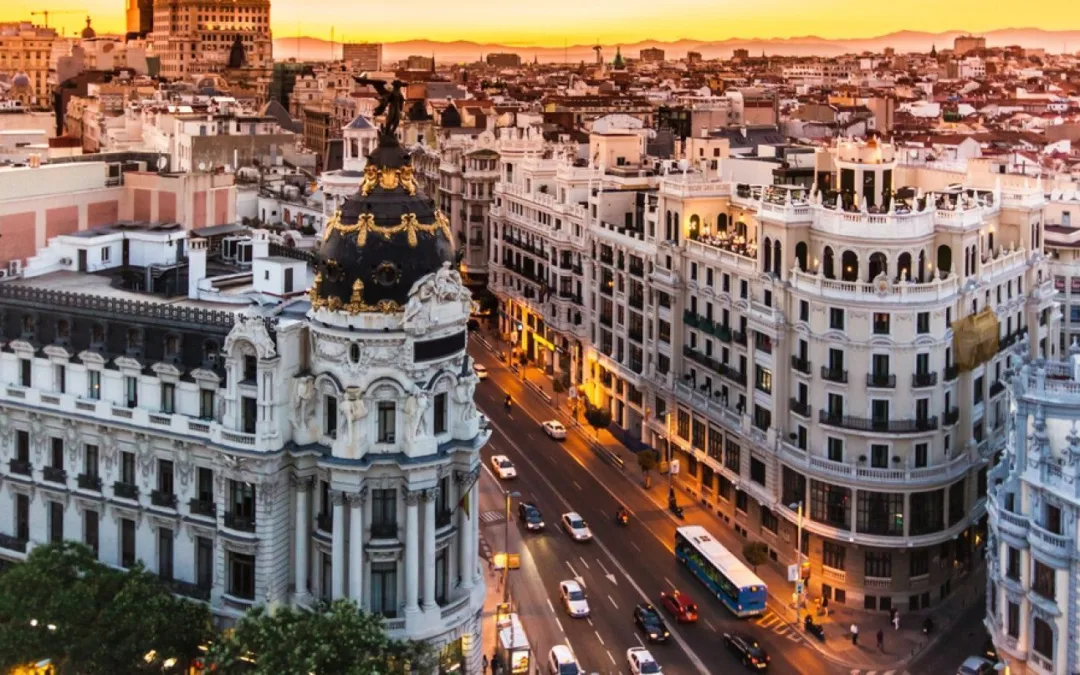
2.Gran Vía
A vibrant city thoroughfare and a hub for the theatre scene, day and night. The “Broadway” of Madrid.
3.Plaza de España.
Here you have to look for the imposing building ofTorre de Madrid and the monument to Cervantes.
4.Plaza de Oriente
Several interesting sights are here: the Royal Palace, the Sabatini Gardens, the Teatro Real opera house, and the Cathedral of La Almudena.
5.Plaza Mayor square
Be sure to see the Casa de la Panadería (the baker’s), the Casa de la Carnicería (the butcher’s) and the terraces where you can try the legendary “calamari sandwich”.
6. Plaza de Santa Ana
A good area for tapas, usually served with “una caña bien tirada”, which is how you should ask for a small glass of beer. By the way: Serving beer is an art form in the bars of Madrid!
7. El Retiro park
A city garden full of idyllic spots. The must-sees: The Palacio de Cristal and the boating pond. Together with the Paseo del Prado and the surrounding area, it has been awarded UNESCO World Heritage status.
8.Plaza de Cibeles
Cibeles Palace (Madrid City Hall) and Círculo de Bellas Artes.
Both with rooftops for a magnificent view of the city from above.
9.Temple of Debod
A gift from Egypt to Spain and a magical place to enjoy the sunset.
Top: Temple of Debod. Bottom left: Plaza de Cibeles and City Hall. Bottom right: Crystal Palace in Buen Retiro Park
10. Barrio de las Letras
Another option is to lose track of time and have a wander around the streets. Iconic bars, vintage signs, urban art, unique shops, shopping around Callao, Fuencarral or Barrio de las Letras, and seeing how the locals live. The streets are the best museum in Madrid and walking through them is the best way to capture its essence.
You can also take the opportunity to see the Santiago Bernabéu Stadium, or visit the Museo del Prado with important works such as Las Meninas or The Garden of Earthly Delights.
88A day in Madrid in 10 essential visits
First, canMadrid be visited in one day? It’s obvious that the capital has much more to give. But if you only haveone day, we’ve come up with a selection ofmust-sees.Ready for that?
Flanked by the Real Casa, the statue of the Bear and the Strawberry Tree and the giant Tío Pepe sign. A classic? Taking a picture of your feet on the Kilometre Zero plaque, the starting point of all distances on Spanish roads.
2.Gran Vía
A vibrant city thoroughfare and a hub for the theatre scene, day and night. The “Broadway” of Madrid.
3.Plaza de España.
Here you have to look for the imposing building ofTorre de Madrid and the monument to Cervantes.
4.Plaza de Oriente
Several interesting sights are here: the Royal Palace, the Sabatini Gardens, the Teatro Real opera house, and the Cathedral of La Almudena.
5.Plaza Mayor square
Be sure to see the Casa de la Panadería (the baker’s), the Casa de la Carnicería (the butcher’s) and the terraces where you can try the legendary “calamari sandwich”.
6. Plaza de Santa Ana
A good area for tapas, usually served with “una caña bien tirada”, which is how you should ask for a small glass of beer. By the way: Serving beer is an art form in the bars of Madrid!
7. El Retiro park
A city garden full of idyllic spots. The must-sees: The Palacio de Cristal and the boating pond. Together with the Paseo del Prado and the surrounding area, it has been awarded UNESCO World Heritage status.
8.Plaza de Cibeles
Cibeles Palace (Madrid City Hall) and Círculo de Bellas Artes.
Both with rooftops for a magnificent view of the city from above.
9.Temple of Debod
A gift from Egypt to Spain and a magical place to enjoy the sunset.
Top: Temple of Debod. Bottom left: Plaza de Cibeles and City Hall. Bottom right: Crystal Palace in Buen Retiro Park
10. Barrio de las Letras
Another option is to lose track of time and have a wander around the streets. Iconic bars, vintage signs, urban art, unique shops, shopping around Callao, Fuencarral or Barrio de las Letras, and seeing how the locals live. The streets are the best museum in Madrid and walking through them is the best way to capture its essence.
You can also take the opportunity to see the Santiago Bernabéu Stadium, or visit the Museo del Prado with important works such as Las Meninas or The Garden of Earthly Delights.
Seville has something for everyone. From its great Moorish and Catholic monuments to its historic bullring, and from great tapas bars to enchanting old neighbourhoods and giant wooden mushrooms, these are the top 20 attractions for you to seek out while you’re in the Andalusian capital.
Royal Alcazar Palace
Along with the cathedral, Seville’s key architectural attraction is the Royal Alcázar Palace. Work on this great palace complex began in the 10th century, when the Umayyads built a Moorish fortress attached to the Roman city walls, but it was not until the 12th century that the first royal palace was built on the site, by the then-ruling Almohad Dynasty. Additions and renovations continued on and off until the 19th century, resulting in a structure that showcases a mix of Moorish, Renaissance and Mudéjar architecture, with the latter being particularly notable in the Mudéjar Palace. The upper floors of the Alcázar are the Spanish royal family’s Seville residence, making it Europe’s oldest continually used royal palace.
Real Alcázar de Sevilla, Patio de Banderas, s/n, Seville, Spain, +34 954 50 23 24
The Gothic Cathedral
Seville’s greatest Catholic monument amazes with its sheer size: it is the largest Gothic cathedral in the world. Construction of this sprawling Gothic complex, which houses 80 chapels and has the longest central nave in Spain, began in 1401 on the site of the city’s former mosque. Work continued for over 100 years, and in 1507 the cathedral was finally completed, having spectacularly succeeded in fulfilling the design team’s aim to make something ‘so beautiful and so magnificent that those who see it will think we are mad’.
Las Setas Metropol Parasol
One of Seville’s most popular – and unusual – attractions is The Metropol Parasol, known locally as Las Setas, or ‘the Mushrooms’, because of the distinctive shape of its vast wooden canopies and supporting pillars. When work started on the Mushrooms in 2005, Roman remains were found underneath Plaza Encarnación, making construction a lengthy and controversial process. To preserve the extensive remains, which can be seen on the lower ground floor, these enormous wooden fungi are supported on just a few elegant white pillars above the square. On the monument’s roof, a winding walkway provides stunning views over the city, especially at sunset.
Giralda Bell Tower
All that remains of Seville’s great mosque is part of its minaret, which is now the cathedral’s Giralda bell tower, another of Seville’s key architectural attractions. The minaret, which was built during the Almohad period, was originally topped with giant copper globes, but these fell off in an earthquake in 1365. The ruling conquistadors, perhaps interpreting their removal as a hint from the universe, decided to replace them with a Christian cross and bell tower. Except for the final section, which features stairs, the route to the top (for stunning views) is via ramps – supposedly so it can be reached by horseback, although it’s unclear whether this means you have to buy two tickets or just one.
Archive of the Indies
Documenting the Golden Age of the Spanish Empire that followed Christopher Columbus’s exploration of the Americas in 1492 is Seville’s Archive of the Indies, a must-see for history boffins. These UNESCO-protected 16th-century buildings house some 80 million documents relating to the Spanish Empire of the 16th, 17th and 18th centuries, a period when Seville was the empire’s most important city. If you think that sounds like a little too much reading for one afternoon, fear not: as well as the beautiful old books and the palatial buildings themselves, other sights here include a 17th-century cannon, maps charting the entire Spanish Empire and several paintings by Goya.
Plaza de España
One of Seville’s Mudejar classics is the Plaza de España, a stunning development built-in 1928 in preparation for Seville’s hosting of the Ibero-American Exposition of 1929. The half-moon-shaped building is fronted by a moat and borders on a plaza with a beautiful fountain at its center; it showcases a striking mix of Mudéjar and Renaissance styles, with splashes of Art Deco to be seen on the colorful façades. Boating can be enjoyed on the moat, which is spanned by four bridges representing the ancient kingdoms of Spain.
In preparation for Seville’s hosting of the Ibero-American Expo of 1929, the southern part of the city received a costly facelift. At the heart of this redevelopment was the Maria Luisa Park, a botanical garden and the Andalusian capital’s largest and most attractive area of greenery. It is a beautiful place to stroll in spring, when the park’s many species of plants and flowers are in bloom and when the local residents – doves, parrots, ducks and swans – are on display. Stretching along the banks of the Guadalquivir, its half-mile of shaded walkways, tiled fountains, ponds and tropical foliage is also home to the Mudéjar Pavillion, in which the Museum of Popular Arts and Traditions of Seville can be found
Torre de Oro
Visible from any of Seville’s central bridges is the 13th-century watchtower known as the Torre de Oro, or the ‘Tower of Gold’. It was built by the Almohad rulers of Seville between 1220 and 1221 and has undergone several restorations over the intervening centuries, the most recent of which was in 2005. Nowadays, it houses Seville’s small but interesting Maritime Museum, which explores the importance of the Guadalquivir River and Atlantic to the Andalusian capital’s history.
Casa de Pilatos
This beautiful 15th–16th-century mansion is one of central Seville’s hidden treasures, and its exquisite gardens, though smaller in scale, match anything you’ll see in the Alcázar. Begun by the wealthy conquistador and Mayor of Andalucia, Pedro Enriquez de Quiñones, in the late 1400s, Casa de Pilatos is another of Seville’s classic Mudéjar structures, built around a central courtyard in the traditional Andalusian style. Its name – Pilate’s House – was bestowed (hopefully with a touch of mockery) after Quiñones’ son Fadrique traveled to Jerusalem in 1519 and returned overflowing with enthusiasm for the Holy Land. The palace’s undeniable good looks have earned it a starring role in two films: 1962’s Lawrence of Arabia and 2010’s Knight and Day.
Bullring
Seville’s Real Maestranza bullring is one of the most attractive and important plazas in Spain. Construction began in 1761 on the site of the city’s old rectangular plaza de Toros and was finally completed in 1881. Particularly attractive is the Prince’s Gate (the main entrance), the ornate black iron gates of which are the work of Pedro Roldan, and which were originally the property of a convent. Being carried through these on the shoulders of fellow matadors and the public is a mark of great triumph, and one of the highest honors attainable by a matador in Spain. The Maestranza’s excellent museum explores the history of bullfighting, and daily tours of the arena are available.
Mercado de Triana
Triana is Seville’s former Gypsy quarter and one of the city’s most distinctive attractions. From its pretty, myth-laden streets have come some of the most influential bullfighters of the last couple of centuries, including the legendary Juan Belmonte, one of the greatest matadors in the history of bullfighting. Its colourful, quaint streets are lined with old-style tapas bars, the walls of which are often plastered with faded bullfighting posters, photos of flamenco artists and weeping Virgin Marys. It is also known for its locally made ceramics, which adorn the walls of its old, whitewashed houses, and one of Seville’s best and most lively markets, the Mercado de Triana.
Feria de Abril
The Feria de Abril, Seville’s legendary fiesta, takes place two weeks after Easter and is one of Andalusia’s biggest fairs. This week-long party has left its humble 19th -century cattle-market beginnings long behind, and its sanded fairground – or recinto – now hosts over 1,000 individual marquees, or casetas, every year. Run by local charities, businesses and collectives, these casetas are where the locals dance and drink until the small hours of the morning, every night for a week. Although the vast majority of the marquees are private and require an invitation for entry, there are several public casetas which are just as much fun. If you’re planning a visit to Seville in spring, make sure you plan it to coincide with this annual extravaganza.
Romeo and Juliet Balcony
Winding along beside the Alcázar in the heart of Santa Cruz is a narrow, shaded alleyway called Calle Agua, named after a mini-aqueduct that used to run along the top of the Moorish palace’s walls. This mysterious path brings you out onto the absurdly romantic Plaza Alfaro, always busy with tourists pointing their cameras upwards and snapping away at the building said to have inspired the balcony scene in Shakespeare’s Romeo and Juliet. Whether this tale is apocryphal or not, it’s easy to imagine a latter-day Romeo scaling the beautiful facade to reach the object of his desire.
Santa Cruz
Surrounding the central plaza on which Seville’s mighty cathedral squats is the charming old Jewish neighborhood of Santa Cruz, one of Andalusia’s most iconic barrios. This was the neighborhood into which Ferdinand III confined the city’s Jewish population when he took the city from the Moors in 1248; nowadays, it’s the heart of historic Seville and the first place many tourists head to. In this maze of narrow cobbled streets and achingly romantic squares are to be found some of the city’s best tapas bars and flamenco joints, but just to wander around Santa Cruz (almost certainly getting lost, if it’s your first time) is an experience in itself.
Granada’s star attraction and one of Andalusia’s most iconic sights is the Alhambra fortress. The greatest surviving relic of southern Spain’s 800 years under Muslim rule, between the 8th and 15th centuries, this sprawling complex sits forbiddingly atop the Darro Valley, with the crisp peaks of the Sierra Nevada in the background.
Originally dating from the 9th century, the fort and walls were extensively rebuilt in the 1200s by the muslim ruler of what was then the Emirate of Granada, Mohammed ben Al-Ahmar. Particularly beautiful are the Nasrid palaces; built by the Nasrid Kings – the last muslimi rulers of Granada – during the 13th and 14th centuries, which feature some of the Alhambra’s most intricate interiors.
The Generalife: A Sultan’s Retreat and Verdant Oasis
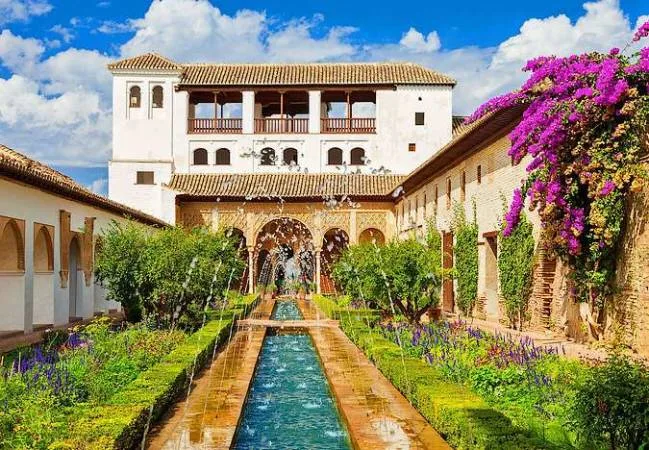
The Generalife served as the Alhambra’s recreational estate, a serene escape for the sultans during the scorching Andalusian summers. This magnificent almunia (a rural retreat with orchards and gardens) was designed as a haven of tranquility, with its lush gardens offering shade and refreshment. Narrow pathways meander alongside vibrant flowerbeds and reflective ponds, where the elegant archways and whitewashed walls of the estate are perfectly mirrored in the water.
An open-air walkway connects the northern and southern parts of the Generalife, offering breathtaking views of the Albaicín, Granada’s historic Arabic quarter. From the Alhambra and Generalife, the Albaicín’s whitewashed houses and cobbled streets create a stunning panorama that captures the essence of the city.
Before leaving the Alhambra hill, take a detour to the Carmen de los Mártires gardens. This lesser-known gem is a peaceful retreat of colorful flowerbeds, small ponds, and shaded paths that are refreshingly quiet compared to the bustling Alhambra. In spring and summer, it offers an idyllic escape from the intense sun, with panoramic views over the city and the countryside beyond. A charming fairytale tower sits in the heart of the gardens—climb its spiral staircase for a romantic vantage point over Granada.
Explore the Enchanting Albaicín: Granada’s Historic Muslim Quarter
Wander through the narrow, cobblestone streets of the Albaicín, Granada’s oldest and most captivating neighborhood. A UNESCO World Heritage Site, this historic Muslim quarter offers a glimpse into the city’s muslim past, with its whitewashed houses, intricate architecture, and stunning views of the Alhambra.
A Journey Through Time Dating back to the 11th century, the Albaicín was the heart of Granada’s Islamic culture. As you stroll through its winding lanes, you’ll encounter beautiful Nasrid-style homes, ancient cármenes (traditional Andalusian houses with gardens), and remnants of the city’s medieval walls. The area’s charm lies in its blend of history and modern life, where traditional tea houses sit alongside vibrant local shops.
Don’t Miss the Iconic San Nicolás Viewpoint No visit to the Albaicín is complete without a stop at the Mirador de San Nicolás, one of the most famous viewpoints in Spain. From this hilltop plaza, you’ll enjoy an unparalleled panoramic view of the Alhambra, framed by the majestic Sierra Nevada mountains. Whether you visit at sunrise, sunset, or any time in between, the view is nothing short of magical.
Street musicians and artists often add to the lively atmosphere, creating the perfect setting to soak in the beauty of Granada. Many visitors consider this view one of the most unforgettable highlights of their trip.
Other Hidden Gems in the Albaicín
Explore the charming Placeta de San Miguel Bajo, a quiet square lined with cafés and local restaurants.
Admire the Puerta de Elvira, one of the old city gates that once marked the entrance to Granada.
A Stroll Through Culture and Tradition The Albaicín’s unique character, steeped in history and culture, makes it a must-see on any trip to Granada. Get lost in its labyrinth of streets, savor traditional Andalusian cuisine, and discover why this neighborhood continues to captivate travelers from around the world.
Sacromonte: Granada’s Enchanting Gypsy Quarter
Time seems to stand still in the rustic quarter of Sacromonte, one of Granada’s most unique and captivating neighborhoods. This historic area is known for its whitewashed caves carved into the hillside, where many locals continue to live. These caves come alive at night with impromptu flamenco gatherings, echoing with the soulful melodies and rhythms of this quintessential Andalusian art form.
As you wander through Sacromonte, you’ll find an authentic charm that reflects a mix of traditional and unconventional lifestyles. The area’s improvised dwellings—built from recycled materials like scrap metal, wood, and cloth—add a raw, unpolished character. Visitors are reminded to respect the privacy of residents, especially when signs kindly request refraining from photographs.
Sacromonte is also the beating heart of Granada’s flamenco scene. For a formal flamenco experience, head to Venta El Gallo, where you can enjoy a mesmerizing performance and take in breathtaking views from its fabulous rooftop terrace.
Would you like recommendations for exploring the caves or other flamenco venues in the area?
The Palace of Dar al-Horra: A Hidden Gem in Albaicin
Tucked away in Granada’s historic Albaicín district, the Palace of Dar al-Horra is a stunning example of Andalusian architecture. This elegant palace, whose name translates to “House of the Honest,” was once the home of Aixa, mother of Muhammad XII (known as Boabdil), the last ruler of Granada.
Step into a serene oasis where history comes alive. Designed in traditional Andalusian style, the palace features three levels of rooms and quarters surrounding a tranquil central courtyard with a reflective pool—offering shade and respite from the summer heat. You can also explore remnants of the lush gardens and orchards that once graced the grounds.
The historic Baths Hammam Al-Yawaz (El Bañuelo)
Nestled along the picturesque Carrera del Darro, El Bañuelo is one of Granada’s oldest and best-preserved Arab baths, dating back to the 11th century. This historic site invites visitors to step into the past and discover the traditions of relaxation and purification in Al-Andalus.
While many hammams were destroyed during the Christian Reconquest, El Bañuelo was spared—a rarity that makes it a must-see landmark. Its survival was likely due to its transformation into a private residence, preserving its architectural beauty and cultural significance.
The baths feature a traditional layout, including cold, warm, and hot rooms designed to promote health and well-being. Inside, you’ll marvel at the stunning star-shaped skylights in the vaulted ceilings, which once filtered sunlight to create a peaceful, meditative ambiance. The elegant horseshoe arches and stone columns further highlight the craftsmanship of the Nasrid period.
Located along Granada’s prettiest street, El Bañuelo is the perfect addition to your stroll through the Carrera del Darro. Its proximity to other landmarks like the Alhambra and Albaicín makes it an easy stop for anyone exploring the historic heart of the city.
Discover the Historical Treasures of Realejo Quarter
The Realejo Quarter, nestled at the foot of the majestic Alhambra, is a living testament to Granada’s rich and layered history. Once the city’s vibrant Jewish neighborhood during the Nasrid dynasty of Al-Andalus, this district flourished as a cultural and intellectual hub. Following the Reconquista in 1492, its identity evolved, leaving behind a fascinating tapestry of medieval buildings, palaces, and remnants of ancient walls that tell the story of centuries gone by.
The Realejo’s historical roots are deeply intertwined with Al-Andalus, the period of Muslim rule in Spain. The neighborhood was originally known as “Garnata al-Yahud,” or “Granada of the Jews,” due to its significant Jewish population during the Nasrid era. Walking its streets today, you’ll find traces of this coexistence, reflected in the layout of the narrow, winding alleys and the elegant architecture that bears the hallmarks of islamic design.
Among the architectural highlights of Realejo are several palatial homes that once belonged to Granada’s elite. These include Casa de los Girones, a beautiful example of Mudéjar architecture, with its intricately carved wooden ceilings and decorative tiles. Another gem is the Palacio de los Condes de Gabia, which now serves as a cultural center hosting exhibitions and events. These buildings showcase the blending of Islamic and Christian influences that define the city’s post-Reconquista era.
The Zirí Wall, an ancient fortification dating back to the 11th century, winds its way through parts of Realejo. Built by the Zirí dynasty, the first Muslim rulers of Granada, this defensive structure protected the city during its early medieval period. Portions of the wall remain remarkably well-preserved, offering a glimpse into the strategic importance of Granada as a fortress city. Strolling along these remnants is like stepping back in time.
The Realejo is more than just a historical treasure trove; it’s a vibrant neighborhood that retains its timeless charm. From its bustling squares, like Plaza del Realejo, to the artistic energy reflected in its murals and street art, the area bridges the past and present. Small artisan shops and traditional taverns add to the authentic experience of exploring this quarter.
As the neighborhood adapted to its Christian rulers, many mosques were replaced or transformed into churches. The Iglesia Santo Domingo, with its ornate Baroque façade and richly decorated interior, is a standout example built in the 16th century.
Top 10 things to do when visiting Cordoba, Andalusia
Boasting a fascinating and multi-faceted history, Córdoba is one of the most popular tourist destinations in Spain. From its iconic Mosque-Cathedral to the beautiful flower-adorned patios open to the public every May, this is a city with something for everyone.
Read on for the 10 best things to see and do in Córdoba.
Mosque-Cathedral
Going to Córdoba and not visiting the Mezquita-Catedral would be like leaving the Alhambra out of a trip to Granada: it is the city’s greatest monument. After the Moors captured Córdoba in 711, what had previously been a Visigoth Christian church was split in two and used by both Christians and Muslims as a place of worship. But in 784, on the orders of the Emir Abd al-Rahman, the church was destroyed and work began on a great mosque. Construction lasted for over two centuries. The building was eventually completed in 987, by which point Cordoba was the most important city in the Islamic Kingdom.
When the city was reclaimed by Christians in 1236, the mosque was converted into a church, and in the 16th century Charles V added a Renaissance nave on top of the Moorish structure. The hybrid structure that resulted has fascinated, outraged and confused in equal measure ever since.
Córdoba’s Mosque-Cathedral takes some beating as a historical attraction, but Medina Azahara – situated some 8km (5 miles) outside the city – is just as intriguing. In the middle of the 10th century, ‘The Shining City’ was the adminstrative capital of Al-Andalus, as Moorish-ruled Spain was then known. Construction started in 936 on the order of the Umayyad Caliph of Cordoba, Abd-ar-Rahman III al-Nasir.
Additions and alterations continued for decades, but in 1010 Azahara was looted and thereafter stood deserted for centuries. Its remains were not discovered until the beginning of the 20th century.
Although they only account for about 10% of the original city, they nevertheless give you a good idea of just how magnificent Medina Azahara must have been.
Carretera Palma del Río, km 5.5, Córdoba, Spain, +34 957 10 36 37
Given that Córdoba is the warmest city in Europe, sightseeing here in spring and summer can be seriously thirsty work. Luckily, the old part of the city is absolutely stuffed with bars that might not look like much from the outside, but which serve some of the best tapas in town.
These old-school places are usually full of locals (always a good sign) and are worth it for their wonderfully chaotic atmosphere as well as for the unbelievably cheap home-cooked food. A must-order in such places is salmorejo– a more substantial version of gazpacho that originated in Cordoba.
Particularly good is Taberna La Sacristia near the Palacio de Viana, where you can gaze upon walls plastered with antique bullfighting paraphanelia as you refuel.
One of the pleasures of visiting Córdoba is being able to view monuments from all three of its most defintive epochs: Roman, Moorish and Christian. It was not until the 1950s, when Cordoba’s town hall was being expanded, that the remains were discovered.
It was built during the reign of Emperor Claudius in the middle of the 1st century AD and was renovated in the 2nd century AD. Of its giant columns, 10 remain, reaching up into the sky amid modern apartment blocks and offices. Archaeologists have theorised from the quality of marble and workmanship used in the construction of the temple that it must have been a particularly impressive structure, perhaps even one of the most beautiful in the Roman Empire.
The city’s famous Roman Bridge, or Puente Romano, dates from the 1st century BC and was extensively rebuilt in the 10th century during the Moorish occupation of the city.
Sitting low over the opaque waters of the Guadalquivir river, which flows down all the way through Andalusia and out into the Atlantic, it is supported by 17 stone arches, of which just two once belonged to the original structure. The middle of the bridge, next to a 17th century statue of Saint Raphael, is the perfect spot from which to survey Cordoba and the green, hilly countryside that surrounds it: it’s a perspective that even locals stop to enjoy while walking over the Puente Romano.
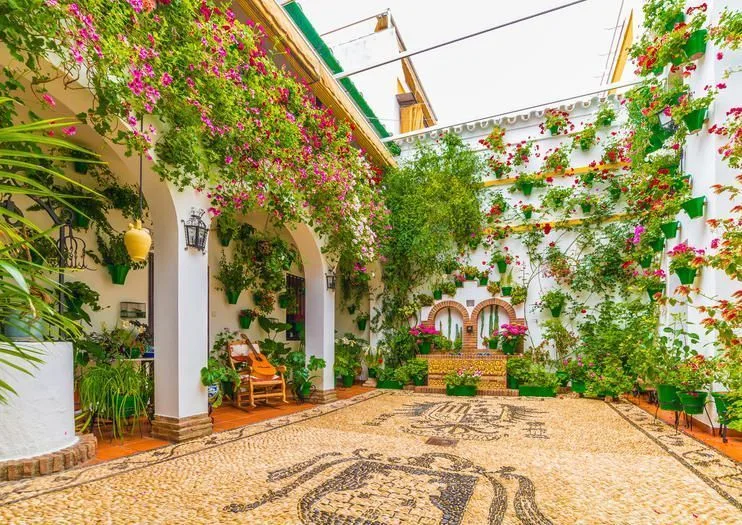
Córdoba’s prettiest and most unique attractions arose from architectural necessity. The city is one of the hottest in Europe during the summer months, when temperatures frequently exceed an insufferable 40°C (104°F), so it has always been essential for its inhabitants to have a cool retreat for the middle of the day.
As far back as the Roman occupation of Cordoba, houses were built with an internal, open-aired atrium, which was protected from the sun on all sides by thick stone walls. Over the centuries, these havens of cool and shade were decorated with flowers, plants and fountains – a practice that was refined during the Moorish occupation of Córdoba.
Since 1918 the Feria de los Patios, as it’s called, has been sponsored by Córdoba’s town hall, which offers a prize for the prettiest patio.
The star of Córdoba’s patios feria is the elegant 15th-century Palacio de Viana, a vast building that has been used over the centuries as a residence for Spanish royalty. For an admission price of €5 (US$5.56), you can visit Viana’s 13 patios and gardens.
Intricately designed and aromatically populated with colourful plants, flowers and trees, these are some of Córdoba’s most gorgeous public spaces. Allow a good hour to slowly wander around these scented, romantic spaces. Peering in through the palace’s old windows as you go; another age of louche affluence and amorous intrigue, once played out amongst Viana’s orange trees and jasmines, comes instantly back to life.
2 Plaza de Don Gome, Córdoba, Spain, +34 957 49 67 41
The annual patios feria and the Palacio de Viana aren’t the only opportunities for seeing the famous flowers of Córdoba. A stroll down most streets in the old quarter will take you past several gorgeously-decorated building facades, but on the Calleja de las Flores every single house looks like something out of a fairytale.
Situated just north of the Mosque-Cathedral in the heart of the old town, this sweet-scented, colourful little street is the prettiest in Córdoba – and in a city where every other house is worthy of being on a postcard, that is quite a compliment.
Often overlooked in favour of the Mosque-Cathedral, the Castle of the Christian Kings is one of the city’s key architectural landmarks. As its name suggests, the construction of this royal palace was ordered by the Catholic King Alfonso XI of Castile in 1328 but – as is so often the case in Andalusia – it was built among the ruins of a vast Moorish fort.
In the late 10th century, when the Islamic Kingdom was at the height of its powers, Córdoba was the kingdom’s – and indeed one of the world’s – great intellectual cities, and the Alcazar housed the largest library in the west. Alfonso used only a fraction of the remains of the original Moorish structure in building the Alcazar, but he chose a Mudejar style, so the Moorish feel of the site has been preserved.
Plaza Campo Santo de los Mártires, s/n, Córdoba, Spain, +34 957 42 01 51
Córdoba is steeped in bullfighting history, and you can visit a monument of its most famous matador, Manolete (1917-1947), in Plaza del Conde de Priego in the old town; right opposite the square is Iglesia Santa Marina, where many Córdobese bullfighters have been married. Also well worth a visit is superb Museo Taurino, or bullfighting museum, which offers a fascinating insight into this controversial spectacle.
Plaza Maimónides, s/n, Córdoba, Spain, +34 957 20 10 56