
Top Islamic Heritage Site in Seville, Andalusia
The travel giant Lonely Planet announced in 2018 the quintessentially Andalusian city of Seville as its top travel city. Home of the flamenco, bullfighting, tapas, and over 500 hundred years of Muslim history. So here are our top five Muslim heritage sites you simply have to visit in the stunning Spanish city once known as “Ishbiliya”
Giralda Tower
The Cathedral of Seville houses the remains of aljama almohade de Sevilla, built in 1172 by the caliph Abu Ya’qub, although the works were extended until 1198, already under the rule of his successor Abu Yusuf. Only the courtyard of the original mosque remains (sahn) in part corresponding to the current “Patio de Orange trees”, and minarets, the popular “Giralda”.
The minaret was started in 1184 and completed in 1198. It is located next to the door its rest of the courtyard (known as “Puerta del Lagarto”), and has a square floor plan with ashlar base and brick elevation. On the facades of the minaret cloth of sebka is worked with the traditional rhomboid pattern, together with blind and open polylobed arches in windows communicated internally by a ramp that communicates the different levels of the building. Originally the minaret was crowned with a yamur composed of four golden balls, ruined in the tea of 1356. The current bell tower is the work of the second half of the s. XVI, crowned in 1568 with the statue/vane of the “Triumph of Faith” or “Giralda”, which gives current name to the whole tower.

Royal Alcazar Palaces
This is Seville’s Alhambra. Smaller but equally beautiful, the Alcazar is often overlooked by seekers of Andalusian Muslim heritage. This is because what you see today has been mainly built by Christian kings on the site of the original 10th-century Muslim fort. However, their architects were Muslims, and nowhere is this more apparent than the “jewel” in The Alcazar’s crown, the Mudejar Palacio de Don Pedro. This sumptuous courtyard built by King Pedro I is a direct replica of the one in Granada’s Alhambra, complete with water feature and arabesque arches. Even inside the Alcazar, Christian kings praised their Lord in the then-fashionable Arabic language, using inscriptions such as “Wa la ghalib ill Allah”: “There is no victor but God.”

The Golden Tower
This 13th century tower is also an Almohad construction. It sits overlooking the River Guadalquivir (from the Arabic “Wadi al Kabir”, or “the Great River”) at what was once a corner of the ancient city. The tower gets its name from the belief that its dome used to be covered in golden tiles. Today, it is home to a maritime museum.

Orange Courtyard
Once part of the Great Mosque of Ishbiliya, this courtyard and the Giralda are all that remain of the old Islamic building. The site was the old sahn during the al-Andalus ages. It contains 66 Naranjos (orange trees, which are said to have been introduced to Andalusia by the Muslims) and has many of the arabesque arches along the original garden walls that flank the Puerta del Perdon, the stunning Muslim-era gate. With a trickling fountain in the middle, the Patio de Los Naranjos is the perfect oasis to sit and contemplate Seville’s five centuries of Muslim civilization.

More about Seville
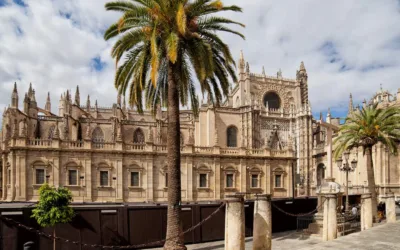
The Seville Cathedral
The Seville Cathedral is the biggest Gothic cathedral in the world and also the 3rd biggest one in terms of size, after Saint Peter (the Vatican) and Saint Paul (London, UK). Its construction started in 1401, after the Christians reconquered Seville, and it ended in...
The Giralda Tower of Seville
The Giralda Tower, located in Seville, is a brick tower on the northeastern side of the Seville Cathedral and was originally the minaret of a mosque constructed by the moors between 1184 and 1198, at the height of Almohad power. Today, standing 104 metres tall, the...
What to Do and See while visiting Seville?
What to Do and See when visiting Seville? The city of Seville boasts a rich history of over 2,200 years with numerous civilisations and eras behind its name. Several well-preserved historic sites such as the Alcázar, Torre del Oro, City Hall, Palace of San...